Making Space: Encouraging Bat Habitat at Great Mountain Forest
March 10, 2026
Kate Regan-Loomis
Supporting bat habitat and resiliency in the forest
Often maligned and feared, bats are actually helpful to humans and serve important ecological functions. Insect-eating bats make summer life more tolerable for people by consuming mosquitoes, black flies, and other nuisance insects and agricultural pests. Fruit-eating bats assist in the agricultural process by dispersing seeds, while other bats pollinate plants. Even without these ecological services, bats need support as the threat of disease and habitat loss caused by forest conversion grows.
In the past few decades, bat populations in the eastern United States have been devastated by an invasive fungus, Pseudogymnoascus destructans. Commonly known as white-nose syndrome for the distinctive white growth it leaves on their muzzles, this disease infects bats during hibernation, damaging their wings and disrupting critical physiological functions. Since its discovery in New York in 2006, populations of little brown bats, northern long-eared bats, and tri-colored bats have declined by more than 90%.
To support bat population growth and resiliency, Great Mountain Forest is working with the Natural Resources Conservation Service (NRCS)—an agency of the United States Department of Agriculture—to help create and promote bat habitat on the property.
During the summer, bats rely on roost trees, to raise their young, or “pups.” Ideal roost trees are characterized as large and having peeling or shaggy bark; however, bats also use standing dead trees with cavities to shelter their pups. In the fall, GMF staff began collaborating with NRCS staff and biologists to identify prime roost trees along GMF’s Iron Trail, marking them with blue dots.
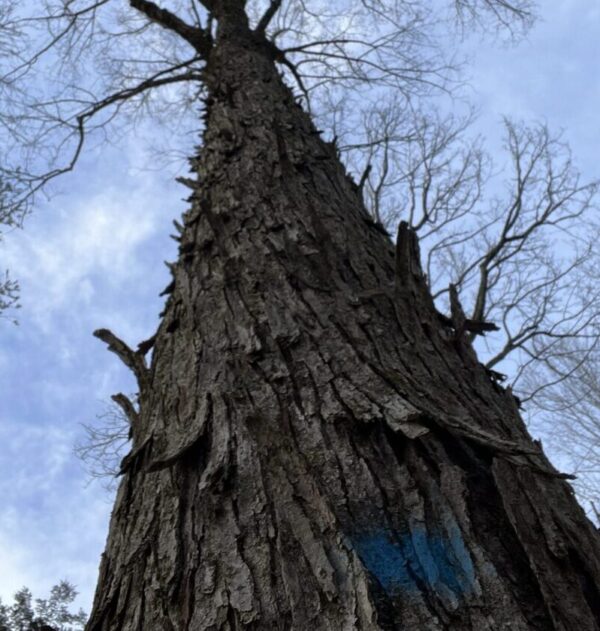
With its shaggy bark, this ideal roosting tree has been identified according to NRCS guidance and GMF preliminary research. Photo by Kate Regan-Loomis.
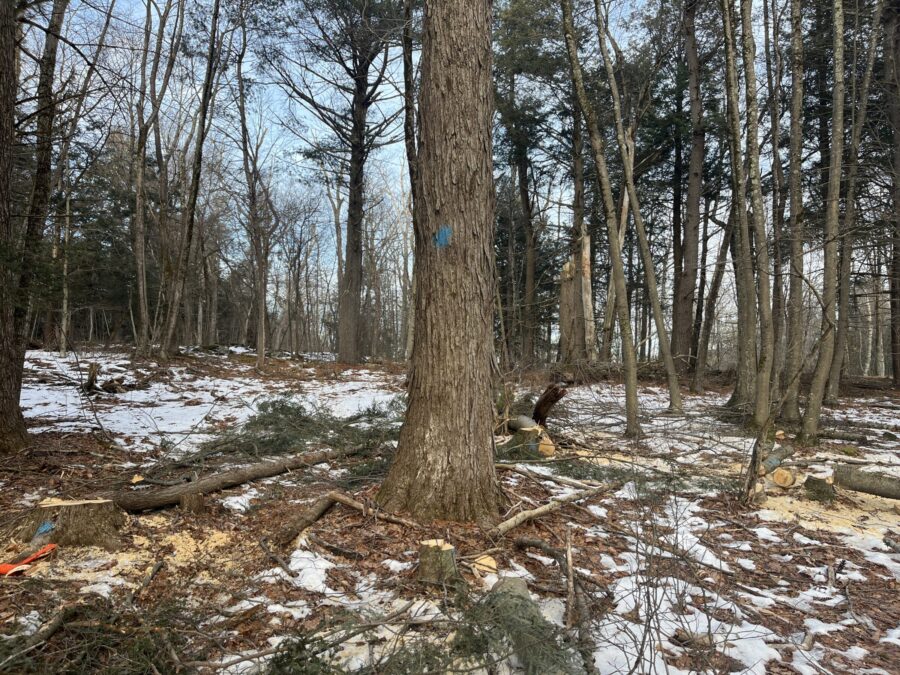
This winter, to support these roost trees and prevent disruption to the bats’ roosting cycle, trees within a 15-foot radius of the marked trees were removed. By reducing competition from surrounding trees, the selected roost trees have more room to grow their canopies and access light and nutrients. This allows them to increase in size, develop more exfoliating bark, and remain healthy for longer.
Clearing smaller surrounding trees also allows more sunlight to warm the tree trunks, creating more comfortable roosting conditions for bats. Additionally, this work increases structural diversity in an otherwise relatively homogeneous forest, thereby developing more foraging opportunities for bats.
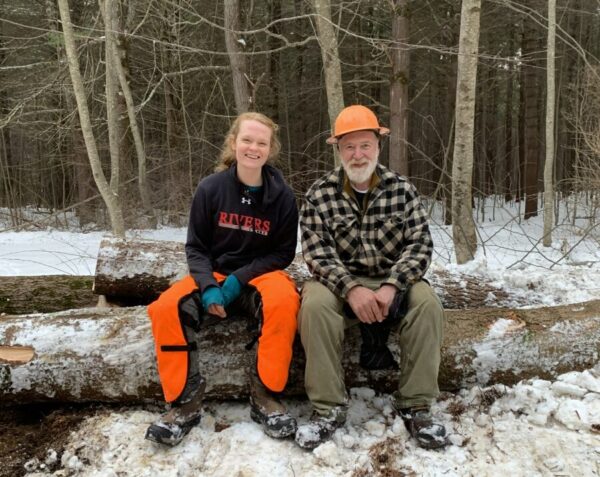
From left to right: Foresters Kate Regan-Loomis and Jody Bronson managing the forest and improving bat habitat. Photo by Kate Regan-Loomis.
The larger trees removed during this process are put to good use by GMF staff. Higher-quality logs are milled and used in current projects and future structures, while lower-quality wood is used for firewood to heat buildings and boil maple sap. Smaller trees and limbs are left in the forest, where they provide temporary shelter for wildlife and return nutrients to the soil as they decompose.
So while certain areas of GMF might look a little less tidy than usual, that apparent mess is creating more habitat for an endangered group of species, improving the health of large, old trees, and supporting the use of local wood by an organization dedicated to forest stewardship.
About the Author
Kate Regan-Loomis grew up exploring the woods of New England and is excited to return to steward the forests that first inspired her love of the natural world. She earned a bachelor’s degree in International Environmental Studies from Kenyon College, after which she spent two years working in environmental communications in Chicago, honing her skills in storytelling and public engagement. Driven by a desire to deepen her hands-on knowledge of forest ecosystems, she went on to earn a Master of Forestry degree from the Yale School of the Environment, graduating in Spring 2025. While at Yale, she was a member of the Forest Apprenticeship program and co-managed the School’s Christmas tree farm. Kate currently serves as Great Mountain Forest’s Natural Resource Manager.