The Understudied Understory: Spring Ephemerals and the Changing Forest
April 16, 2026
Alec Linden
Recognizing the beauty and ecological value of spring ephemerals
A walk in the woods in April can feel confusing. The twiggy canopy and leaf-brown forest floor look like November, while the bright sun seems to indicate summer has arrived.
During this brief window between snowmelt and foliage—while the bears are still groggy, the birds are returning from southern sojourns and the deciduous trees are still bare—the spring ephemerals make their appearance. Great Mountain Forest abounds with these woodland blooms, beloved by foresters, hikers and pollinators alike.
For all their familiar beauty, there’s much to be learned about how these species are responding to the various anthropogenic stressors impacting New England’s forests today.
“Herbs are so understudied as a whole,” said Dr. Marlyse Duguid, a forest ecologist with the Yale School of the Environment. “We’re just a very tree-centric field.”
The understory, she explained, “is where most of our vascular plant diversity is.” If you’re only looking at trees, or the “charismatic megaflora” as she called them, “you’re ignoring the vast majority of different species.”
What are spring ephemerals?
The term “spring ephemeral” is a quasi-scientific label given to herbs—a term botanists use to describe small, non-woody flora—that take advantage of the early-season sunlight that reaches the forest floor. “True” ephemerals are perennial flowers that complete their entire yearly cycle of blooming and dispersing seeds in the period before leaf out, usually a span of several weeks. Some species may only be in flower for a few days, while others (not so “true” ephemerals) may last past leaf out.
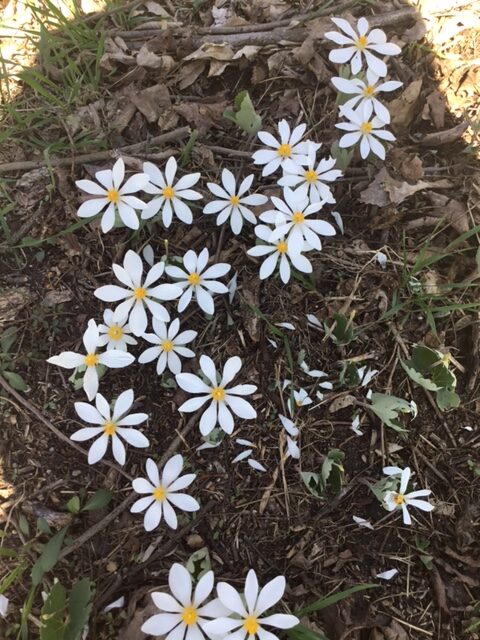
Bloodroot in blossom. Photo by Jody Bronson.
Bloodroot (Sanguinaria canadensis) is one ephemeral that lives up to the label. The plant sometimes loses its petals less than three days after flowering in heavy rain, explained Deb Munson, an expert horticulturalist and neighbor of GMF’s West Gate on Canaan Mountain Road.
“But they’re incredibly beautiful and they have a very thick tuberous root that if you break it in half, it bleeds a reddish substance,” Munson said, noting that the substance is used by Indigenous tribes as a skin paint and dye for baskets.
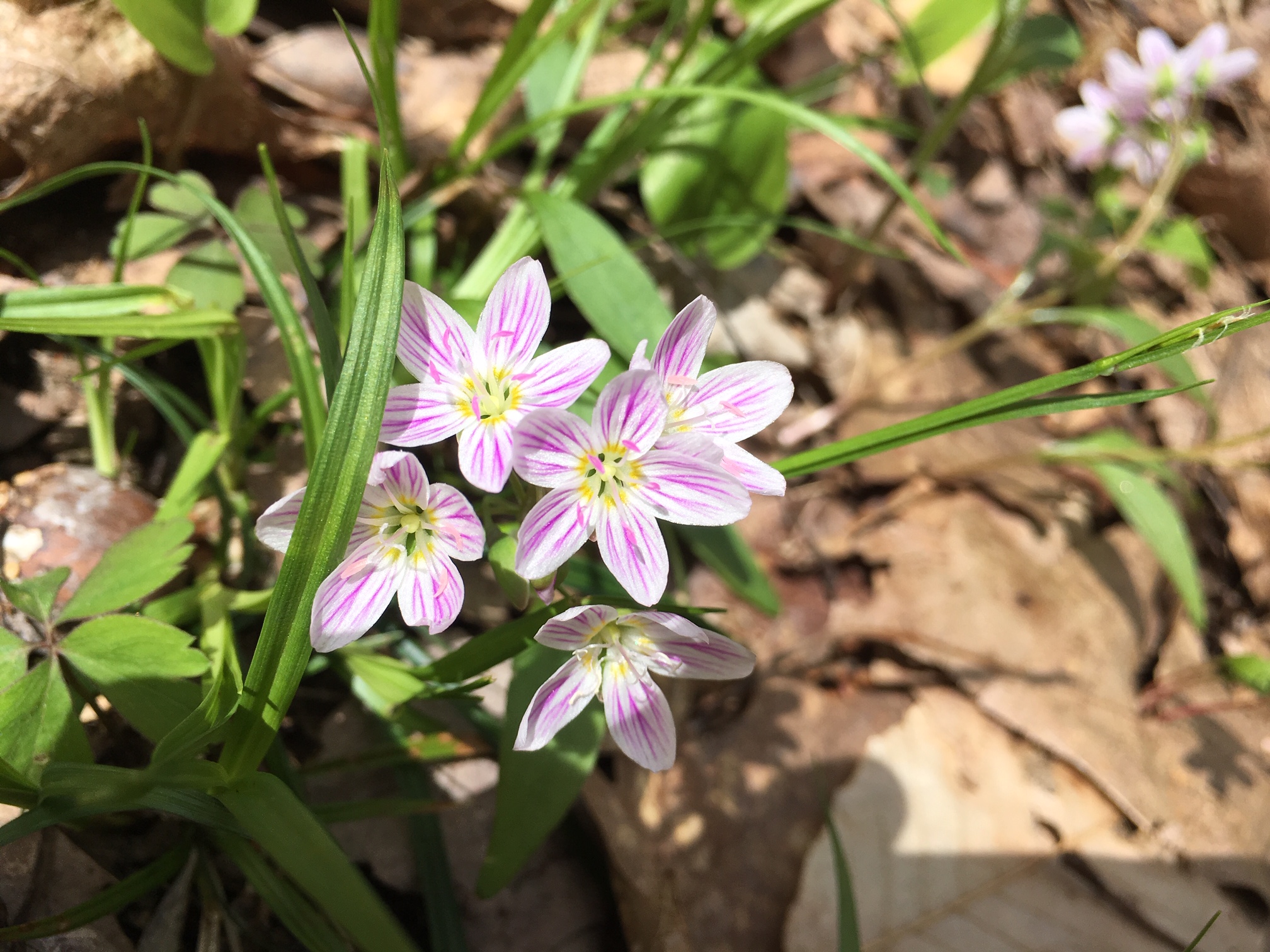
Some of her other favorites to watch out for in the April woods are Dutchman’s breeches (Dicentra cucullaria), the flowers of which “look like little Dutch pantaloons,” and spring beauty (Claytonia), which have white to pale pink petals streaked with vibrant pink.
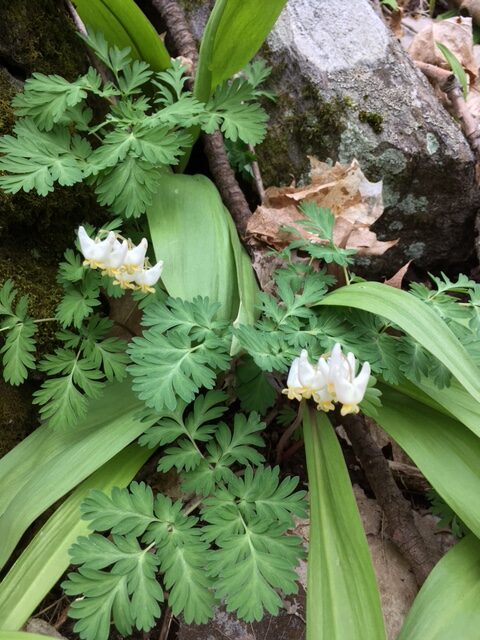
The idiosyncratic namesake blossoms of Dutchman’s breeches. Photo by Jody Bronson.
Munson advised gardeners who wish to grow spring ephemerals to do so with a gentle touch—they like to be left wild. She also warned to never dig them out from the forest, but rather patronize a local garden center. Taking them from their natural environment is harmful to both the plants themselves and the broader ecosystem, she explained.
GMF Forester Emeritus Jody Bronson is also an ephemeral enthusiast, explaining that he fell in love with them the same way an early season pollinator might: “When anything shows up as a flower, especially when everything else is brown and gray and the green is not out yet, you’re going to be drawn to it—who wouldn’t be drawn to it?”
Bronson said that even after decades of logging blooms in Great Mountain Forest, the tiny, transient wildflowers can still surprise.
“A few years ago I was just doing one of my walkabouts, which I love to do,” Bronson recalled, when he stumbled upon a colony of rare yellow morph red trillium (Trillium erectum, also known as wake robin or red trillium). “I’m like, ‘what the hell am I looking at,’” he said. “It’s something you don’t see at all.”
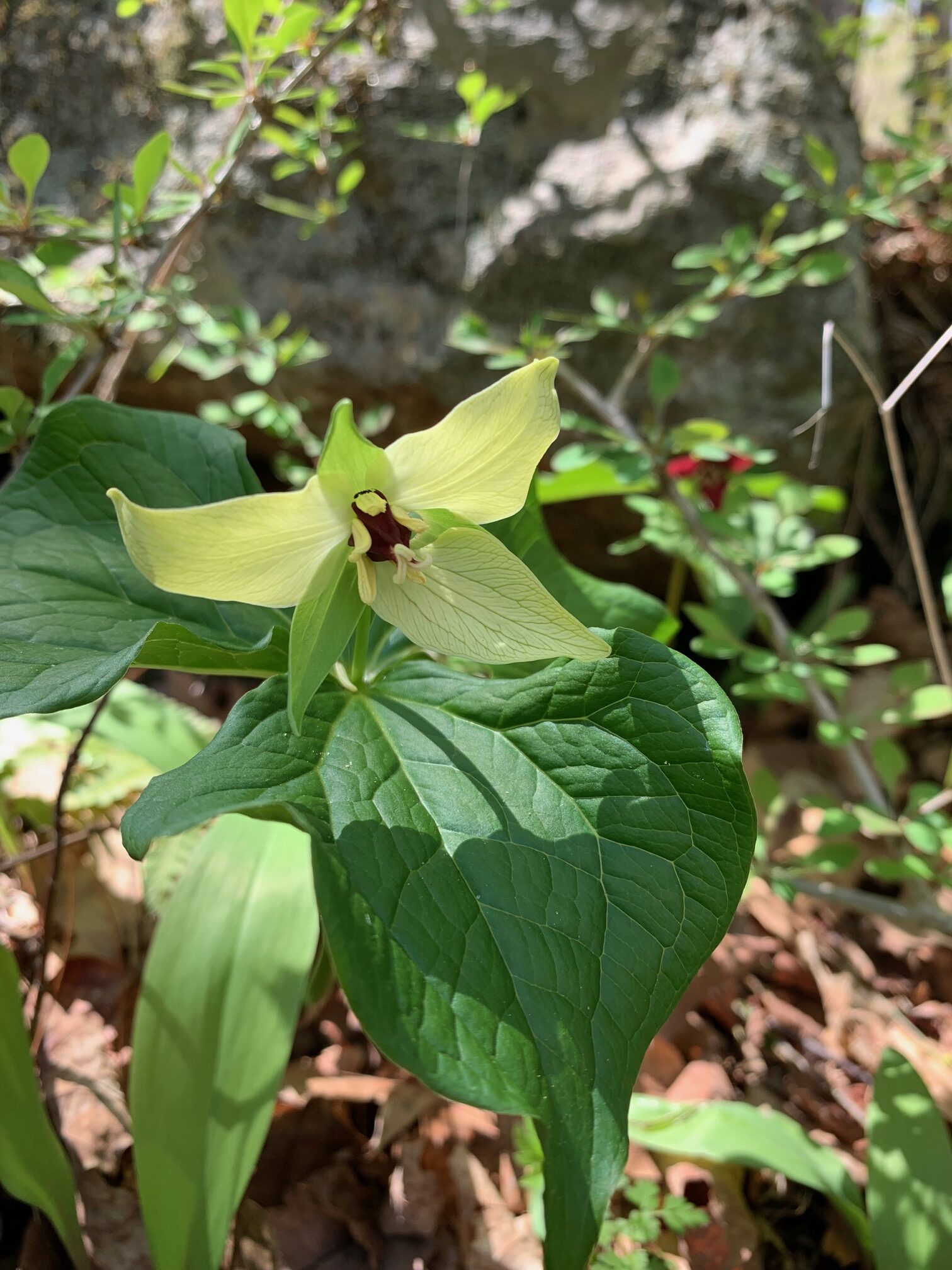
A rare yellow morph of red trillium, found by GMF Forester Emeritus Jody Bronson. Photo by Jody Bronson
A meal for the early risers
While spring ephemerals make up only a small percentage of understory plants, they play a vital ecological role as the first species to green and flower each spring. Part of that role is serving breakfast for hungry over-winterers.
“They’re actually really important to a lot of organisms because they might be some of the first food sources they have,” explained Dr. Sara Kuebbing, a Yale School of the Environment ecologist and recent speaker for GMF’s Winter Lecture Series. Ants, rodents, pollinating insects, deer and more all take advantage of the early nutrition.
Ephemerals also act as nutrient stores for the ecosystem to access later in the year. Forest ecologist Dr. Martin Dovciak, a professor at the State University of New York’s College of Environmental Science and Forestry, explained that since they are active before other plants, they uptake and store some of the nutrients generated by microbial decomposition that may have otherwise been lost to snowmelt or rainfall runoff. “They prevent nutrients from leaving the system,” he explained.
Dovciak also pointed to a unique adaptation of skunk cabbage, the earliest wildflower to bloom in New England forests. “It has the ability to create its own heat through thermogenesis,” he explained, “and it can actually melt out through the snow.”
In doing so, it creates a more temperate microclimate and shelter—a warming hut for insects, of sorts. “And in the process they pollinate the plant, right?” said Dovciak.
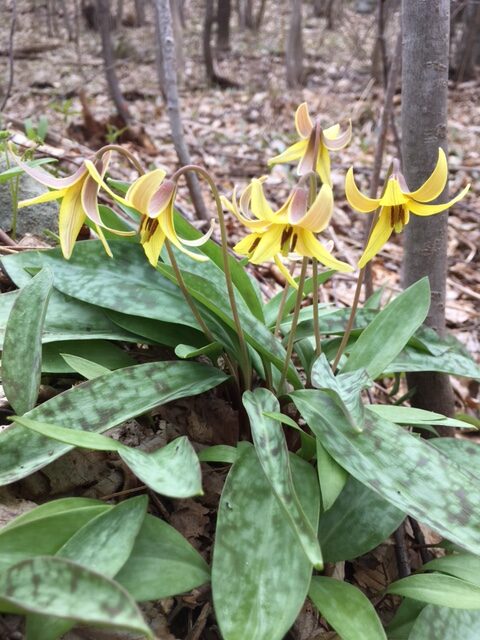
Trout lilies are a favorite of GMF Forester Emeritus Jody Bronson. Photo by Jody Bronson.
Climate change, invasives, and deer – oh my!
But what happens if there isn’t any snow to melt?
Dovciak said that’s a question researchers are starting to ask about the complex implications of shorter, warmer, and less reliably snowy winters on early blooming plants and their interaction with the broader ecosystem.
“What are these plants going to do when they are robbed of that opportunity to create this unique microclimate that they depend on to attract those insects to pollinate them?” he said.
The effects of a changing climate, and the constellation of weather impacts it will bring, are complicated and multifaceted, Dovciak explained. For instance, with no snow cover, skunk cabbage also face early season over browsing by herbivores. “They can really just be mowed by the deer because they are some of the first kind of juicy, substantial material that shows up above the ground so early,” he said.
This uncertainty belongs to the field of phenology, which explores the annual seasonality of plants and animals in relation to climate. Dr. Kuebbing has been researching differential responses between understory wildflowers and trees to earlier spring seasons. She said evidence has indicated that trees are responding to the changing seasonal pattern more quickly than the ephemerals, meaning that leaf out is happening earlier, while wildflowers might not be making up the time on the other end of their flowering window. This amounts to a shorter above ground life cycle, which can put stress on the plants and deplete them over time.
There’s also the threat of mistimed flowering with ants waking up, which are responsible for the seed dispersal of many wildflower species. “There are lots of important questions about whether those interactions are disrupted because of warming,” Kuebbing said.
Invasive plants also may have the adaptive upper hand with a warming climate. Ephemerals are conservative in leafing out, Kuebbing explained—an energy storing tactic to account for New England’s once-common late season frosts. Many invasive species don’t have that same safety mechanism, and “they’re really capitalizing on the warming weather.”
They also capitalize on not being tasty to plant browsers. “The reason why they’re invasive is that deer don’t like to eat them,” said Dr. Jeffrey Ward, who was chief scientist at the Connecticut Agricultural Experiment Station from 2005-2022 and is a current GMF board member.
Spring ephemerals, on the other hand, are very appealing to a deer that has spent the winter digging for twigs under the snow.
Ward sees deer over browsing—and invasive plants, which he explained are a symptom of deer overpopulation—as the most immediate danger to understory plant populations in the Northeast. “Climate change, that’s going to happen over the scale of decades,” he said, but right now, we have a “real-time problem.”
To fence, or to hunt?
So what to do about deer? Many advocate for hunting, including Dovciak. “It’s great food actually—venison is really yummy.”
“I think we need to get more young people and women involved in hunting,” Deb Munson offered, noting that deer fencing, another method people use to protect plants, is prohibitively expensive. “Plus, it interferes with wildlife corridors,” she added.
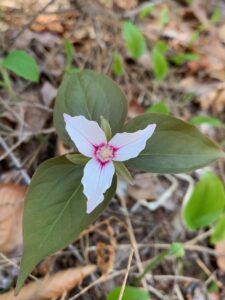
Painted trillium (Trillium undulatum), an increasingly rare feature of Connecticut’s April forest floor. Photo by Jody Bronson.
Ward noted that while forests that allow hunting demonstrate noticeably greater wildflower and shrub populations, deer hunting is ultimately a policy issue. “Because you can’t sell [hunted deer meat], there’s really not an incentive to go out there and shoot even more deer,” he said.
Ward advocated for a type of fencing that uses slash from a forestry operation which has yielded encouraging results. “It was just unbelievable on the inside, just this explosion of plant diversity,” he recalled of one slash wall enclosure.
Dr. Duguid has been similarly impressed by slash wall projects she’s worked on—“I cannot believe the difference inside and out,” she said.
But, as Dovciak pointed out, “you can’t fence everything.”
Duguid agrees. She sees selective enclosing as a temporary solution to protect biodiversity as scientists address the bigger problem. “The deer are just out of control,” she said, “it’s definitely the biggest risk.”
About the Author
Alec Linden is a news reporter, environmental storyteller, and researcher based out of Norfolk. After completing a master’s degree in environmental governance and policy at the University of Oxford in 2023, Alec moved back to the Northeastern US to begin a career caring and advocating for the hills, ravines, and rivers that he cherished growing up in downstate New York. Alec relocated to the Northwest Corner in the summer of 2024 to become a reporter with the Lakeville Journal, and now helms newsletter and copy editing duties for GMF. During his down time, Alec spends as much time as possible on skis, and in the warmer months pokes around the woods of the Berkshires and Taconics to search for new rock climbing routes.