Following the Forest GMF Style
December 23, 2025
Alec Linden
A Forest Stronghold and Climate Refuge Anchoring the Largest Stretch Temperate Forest in the World
Great Mountain Forest’s 6,300-acre expanse is, in a sense, one of Connecticut’s broadest highways. Save the rare maintenance vehicle or Sunday stroller, though, it is no conduit for humans, but rather the fast lane – or a rest stop – for the abundant flora and fauna of the New England woodlands.
That highway is not isolated to Norfolk and Falls Village. It is part of an ecological interstate that runs from the uplands of the lower Hudson Valley to the northern forests of Quebec. The Follow the Forest initiative, a collective effort between the Housatonic Valley Association, the Litchfield Hills Greenprint Collaborative, and many other regional groups, seeks to connect and protect this dark green thoroughfare, and GMF is a vital junction on a route that carries moose, bears, bobcats, salamanders, seed pods and beyond across an increasingly fragmented landscape.
The project recently received $30,000 in grant funding to further its mission, which combines citizen science, expert input, and regional partnerships to aid in wildlife mobility along a “corridor” that follows protected forests from the Hudson Highlands through the Berkshire and Taconic ranges before connecting with the Adirondack and Green Mountains and ultimately Canada.
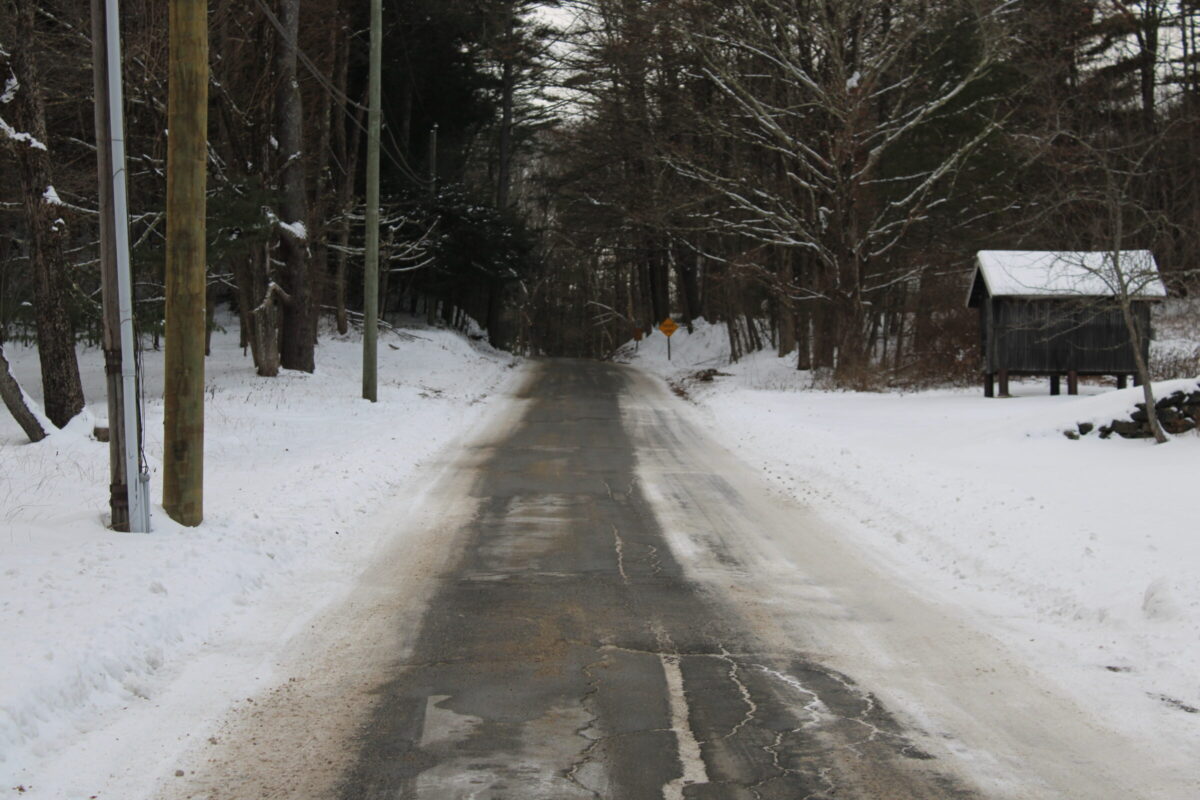
Windrow Road approaching the GMF Visitor Center in early December. Even quiet roads like this can pose an obstruction to wildlife mobility between large forest cores. Photo by Alec Linden.
“Connectivity” is the concept of keeping “core” habitats bridged through “linkages” – sites where animals are able to traverse an anthropogenic boundary from one core to another. Many animals depend on mobility for vital reasons, such as seeking food or water or mating and reproduction, but the isolation of habitats from one another impacts humans downstream as well. According to the World Wildlife Fund, habitat fragmentation stemming from development has impacts beyond local ecosystem collapse, including degrading soil health and polluting fresh water.
Large and connected refuges of wildland that enable animals and plants to move freely are considered havens of “resilience” amid increasing pressures from climate change and development, which is an ecosystem’s ability to survive and thrive amidst disturbance. The corridor that runs up the highland spine from southern New York state to Canada connects an extensive swath of North America’s eastern woods, regarded to be the largest stretch of intact temperate mixed and deciduous forest in the world, according to Follow the Forest.
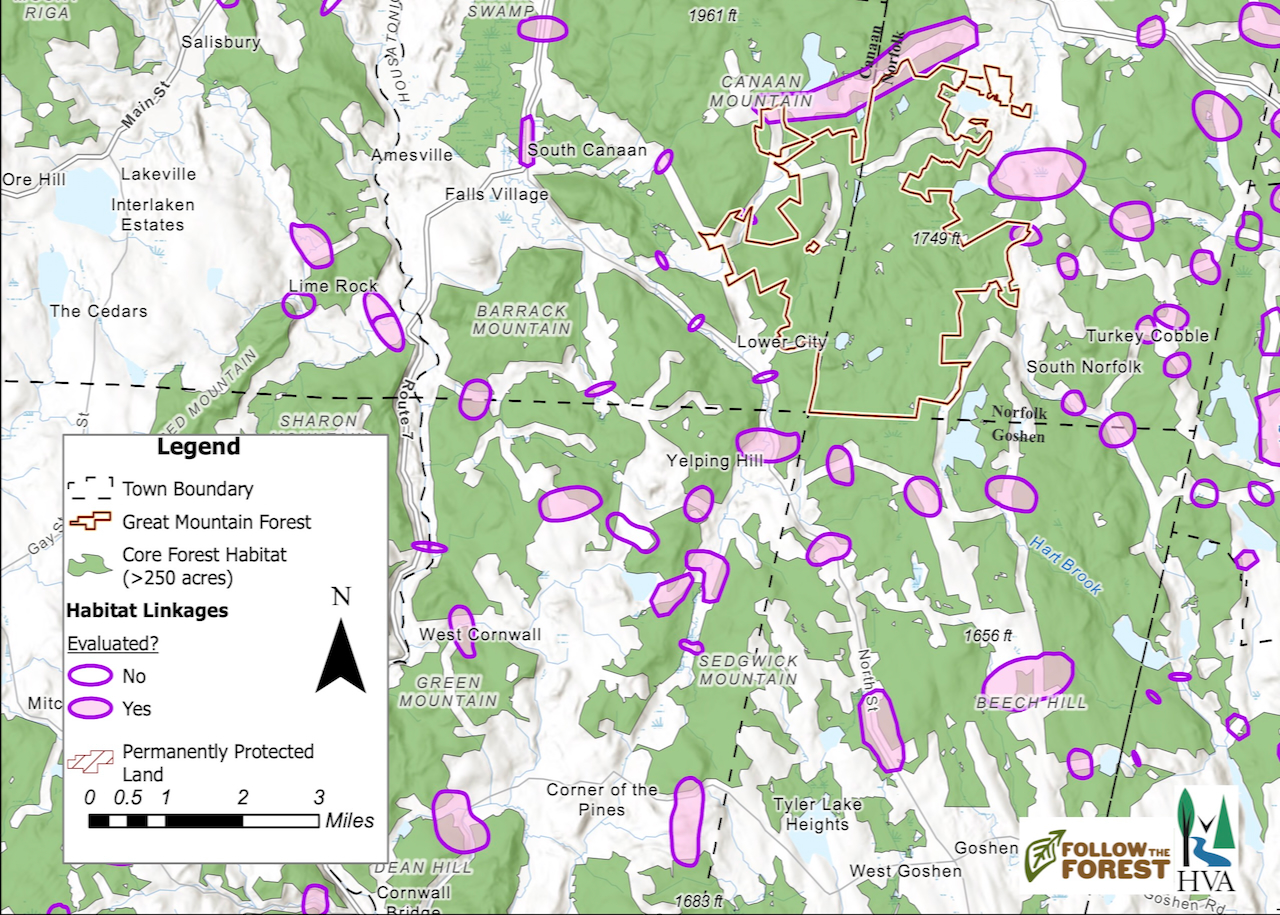
GMF’s territory makes up what the Follow the Forest initiative identifies as “core forest habitat” – a tract of protected woodland, 250 acres or greater, that is not disrupted by human alterations like roads or farmland. In addition to GMF’s conserved lands, thousands more acres of protected state-owned highland forest spread across the Canaan Mountain massif. Far exceeding the size qualification, the extensive, contiguous, and diverse forest contained within and directly abutting GMF’s boundaries is part of a “key stronghold” of climate resilience, according to HVA Conservation Director Julia Rogers.
During a recent interview, Rogers addressed the value in GMF’s longstanding commitment to conserving forestland. “Without that legacy,” she said, “I would predict that there is a strong likelihood that parts of [the forest] would be developed and we would have a much smaller core forest.”
Big cores, she explained, are fundamental as they are able to withstand disruption and damage more so than smaller tracts of land. “Larger cores are going to be more resilient to all the impacts of climate change,” she said, including more extreme and unpredictable weather patterns, which may topple trees that have less protection.
Plus, GMF has elevation on its side: “As we think about species who are going to need to move either north or upward in elevation as a response to climate change, Great Mountain Forest is going to serve as a key climate refuge.”
“That connectivity with the protected lands further south and lower in elevation is so critical to Great Mountain Forest serving as a key part of the Follow the Forest initiative,” Rogers added.
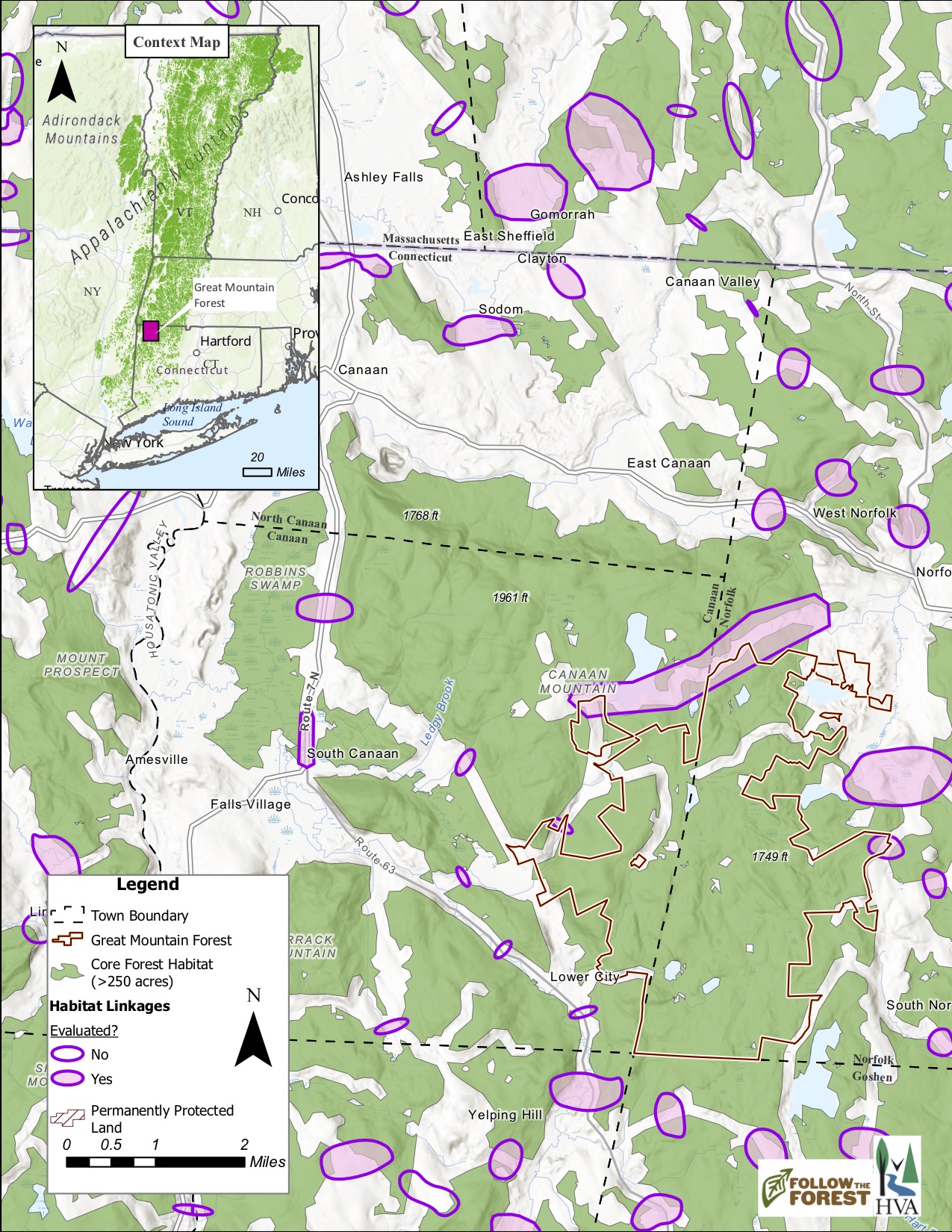
The property lines of GMF, outlined in red, with the surrounding wildlife linkages to other core forest habitat demarcated by purple ovals. Shaded ovals indicate sites that have been assessed in person by a community scientist. Map courtesy of Stacy Deming/Housatonic Valley Association.
Not just a stronghold, GMF is also surrounded by linkages to other protected habitats. These sites, identified by purple ovals on the Follow the Forest map, were initially identified by computer modeling, but many have been visited by volunteer citizen scientists who contributed their own observations to the data pool.
Stacy Deming, HVA’s GIS manager who is behind Follow the Forest’s intricate and user-friendly story map, also joined the interview. She spoke with pride about the collaboration with locals. “I’d say we’ve really done a lot of work with community scientists to come up with these,” she said of the map tags detailing each linkage. “I feel like they’re a better display of what the linkages really are.”
Rogers echoed Deming’s sentiment: “What’s really cool about getting community scientists out there is that they have information that we can’t gather from a computer.” Plus, involvement begets interest, she said, noting that the project promotes engagement with the idea of wildlife connectivity as volunteers inspect these linkage sites firsthand.
Both Rogers and Deming agree that a communal approach to preserving connected wildlife corridors is essential in southern New England, a region abounding with roads, property lines, and town borders.
“None of us can do it alone,” said Rogers. “We need each other. And what’s fun about Follow the Forest is that it unites all of us under something that’s exciting, right?”
About the Author
Alec Linden is a news reporter, environmental storyteller, and researcher based out of Norfolk. After completing a master’s degree in environmental governance and policy at the University of Oxford in 2023, Alec moved back to the Northeastern US to begin a career caring and advocating for the hills, ravines, and rivers that he cherished growing up in downstate New York. Alec relocated to the Northwest Corner in the summer of 2024 to become a reporter with the Lakeville Journal, and now helms newsletter and copy editing duties for GMF. During his down time, Alec spends as much time as possible on skis, and in the warmer months pokes around the woods of the Berkshires and Taconics to search for new rock climbing routes.