The Forest as a Source of Artistic Inspiration
May 14, 2026
Alec Linden
Understanding the Forest Through Art
In addition to serving as a site for conservation science, a classroom for future forest stewards and an outdoor community resource, the ridges, swamps, ponds, and wooded slopes of Great Mountain Forest continue to inspire artists of many mediums.
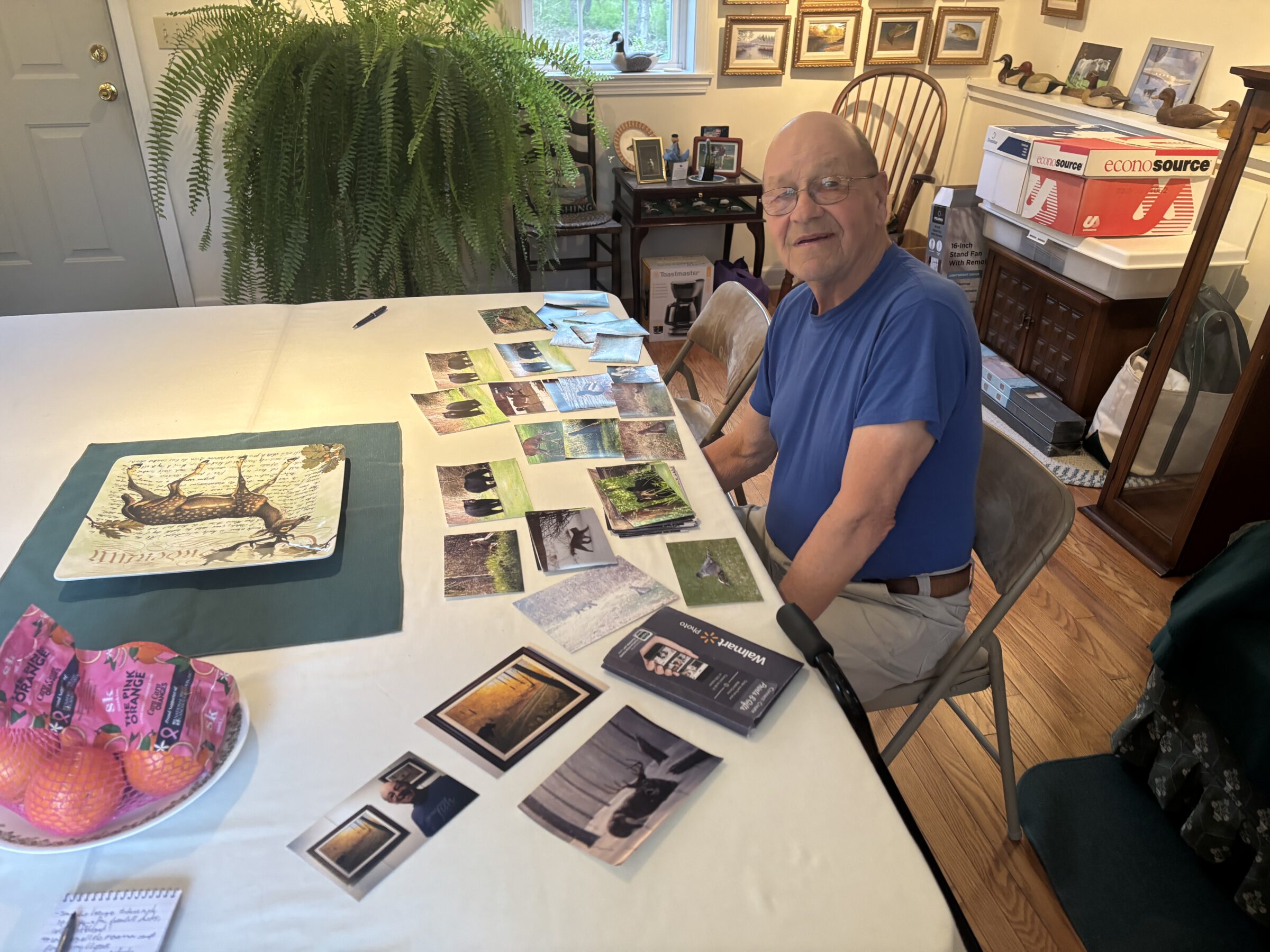
Painter Wayne Jenkins
Among them is Wayne Jenkins, who started painting scenes from the forest more than 60 years ago.
“I’m always trying to observe something,” he said on a recent afternoon at his home in the north woods of Canaan, where some 25 of his original woodland and agrarian scenes adorn the walls.
Jenkins was hired by former GMF owner Edward “Ted” Childs in 1965 as a gardener when he was 21 years old. Jenkins spent over four decades working the GMF woodlands, boiling sap for syrup, cutting Christmas trees, harvesting cordwood, and—of course—painting.
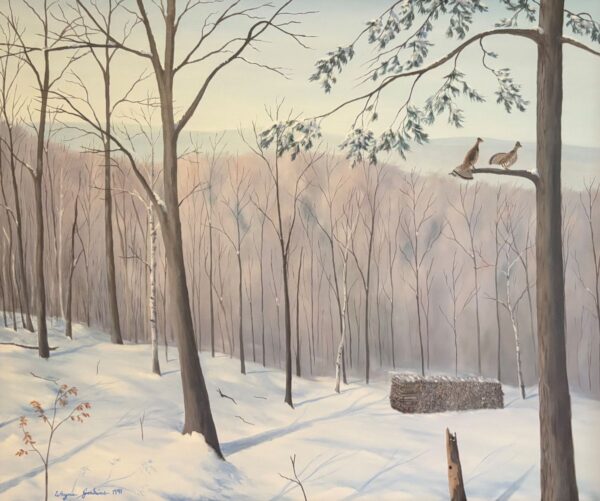
A scene Jenkins painted in 1991 of a viewshed looking north from near Camps Pond, featuring some GMF cordwood. Jenkins acknowledged that the pair of grouse perched on the branch was a bit of creative license, as it would be an uncommon location to spot them.
Jenkins generally paints from photos taken in the field. He said the act of painting is a way to connect with the places and scenes he encounters in the woods and rural landscapes of the Northwest Corner: “Sometimes it just puts me back there.”
Jenkins recalled many such moments—beeches glowing in the late afternoon sun over Camps Pond, the “bark” of snow geese as they migrated south, or one time when he saw about 30 redstarts hopping about in a tree near a remote cabin. These snapshots of woodland—and agrarian, as he also loves cattle—life have been the basis of his art for six decades.
Sometimes, Jenkins’ subject matter is playful, but never strays far from real life. One small picture shows a bobcat licking its lips behind a grassy rise as an unwitting pheasant stands in the foreground. It would seem to be the product of a wry imagination if Jenkins didn’t have the photos to confirm the moment.
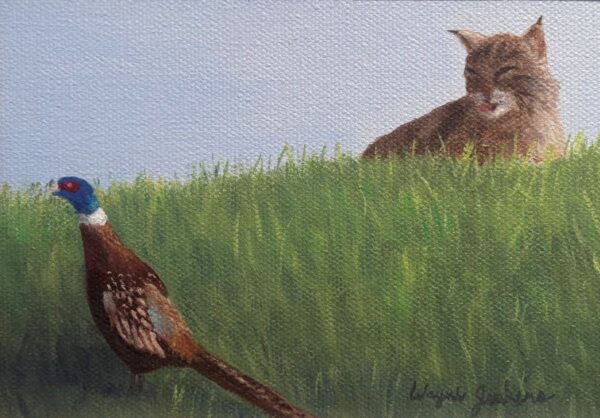
This encounter was no fantasy, Jenkins said, but a real scene he’d witnessed in his backyard. He didn’t see the result, but confirmed the pheasant wasn’t around much longer.
Jenkins’s art is displayed on walls both public and private throughout the region. Just this month, Jenkins reported that Norbrook Brewery, a popular agritourism destination just over the Colebrook town line, picked up two more of his pieces, bringing the brewpub’s total to three original Jenkins paintings. The North Canaan NBT Bank branch also hangs a work of his.
Reflecting on his many years painting landscapes, Jenkins also noted that as a nature-inspired artist, the work must change as the forest changes. These days, there are more bobcats and bears, while the ruffed grouse, one of his favorite subjects, he seldom sees.
Photographer Tom Blagden
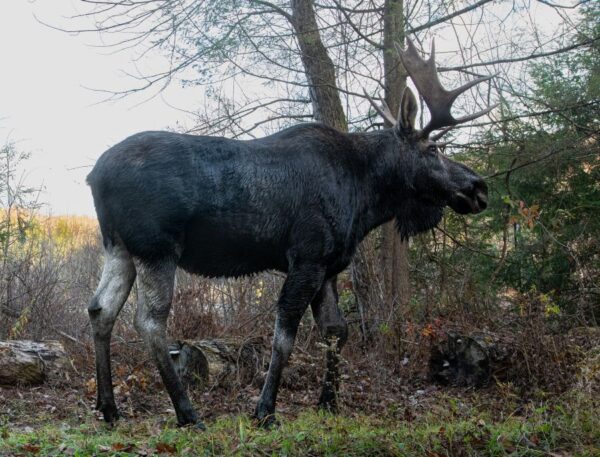
Moose, like this proud bull, are the “holy grail” of GMF photography subjects, said Blagden.
Conservation photographer Tom Blagden is another artist both documenting and drawing inspiration from GMF’s landscapes and wildlife. “The photographic record can reveal a lot over time about how the landscape is changing,” he said during a recent interview.
Since returning to the Northwest Corner seven years ago, the Salisbury-reared artist—who himself comes from a family of landscape painters—has been donating his forest images to a growing archive of GMF photography that he hopes will be used “in perpetuity.”
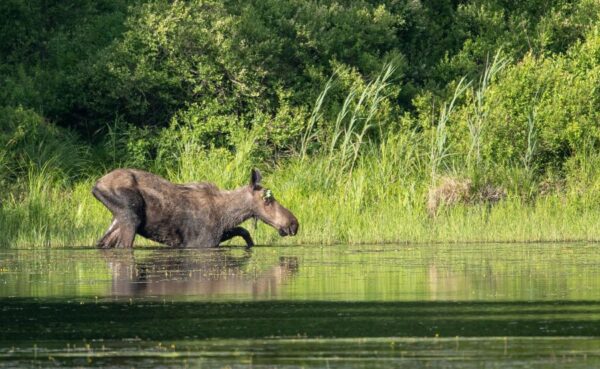
“Moose are always the holy grail,” said Blagden of photographing the forest. GMF is home to approximately 20% of Connecticut’s 100 or so resident moose. Photo by Tom Blagden.
“Nature photography has a powerful ability to assign a higher sense of value to a place,” Blagden said, noting that beyond its function as a historic record, images can generate an emotional response that drives action. “We all are deluged with information and data and science,” he said, “but really, if we don’t feel that emotional connection, we’re not going to ultimately care about it as much.”
Blagden has published coffee table books of photos from landscapes including the dramatic Grand Canyon and Acadia National Park, but maintains that the quiet beauty of GMF offers a particular capacity for surprise.
“It’s a classic New England wilderness, which is inherently subtle and very intimate,” he said, “so that’s where the unpredictability and the discovery come in.”
Blagden grew up visiting GMF, which seemed to him a “wild and untrammeled” wilderness when he was a child and said that through his work, he connects to his younger, more innocent youth.
Beyond raising awareness for the natural world, Blagden aims to engage more deeply with nature on a personal level. “It’s not just visual,” he said, “it’s your body engaging with the terrain. It’s being tuned into the sounds and the smells.”
He suggested that many people could benefit from a similar practice of deepening their experience with the natural world.
“We’re at a point where we need to rewild ourselves in terms of engaging with the landscape,” he suggested, “and a place like Great Mountain Forest does exactly that.”
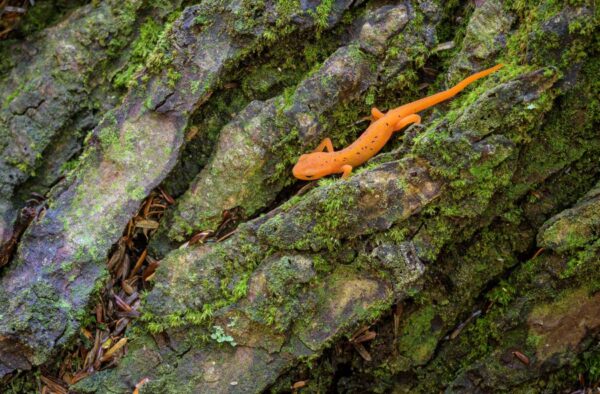
Watch out for these this time of year when hiking on GMF’s trails, especially after rainfall. The red eft, a terrestrial juvenile stage of the eastern newt, likes to sit still on damp trails. Photo by Tom Blagden.
Landscape Painter George Browne
Aside from the living artists, a number of creatives who have passed on have also contributed to the GMF cultural canon.
Among them was George Browne, a highly respected painter of game and hunting scenes in the mid 20th century. The son of adventurer and painter Belmore Browne, the younger Browne had an exciting career of his own. While enlisted during World War II, he was the first person to survive a 40,000 foot parachute jump without freezing to death. Later, he summited the 20,310 foot Denali in Alaska, a feat his father attempted multiple times but never achieved. To boot, he did it while lugging canvasses, paint, and easels, stopping to paint the rugged alpine scenery along the way.
In the 1950s, Browne and his family moved to Norfolk from the mountains of Alberta, Canada to be closer to the hub of sporting arts. Late in the decade, Ted Childs commissioned a piece from Browne, the final product of which, called “Coolwater Stag,” depicts a buck and doe wading at the water’s edge as wood ducks fly overhead against a backdrop tableau of autumn pastels.
In a correspondence dated to 1957, Browne, who had lived much of his life in the Pacific Northwest and Canadian Rockies, said he was thrilled at the proposition. “I think the forest growth around Norfolk is the most beautiful I have ever seen, certainly more varied and subtle than in the west,” he wrote in a letter preserved by the Browne Family Collection.
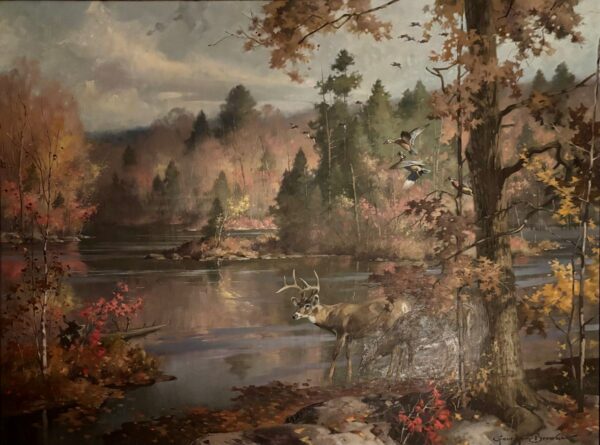
George Browne’s “Coolwater Stag,” showing an autumn scene at Old Man McMullen Pond, formerly known as Great Mountain Pond, was commissioned by former GMF owner Edward “Ted” Childs in the late 1950s.
He wrote again in February 1958 to announce that the painting was complete. “I do not feel that it is necessarily the best picture that I have ever painted, though I do feel that it is my greatest technical achievement to date,” he stated in the letter.
The next month, Browne was killed at the age of 40 by accidental gunfire from a companion while on an outing in the Adirondacks.
Poet David K. Leff
Pushcart Prize nominee and environmental official for the State of Connecticut, poet David K. Leff also served as a trustee of GMF and helped establish the original easement that continues to protect the forest today.
Like Jenkins’, Leff’s work demonstrates that patience, attention, and openness to one’s surroundings can yield deep rewards in a forest like ours.
Leff wrote in a yet-unpublished memoir of his time roaming GMF’s woodlands, urging forest-goers to truly take notice of what is all around:
“If the vocabulary of hills and watercourses, boulders, banks of sand and gravel, and scratches on ledges could be understood, perhaps the words of the owl that called to us earlier, or the grammar of forest ecosystems might be made intelligible and accessible. Reading the landscape opens a book of revelation.”
Leff passed away from a medical emergency in 2022 at the age of 67, but his words continue to inspire. He understood that communicating the mysteries of the forest is no easy task, but a good first step is to just stop, listen, and see what happens.
There are many ways to write about nature, which is why GMF is hosting the 2026 Writing Retreat to help forest writers hone their voice and translate awe and inspiration into effective prose that connects to a breadth of audiences. The program runs August 7-9 at the Yale Camp; sign up here.
About the Author
Alec Linden is a news reporter, environmental storyteller, and researcher based out of Norfolk. After completing a master’s degree in environmental governance and policy at the University of Oxford in 2023, Alec moved back to the Northeastern US to begin a career caring and advocating for the hills, ravines, and rivers that he cherished growing up in downstate New York. Alec relocated to the Northwest Corner in the summer of 2024 to become a reporter with the Lakeville Journal, and now helms newsletter and copy editing duties for GMF. During his down time, Alec spends as much time as possible on skis, and in the warmer months pokes around the woods of the Berkshires and Taconics to search for new rock climbing routes.