What Happens When We Lose the American Beech?
February 10, 2026
Alec Linden
Research Efforts to Defend Against an Uncertain Future for the American Beech
Less than a decade ago, beech leaf disease was unknown to New England’s expansive beech canopies.
But now? “In Connecticut, every single beech tree has beech leaf disease,” said Elisabeth Ward, a forest ecologist with the Connecticut Agricultural Experiment Station (CAES).
Ward is one of several researchers working on a long-term study in Great Mountain Forest – and across Connecticut – to gather data on this rapidly spreading pestilence in order to forecast what might happen to New England’s woodlands if – or rather when – the beeches are gone.
“This project isn’t about preserving existing beech,” said GMF Forester Kate Regan-Loomis, who helps coordinate and support research projects in the forest. “The question is how is the forest going to respond to beech leaf disease?”
“What is going to come back when the beech are gone? And how does our management affect that?”
Beech leaf disease, often referred to as BLD, was first detected in Ohio in 2012 and jumped to Connecticut in 2019. Caused by an invasive nematode – a microscopic worm – the disease infects the leaves, causing a noticeable “banding” effect, then crinkling the leaves as the disease progresses, ultimately defoliating the tree. Without leaves, the trees cannot photosynthesize, which means they cannot grow and will eventually die.
Ward, who coordinates Connecticut’s forest health program, a joint effort between the Agricultural Experiment Station and the Department of Energy and Environmental Protection, said that BLD is an invasive disease that stands out even in New England’s increasingly-diseased woodlands.
“The northeastern U.S. has a long history with lots of different introductions of forest pest pathogens and diseases from around the world… but an invasive foliar nematode is not something we’ve seen before,” she explained. “Foliar” means that the pest targets the leaf.
“It’s just not something that’s ever been dealt with in terms of a forest health issue.”
This fact, along with the unprecedented speed with which the disease spreads, means that “scientific research hasn’t really been able to keep up with what to do,” Ward said.
Ward’s own work on BLD seeks to fill the gap formed between the disease’s swift takeover of northeastern forests and the relative lag of peer-reviewed scientific research. She is part of a collaborative, multi-discipline study using eight sets of large forest plots across Connecticut, including some nearly 70 year-old plots within GMF, to examine how beech trees of various age, size, and other variables are responding to the disease.
“We’re calling it a rapid assessment,” she explained, noting that the goal is to survey a large sample size “to get some really robust, good initial data about beech leaf disease and its impacts.”
Her work continues that of Jeffrey Ward (no relation), former chief scientist at CAES and GMF trustee, who began monitoring the GMF plots specifically for BLD when it landed in Connecticut. The project, which is ongoing, tracks 2,500 trees across the research sites, and so far, the scientists have found “pretty much complete stagnation of growth amongst all tree size classes,” she reported.
Interestingly, the researchers have not found a notable uptick in mortality in beech yet, but Ward warned that this isn’t cause to rejoice. Beech are clonal, meaning that in a stand, many stems are connected to the same root system. This enables healthier, larger trees to subsidize sicker ones for a time. When this reservoir runs out, though, possibly due to a co-stressor such as drought, “we’re going to see stand level die back,” Ward said.
While the situation is dire, Ward emphasized that much is still unknown. “We’re kind of limited by our lifetimes and what we see happening,” she said, noting that in Japan, where the nematode is suspected to have originated, beech have “completely co-evolved” with the nematode and live alongside it.
Regan-Loomis said that forest management can help play a role in giving the species a chance at survival: “Evolution is just luck… we can try to direct that in selecting management trees [to protect] that we hope have a good shot.”
Ward is working with GMF to explore another project that would test a potential treatment that could help preserve a sampling of healthier beech trees. Over the summer, she plans to test a phosphite bark spray at sites across the state including GMF. While not a landscape-scale solution – “I wouldn’t recommend spraying anything over the entire eastern United States” – it could save some trees, which is important, Ward explained:
“At least we’ll be doing something to preserve some beech genetic diversity across Connecticut rather than just waiting for them all to die.”
Other researchers are tackling BLD from other angles at GMF. Ecosystem ecologist Jonathan Gewirtzman, who just defended his PhD thesis at the Yale School of the Environment and is moving on to a post-doc at Stanford University, is part of the same collaborative, state-wide project that Ward is working on, but his focus is on what’s happening below the bark.
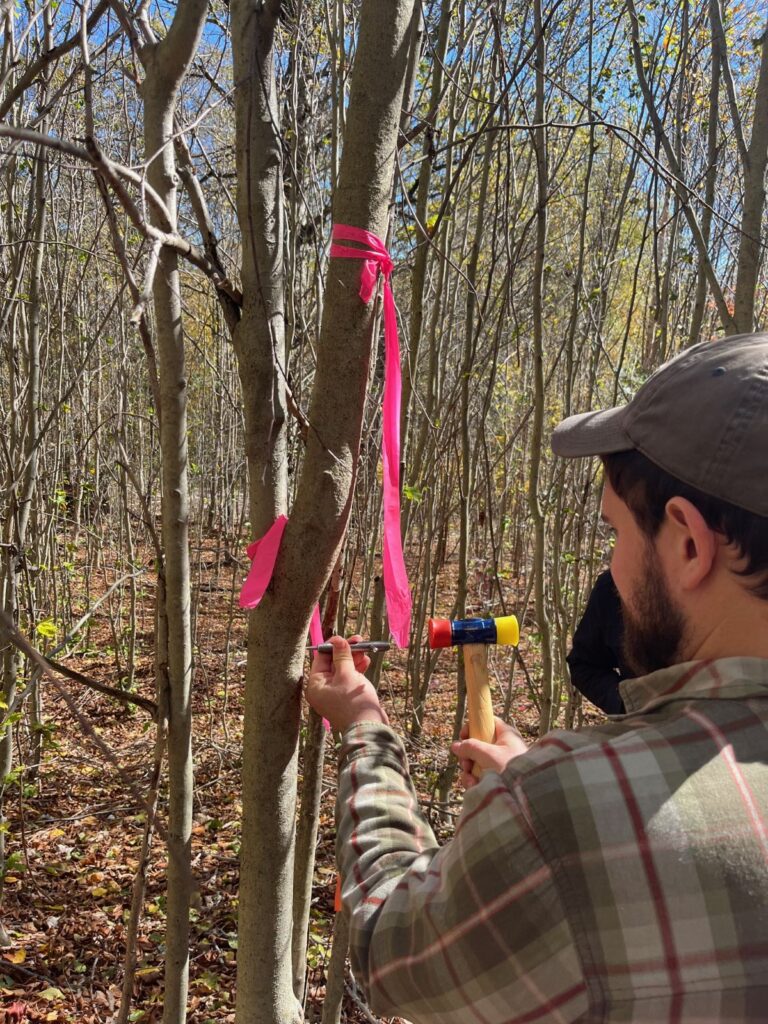
Researcher Jonathan Gewirtzman takes a core from a small beech to search for nutrient uptake. Photo by Kate Regan-Loomis
Gewirtzman studies non-structural carbohydrates – sugars and starches – in the outer part of infected beech trunks. In other words, he researches tree food. “Do these trees run out of sugar and die? Is that what’s going to lead to their mortality?”
He explained that his lab takes samples twice a year to get maximum and minimums, as trees build up stores throughout the leaf season to sustain them over the winter – “like a hibernating bear.” The research group expects results from the first batch of samples within the next several months.
Another upcoming project comes from Akshay Patel, a first-year Master’s student at the Yale School of the Environment. Patel is currently in the planning stages of a study on whether the disease can be accurately monitored using drone technology.
“In a lot of my research,” he said, “I’ve seen that a common pattern of diseases that run away from us is that we’re not able to keep a consistent and spatially explicit record of where they are.” He explained that more efficient tracking of the disease’s progress will aid forest managers and researchers in myriad ways as the scientific community deepens its understanding of this devastating pathogen.
Despite hints of progress, the story of New England’s beech trees is a sad one, and not just for humans, Regan-Loomis said. She noted that while the tree has often been regarded as a nuisance and of low-value among foresters, it provides vital nutrition for wildlife. “Beech nuts are important especially where there aren’t oak trees around,” she said. “It’s just a very useful, very fatty food for, like, everything, especially larger animals like deer and bear.”
“I always want to defend the beech,” emphasized Loomis.
About the Author
Alec Linden is a news reporter, environmental storyteller, and researcher based out of Norfolk. After completing a master’s degree in environmental governance and policy at the University of Oxford in 2023, Alec moved back to the Northeastern US to begin a career caring and advocating for the hills, ravines, and rivers that he cherished growing up in downstate New York. Alec relocated to the Northwest Corner in the summer of 2024 to become a reporter with the Lakeville Journal, and now helms newsletter and copy editing duties for GMF. During his down time, Alec spends as much time as possible on skis, and in the warmer months pokes around the woods of the Berkshires and Taconics to search for new rock climbing routes.