Exploring Our Deciduous Forest: Connecting Stories to Nature (K-2)
Most Prevalent Themes:
ELA (Grades K–2):
Students build literacy and communication skills by asking and answering questions, sharing observations and ideas, and using drawing, speaking, and writing to record and communicate what they discover. Connections: W.K–2.2 • SL.K–2.1
NGSS (Grades K–2):
Students use observations and hands-on investigations to explore what plants and animals need to survive, how their structures help them live and grow, how living things depend on their habitats, and the diversity of plants and animals in different environments. Connections: LS1 – Needs, Structure & Function • LS2 – Interdependence • LS4 – Habitats & Biodiversity
Audience:
Kindergarten and Elementary School
Duration:
2 ½ hours
Description
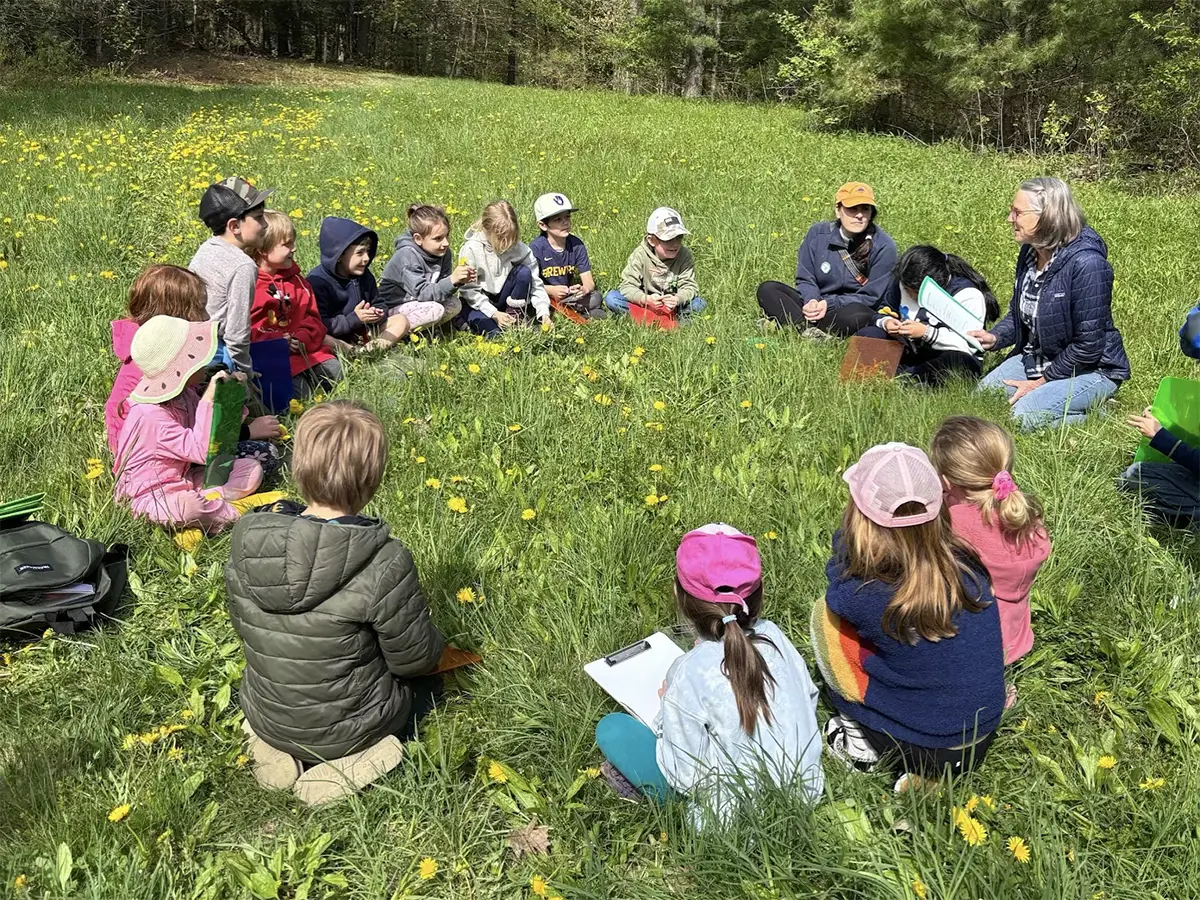
This immersive, literacy-integrated forest experience invites first-grade students to connect storytelling with real-world observation. Explore the layers of a deciduous forest while investigating both living (plants, animals) and nonliving (sunlight, water, soil, air) parts of the ecosystem. Students will also explore the four essential components of a habitat, food, water, shelter, and space, and how these needs are met within the forest. Through hands-on exploration, sensory activities, and guided inquiry, students begin to understand how all parts of the forest are connected. Stewardship and respect for nature are emphasized throughout.
Learning Intentions:
By the end of the session, students will be able to:
- Identify and describe forest layers (canopy, understory, forest floor)
- Observe and record plant and animal life
- Identify nonliving components of the forest (sunlight, water, soil, air, temperature)
- Explain how living and nonliving parts of the forest affect one another
- Use descriptive language through speaking, drawing, and writing
- Participate in collaborative discussions
- Practice respectful and responsible behavior in nature