
Aquatic Explorers: Discovering the Tiny Life in Forest Waters (K-4)
Most Prevalent Themes:
ELA (Grades K–4):
Students strengthen communication and science literacy skills by discussing their discoveries, describing observations, and using drawing and writing to record and share information from field investigations. Connections: W.K–4.2 • SL.K–4.1 • SL.K–4.4
NGSS (Grades K–4):
Students observe and investigate plants and animals to discover what they need to survive, how their structures support survival and growth, how organisms vary across habitats, and how living things respond to environmental conditions and change. Connections: W.K–4.2 • SL.K–4.1
Audience:
Kindergarten and Elementary School
Duration:
2 ½ hours
Description
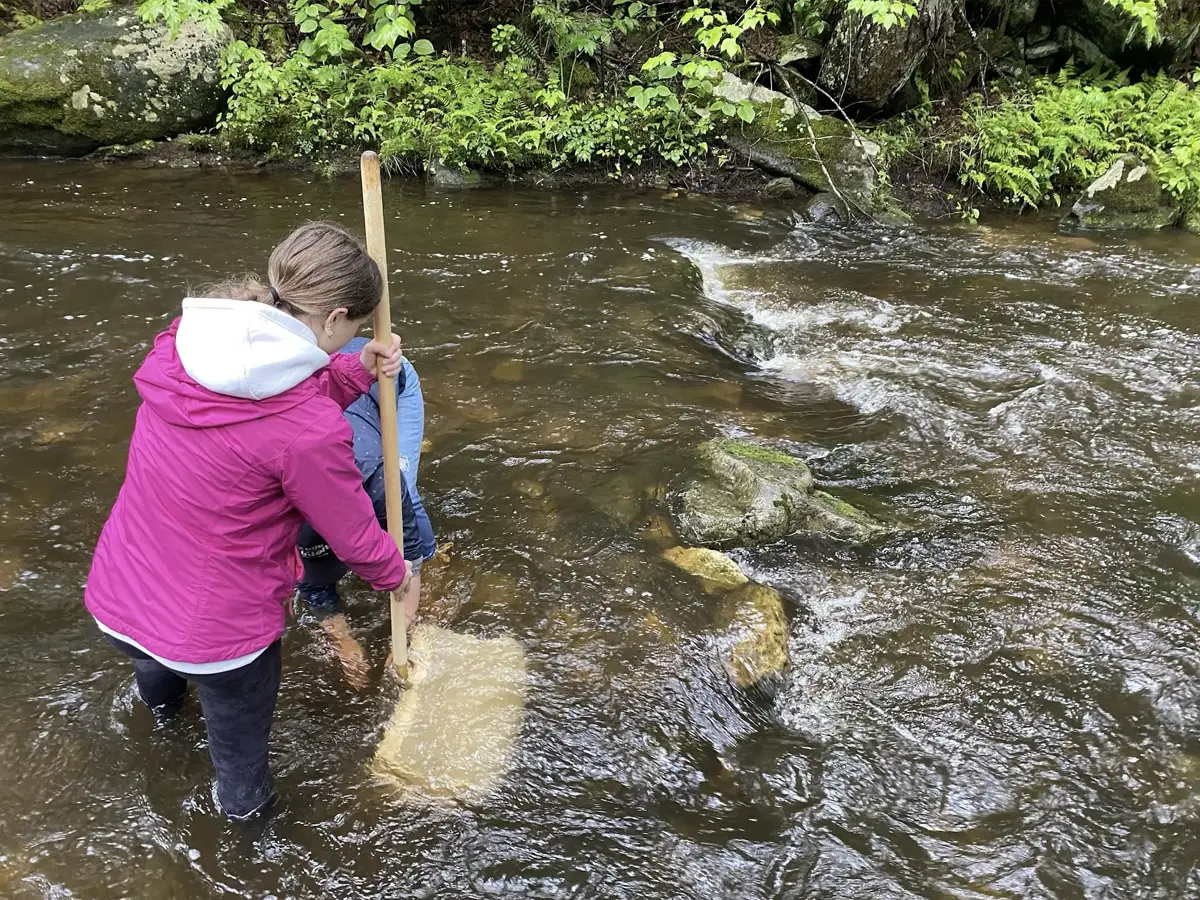
Let’s discover the surprising world hidden beneath the surface of Great Mountain Forest’s freshwater habitats! In this hands-on field experience, students become Aquatic Explorers, using nets, collection trays, and magnifiers to search for the tiny animals that make their homes in the water. Students collect and carefully observe aquatic macroinvertebrates, compare how they look and move, and investigate the special features that help them survive underwater. Using their discoveries as evidence, students identify and compare organisms and learn how scientists use certain macroinvertebrates as clues to better understand water quality and habitat conditions. Along the way, students discover that even a quiet-looking stream can support a diverse community of life and explore how the surrounding forest helps protect these freshwater habitats. Centered on “Look closely,” “What do you notice?” and “What can we discover?”, this engaging K–4 investigation combines exploration, observation, movement, and scientific thinking while encouraging students to become careful visitors and stewards of the forest’s waters.
Learning Intentions:
By the end of the session, students will be able to:
- Discover the diversity of small animals living in freshwater habitats.
- Learn that macroinvertebrates are animals without backbones that are large enough to see without a microscope.
- Carefully collect and observe aquatic macroinvertebrates.
- Compare how different organisms look, move, and survive underwater.
- Recognize that different organisms need different habitat conditions.
- Understand that scientists can use macroinvertebrates as clues about water quality.
- Practice stewardship by carefully handling organisms and protecting their habitat.