
Forest Findings: Surveying Biodiversity in Great Mountain Forest
Most Prevalent Themes:
HS-LS2-2 — Ecosystems: Interactions, Energy, and Dynamics
Use mathematical representations to support and revise explanations about factors affecting biodiversity and populations in ecosystems.
Strongest connection: This should be your primary standard. Students collect biodiversity data, calculate relative abundance, density, and a biodiversity index, and use those results to interpret biodiversity at GMF.
HS-LS2-6 — Ecosystems: Interactions, Energy, and Dynamics
Evaluate claims, evidence, and reasoning about how interactions within ecosystems contribute to ecosystem stability and how changing conditions can affect that stability.
Connection: This fits your discussion of trophic levels, decomposers, functional diversity, food webs, and the CER activity about ecosystem health. Those elements are already central to Stop 3.
HS-LS2-7 — Ecosystems: Interactions, Energy, and Dynamics
Design, evaluate, and refine solutions for reducing human impacts on the environment and biodiversity.
Audience:
High School
Duration:
2 ½ hours
Description
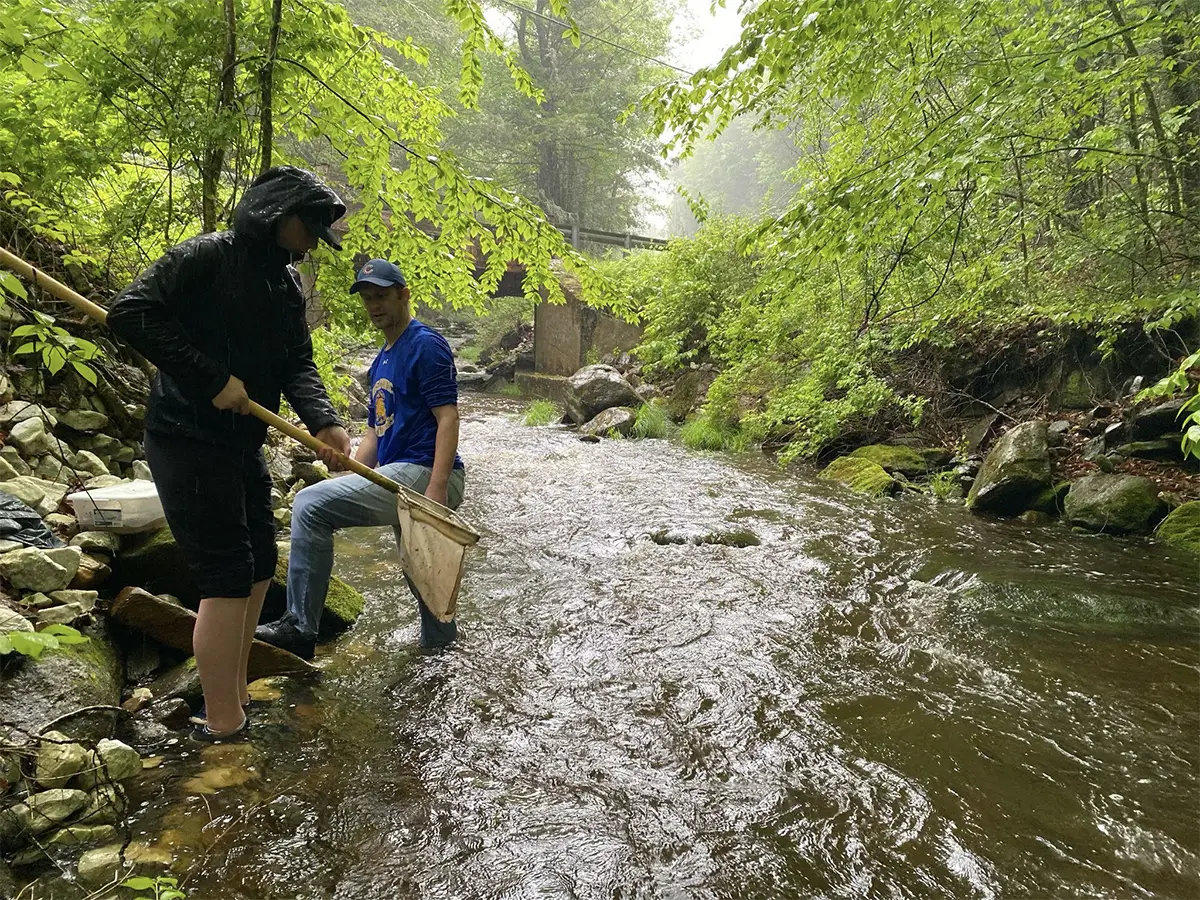
In this hands-on field adventure, students explore Great Mountain Forest’s rich habitats to uncover the sometimes unnoticed components of complex ecosystems. They’ll spend time slowing down and observing the forest, and get the opportunity to set up and conduct a grid quadrat survey to assess biodiversity in GMF’s. They will identify species, collect and record data, and calculate simple biodiversity indices to interpret as a group. Along the way, students will investigate trophic levels, ecosystem roles, and reflect on the connections between wildlife and human impact. Perfect for curious minds ready to connect science skills with real-world ecosystems, this program blends outdoor exploration, teamwork, and critical thinking—right in the heart of Connecticut’s forests.
Learning Intentions:
By the end of the session, students will be able to:
Through hands-on data collection and data analysis, students explore how living organisms interact with their environment and how biodiversity is an important component of a healthy forest.
By the end of this experience, students will:
- Identify signs of wildlife through tracks, scat, calls, nests, and markings.
Understand local wildlife habitats and adaptations.
Practice field science techniques: observation, journaling, and data collection.
Complete a biodiversity grid survey.
Reflect on the role of biodiversity and human impact.