Unearthing the Past: A Geological Quest in Great Mountain Forest
Most Prevalent Themes:
HS-ESS2-1 – Earth’s Materials and Systems
Develop a model to illustrate how Earth’s internal and surface processes operate at different spatial and temporal scales to form continental and ocean-floor features.
HS-ESS2-5 – Weathering and Surface Processes
Plan and conduct an investigation of the properties of water and its effects on Earth materials and surface processes.
HS-ESS2-7 – Earth’s Systems and the Biosphere
Construct an argument based on evidence about the simultaneous coevolution of Earth’s systems and life on Earth.
HS-ESS3-1 – Natural Resources and Human Activity
Construct an explanation based on evidence for how the availability of natural resources, occurrence of natural hazards, and changes in climate have influenced human activity.
HS-ESS3-4 – Reducing Human Impacts
Evaluate or refine a technological solution that reduces impacts of human activities on natural systems.
Audience:
High School
Duration:
2 ½ hours - 5 hours
Description
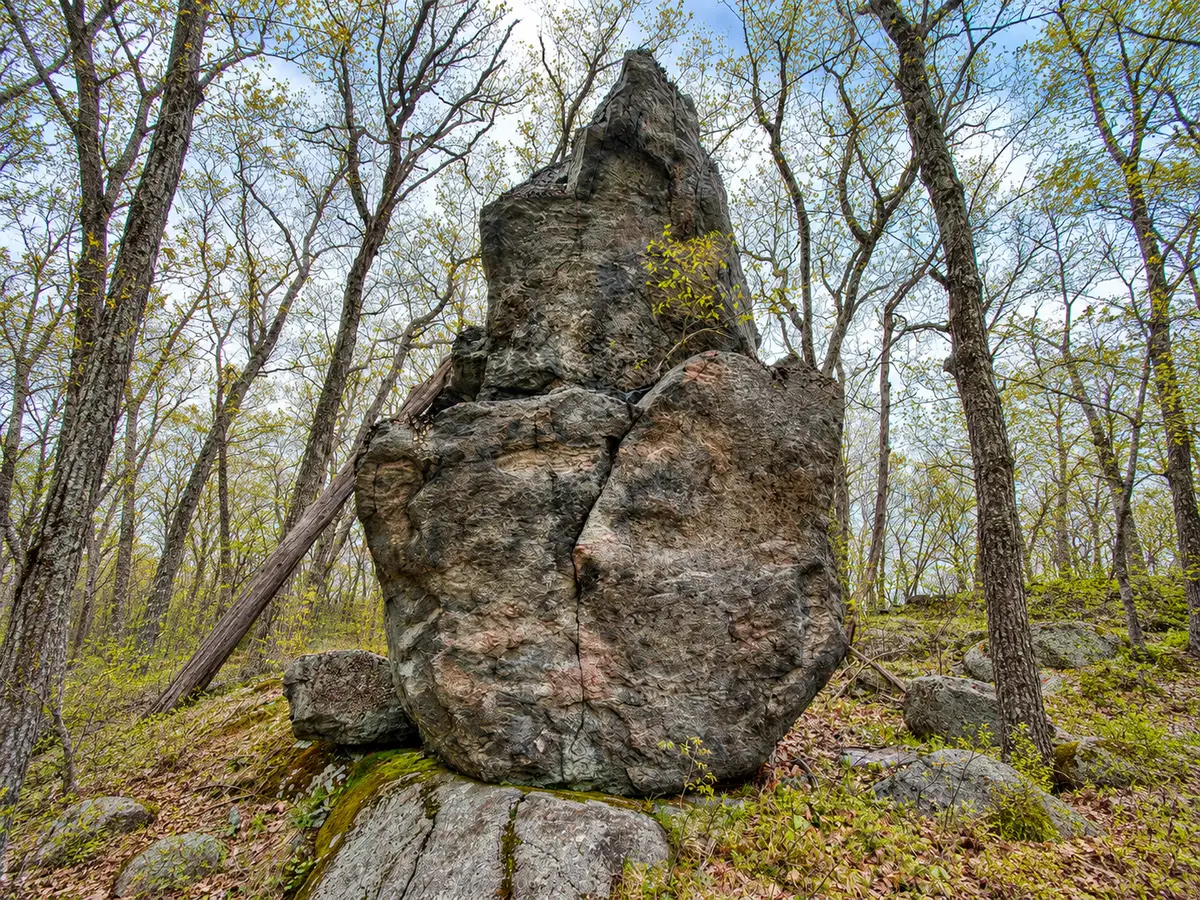
This hands-on, interactive field trip will take high school students through Great Mountain Forest (GMF) in Northwest Connecticut to investigate the geological processes that shaped the landscape. Students will explore glacial features like bedrock and glacial erratics, roche moutonnée, a charcoal mound and a kettle pond. They will use scientific tools like compasses, magnifying lenses, model formation of a kettle pond, study soil composition, and analyze how different rock types and minerals affect local ecosystems. Engaging, tactile activities—including edible rock demonstrations—will help students understand the rock cycle, plate tectonics, and how glaciers altered the region.The geology module doesn’t just teach students about rocks—it asks them to observe how Earth’s past shapes today’s ecosystems, and how human choices leave lasting impacts on soil, forest health, and biodiversity. By emphasizing connections between geology, ecology, and human use, the module cultivates a strong sense of environmental stewardship and conservation ethics.
Learning Intentions:
By the end of the session, students will be able to:
How do past and present geologic processes- glaciers, tectonic forces, and soil dynamics, shape Great Mountain Forest’s landscape and, in turn, influence today’s ecosystems, human history and land use, and our stewardship choices?
By the end of the session students will be able to:
- Describe how glaciers and tectonic forces shaped the landscape of Great Mountain Forest.
- Identify and classify different rock types (igneous, metamorphic, sedimentary) using texture and visual clues.
- Explain how kettle ponds and glacial erratics form, using evidence from real-world observations.
- Analyze soil samples to compare texture, pH, and the relationship between soil and local vegetation.
- Make connections between geology and human history by exploring how natural resources like rock and charcoal influenced early industry.
- Practice taking geologic field notes: observation and data recording.
- Successfully employ the CER model of scientific explanation.