The Paths Less Traveled: Trails, Views, and Hidden Gems
September 2, 2026
Alec Linden
Hike, Bike, and Ski through Great Mountain Forest with a Brief Trail Guide
The swamp red maples have been tipped with color for a few weeks now, and the evenings are coming on faster than our summer-lulled minds want to believe. Fall is close at hand at Great Mountain Forest, bringing with it the promise of brisk hikes and bike trips under candy-colored foliage.
While GMF’s 30-plus miles of gravel roads and footpaths shine in all seasons, fall is the preferred time for those in search of cooler temperatures and vibrant views. GMF’s trail system, suitable for hiking, trail running, and cycling on some routes—and in the winter months, cross-country skiing and snowshoeing—has long been a treasured resource for residents of the Northwest Corner and beyond who wish to leave daily concerns in the parking lot and lose themselves in the woods for a few hours.
The Iron Man Trail and Stone Man Mountain
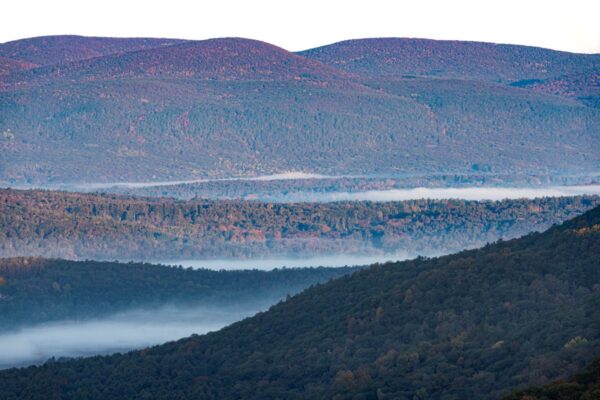
Stone Man Mountain is popular with hikers in autumn for sweeping foliage views, such as this one captured on October 12, 2022. The exposed summit is accessed from GMF’s Iron Trail via a 2.8 mile out-and-back hike. Photo: Tom Blagden.
The Iron Trail to Stone Man Mountain peak leads to an expansive view over the rolling peaks of Canaan Mountain and beyond. This is a rarity among the region’s mostly forested summits.
Though about half of the hike is on state-owned land, it is accessed from GMF’s Iron Trail entrance on Canaan Mountain Road just south of the intersection with Steep Road/Wangum Road. The roughly 2.8 mile out-and-back trail is of easy to moderate difficulty and takes between one and two hours.
“It’s challenging, but it’s a beautiful trail,” said trail runner and GMF Trustee John Nathanson. “The view from the top is the best.”
Nathanson has been running it since his family first visited the area in 2020. “The Iron Trail… has a lot of significance to me,” he said. “It was my introduction to Norfolk, my introduction to Mountain Road, and my introduction to the wildlife in the area.”
Nathanson still runs the trail regularly, and says it’s not only the sentimental value that keeps him coming back, but the feeling of the landscape’s history underfoot.
“It’s just interesting to think about the fact that you’re running through a forest that at some point ceased to exist,” Nathanson said. Once cut bare and stripped of its ecological value for charcoal and iron production, the now vibrant forest ecosystem is a result of GMF’s mission to create resilient and biodiverse community forests.
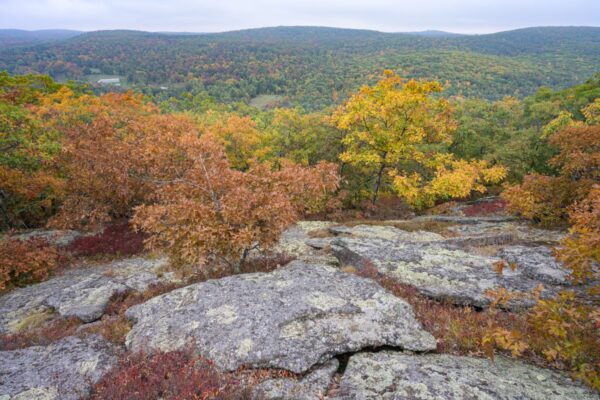
There are several rocky outcroppings along the trail to the summit of Stone Man Mountain offering views of the surrounding rolling hills, though hikers are advised to tread carefully as these stones host lichen populations that have taken decades to grow. Photo: Tom Blagden.
Gate to Gate
GMF’s classic gravel road trip runs from Camp Road at the East Gate in Norfolk through Chattleton Road and the West Gate in Falls Village. Cyclists can incorporate the 3.2 mile stretch into a larger loop connecting Canaan Mountain, Mountain, Westside, and Windrow roads to GMF’s Camp and Chattleton forest roads. The popular ride doubles as the route for the annual Tour de Forest gravel ride, held this year on October 17th.
The gate to gate route is commonly groomed for cross-country ski tracks in winter by Star Childs, a GMF founding member, trustee and forester. Some say that Great Mountain Forest has the best cross country skiing in Connecticut.
In the snowless months, the roads provide a pristine forest byway that passes some of GMF’s most popular sights, such as the charcoal hearth exhibit, several examples of old mill sites, experimental stands of conifers from around the globe hemming Chattleton Road and a lookout onto Old Man McMullen Pond.
In peak foliage, visitors may be lucky enough to see the pond scene close to how it appears in painter George Brown’s late-1950s “Coolwater Stag,” a pristine example of mid-20th century sporting art.
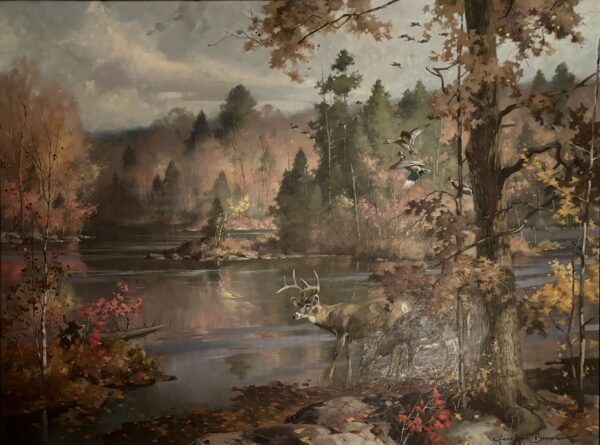
Renowned sporting artist George Brown considered “Coolwater Stag,” depicting an autumn scene at Old Man McMullen Pond, then called Great Mountain Pond, to be among his finest technical achievements. The painting was commissioned in the late 1950s by former GMF owner Edward “Ted” Childs.
GMF Trustee Jeremy Koch said a popular route is a round trip to the pond overlook from either side. “That’s just such a fantastic destination because the walk is the perfect distance from either gate,” he said.
Plus, “you don’t have to worry about ticks as much because you’re walking on gravel,” he added.
For those who want to add a little extra adventure to their stroll, the High Pocket Swamp Trail splits off from Chattleton Road about a half mile from the West Gate and reconnects at Potters Corners—an old farmstead.
Closer to the East Gate, hikers can enjoy a short loop on the Crossover Trail which connects Camp Road and the Crissey Trail and includes a scenic viewpoint over Crissey Pond.
Koch, also a cyclist, likes to add a bit more exertion to the Tour de Forest Route. “If I’m feeling really energetic,” he said, he coasts down Canaan Mountain Road to the valley below and climbs back up—about 650 feet of vertical gain in just under two miles— “just to prove that I can.”
In winter, David Beers, a state service forester with the Department of Energy and Environmental Conservation and the route-setter of the Tour de Forest, said his preferred way to see the forest is a ski loop that starts steep on the Crissey Trail from the East Gate and ends easy following Camp Road back to the parking the lot.
When the snowpack is good, Beers’s favorite spur off the main loop is the Crissey Ridge Trail up to the peak of Norfolk—“It’s slightly higher than Haystack Mountain and has a nice view in the winter.”
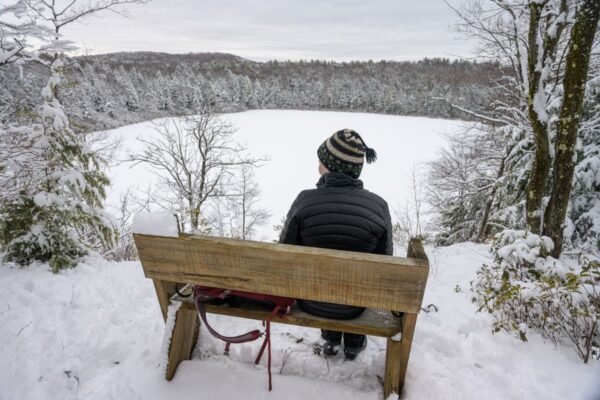
The Crissey Pond Overlook, accessed via the Crossover Trail, offers a welcome rest to skiers and snowshoers looking for a more adventurous outing than the wide and often groomed Camp Road. Photo: Tom Blagden
The Southern Wilds and Beyond
For the intrepid, a wilder and harder-to-access tract of forest featuring remote ponds, swamps, cliffs and streams awaits at the southern reaches of GMF’s 6,000-plus acres.
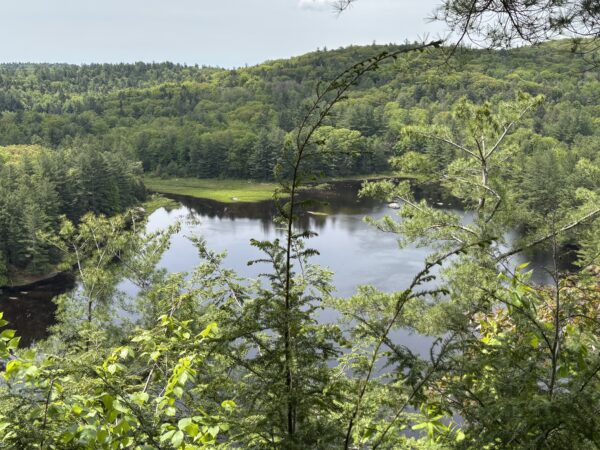
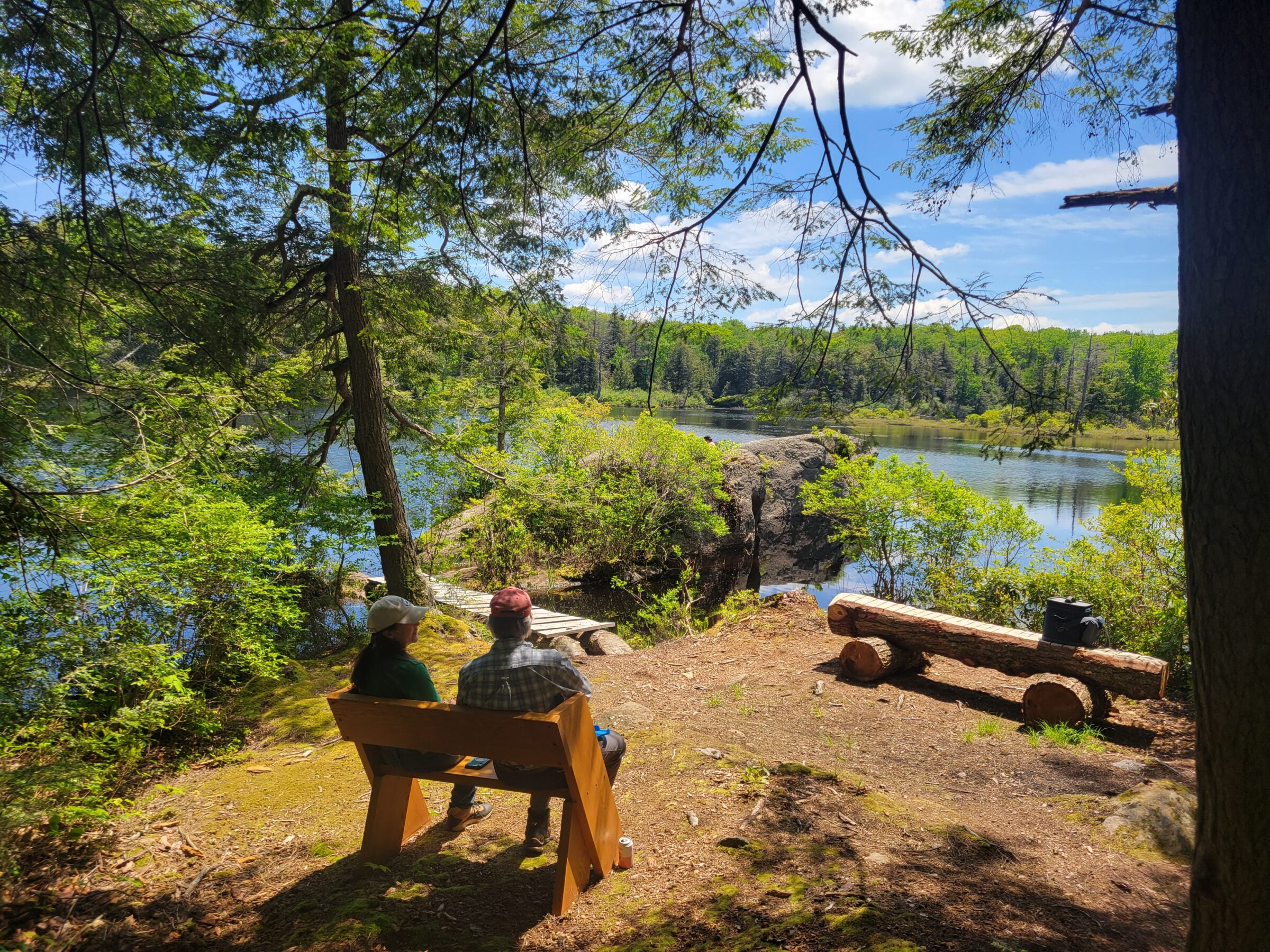
For those willing to hike (or bike) for it, GMF’s remote southern reaches provide a wilderness feel that many describe as more reminiscent of Maine or New Hampshire than Connecticut. Wapato Lookout, pictured above in May 2025, is among the most popular destinations of the area. Photo: Alec Linden
Bob Gilchrest, organizer of the Tour de Forest and an avid user of GMF’s trails, said that the forest “gives you that feeling of being up north”—like his favorite vacation spots in Maine or the Adirondacks—“but it’s kind of in your backyard.”
This wilderness can only be accessed by a long walk or a bike ride down the Number 4 Trail or Chattleton Road (which becomes a trail south of the Yale Camp). Using Chattleton Road requires fording Brown Brook where an old stone bridge has long been washed out, making for what Beers and Fairman both described as an interesting obstacle in some of their more adventurous cross-country ski outings.
Aside from the wilderness feel, the southern region features one of GMF’s most dramatic viewpoints. The Wapato Lookout, accessed via a short side trail that shoots off of the Number 4 Trail, peers out from a clifftop perch over the dark water of Wapato Pond.
“When I sit up there, I really feel like I’m up in Canada,” Gilchrest said, describing the spot as a “pocket that sits up high, cut off from civilization.”
“You look down,” he added, “and you can see the trail of moose in the water through the lily pads.”
A round trip from either gate—which can be done on foot or by bike—to the lookout approaches ten miles, so Koch and Gilchrest advised trekkers to plan for time and supplies accordingly.
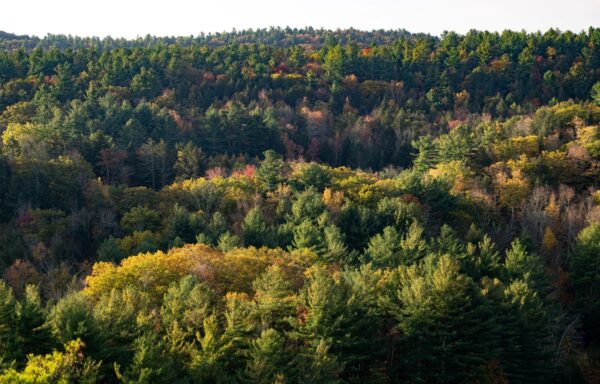
Wapato Pond and the dense forest that surrounds it is a northwoods oasis tucked into GMF’s distant southern wilds. Photo: Tom Blagden
For those who have spent their whole lives in the forest, like Forester Emeritus Jody Bronson and Property Manager Russell Russ, their favorite places to pass the time may not be on the map—and they’re not upset about it.
“Some of my favorite spots are random little off trail spots that would be impossible to describe,” said Russ.
“We are happy taking the path less traveled,” said Bronson. As for his own spots, “It depends on the season, if I saw anything unique or if it is just a good place to be alone and sit on a stump.”
“The one honest answer I can give,” he said, “is that my favorite places are where no one else goes!”
About the Author
Alec Linden is a news reporter, environmental storyteller, and researcher based out of Norfolk. After completing a master’s degree in environmental governance and policy at the University of Oxford in 2023, Alec moved back to the Northeastern US to begin a career caring and advocating for the hills, ravines, and rivers that he cherished growing up in downstate New York. Alec relocated to the Northwest Corner in the summer of 2024 to become a reporter with the Lakeville Journal, and now helms newsletter and copy editing duties for GMF. During his down time, Alec spends as much time as possible on skis, and in the warmer months pokes around the woods of the Berkshires and Taconics to search for new rock climbing routes.