
PREVIOUS WEATHER REPORTS
Misunderstood Asters: A conversation with Horticulturist Deb Munson
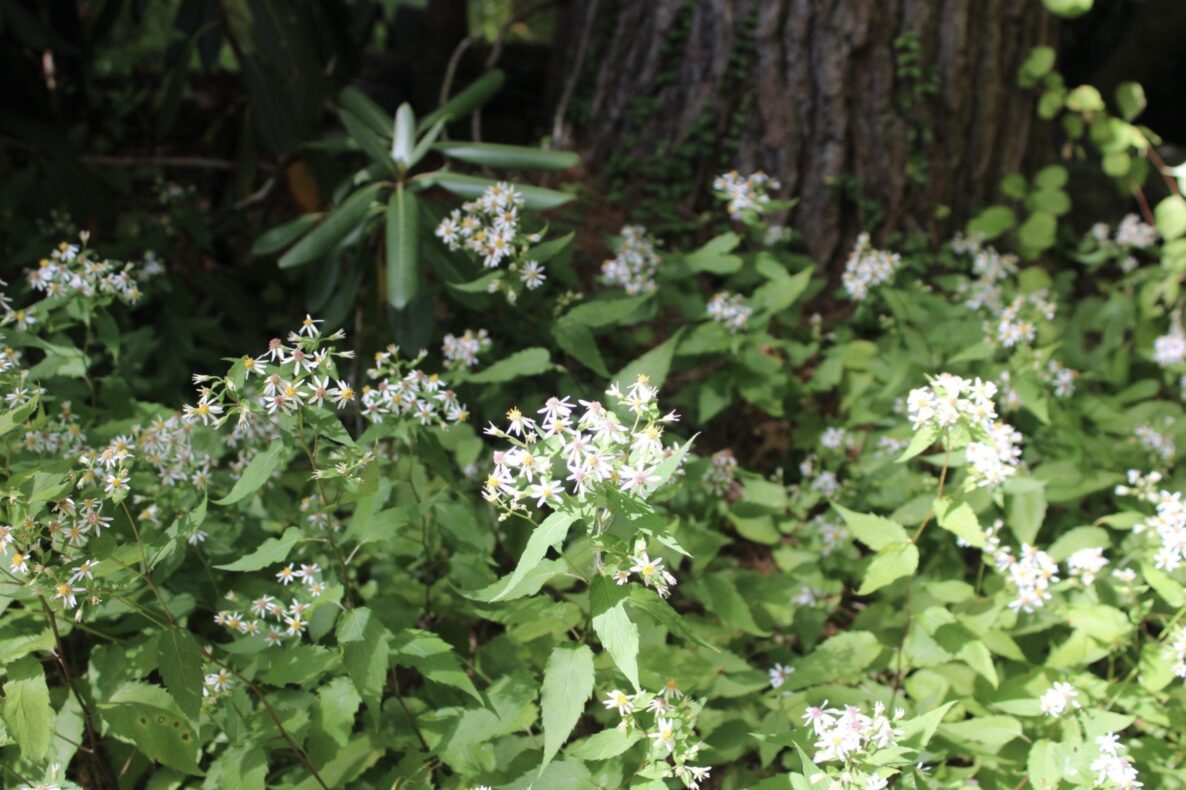
August has come and gone at last, the kids are back at school, and the forest floor is blanketed in white. While recent weather patterns have made anything seem possible, this is not the result of a historic Labor Day blizzard, but rather the on-schedule flowering of Eurybia divaricata, or, as it is commonly known, the white wood aster.
Expert horticulturalist, native plants advocate, and close GMF neighbor Deborah (Deb) Munson advises homeowners who see that snowy carpet abutting their yards at the forest’s edge to welcome the asters. They bring a host of late-season benefits to the garden and broader ecosystem alike.
“I think asters are very misunderstood,” said Deb in a recent interview, “which is unfortunate because they’re one of the greatest plants for pollinators and caterpillars,” second only in caterpillar hosting to fellow autumn-flowering goldenrod. The white wood aster is among the first of the New World asters to bloom in late August, and it has already brightened the dry and shady corners of Northwest Connecticut’s yards and woodlands.
If you’ve glanced out from your kitchen window in the past week, taken a recent stroll on one of GMF’s trails, or paid a long-weekend visit to your garden, chances are you’ve seen these late bloomers thriving under dappled sunlight, their individual stems mingling with their neighbors to create a veritable stronghold of delicate white blossoms.
The white wood aster’s ability to cover ground so extensively can alarm home gardeners and yard keepers who may find them to be “messy and weedy,” Deb said, but she assured that they provide a wealth of services.
That ability to provide a herbaceous groundcover is actually one of the aster’s greatest assets, she explained. “I believe in plants sort of being their own mulch,” Deb said, and the white wood aster can provide a perfect “carpet” in shadier portions of one’s garden or at the fringe where the yard meets the forest. She explained they flourish in the “ecotone” area at the woodland edge, or under a canopy that provides dappled shade.
Letting the garden, yard, or woodland mulch itself with understory plants and autumn leaf fall keeps the ecosystem contained, protecting against diseases or invasive species that could be brought in by an external material. Plus, it’s cost effective: “you pay people to take your debris away, and then you pay them to bring in mulch.” Deb suggested it’s cheaper, simpler, and safer to let the plants do the heavy lifting for you.
Plus, they’re self-sufficient. As they self-sow and are generally hardy, they require little maintenance. In Deb’s words: “They’re pretty carefree.”
Deb pointed out that like many other native fall-blooming wildflowers, they are drought-tolerant, unlike lots of non-native species that are sold at garden centers: “Native plants are adapted to our region, and they have more resiliency… I feel like it’s pretty dry right now, but it doesn’t seem like the asters are skipping a beat.” As erratic weather patterns, including droughts, persist, species that are able to withstand dry weather will continue to provide vital ecosystem functions and also, in the case of garden and yard populations, save water for homeowners.
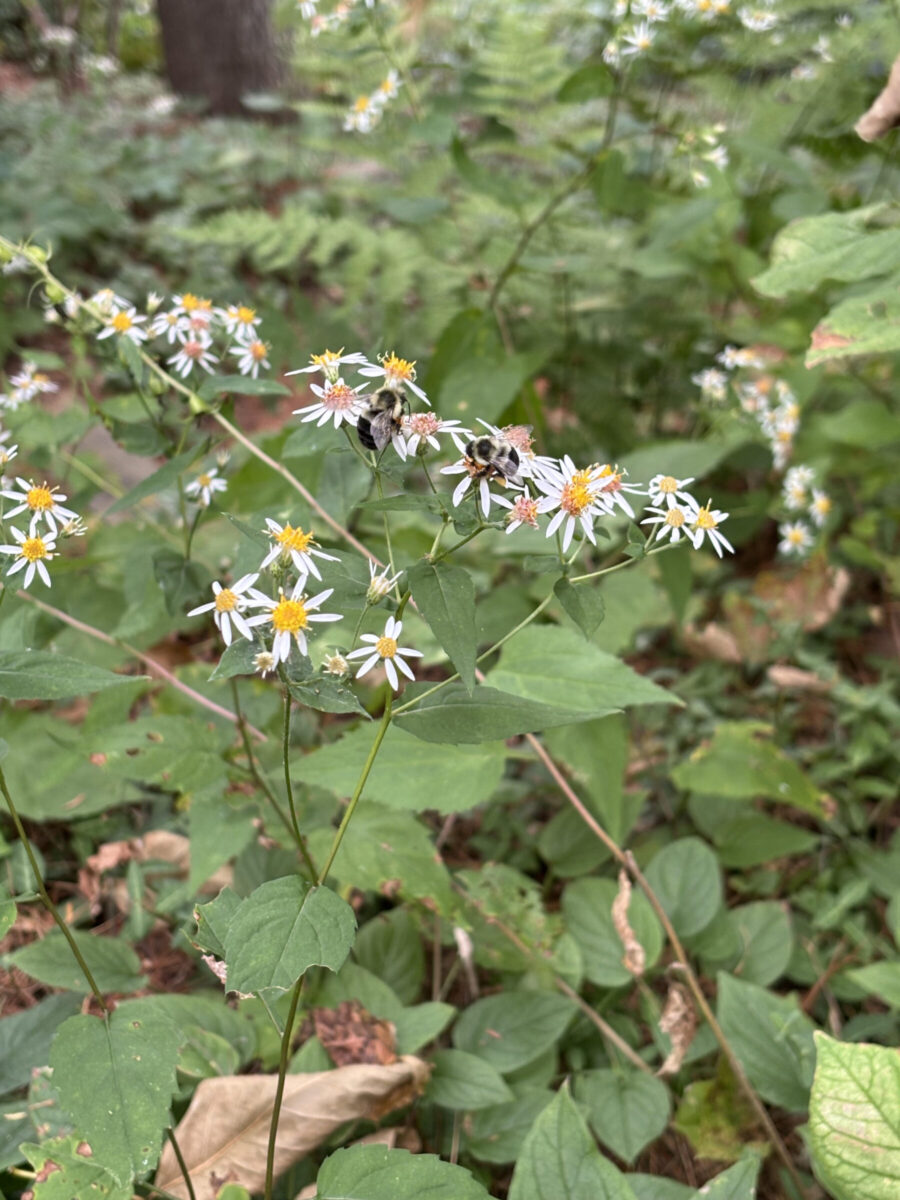
Photo by Alec Linden
And finally, aesthetics matter – as Deb put it, “they’re beautiful.” Since they are plants that flower in autumn, their comparatively humble springtime appearance of green, serrated foliage may entice many gardeners to pull them prematurely, unaware of the decorative potential in just a few months when the most glamorous spring ephemerals have long since shed their petals. Their good looks serve an ecological purpose too, bringing in bees, butterflies, and other late-season pollinators whose options for a meal are dwindling.
“If you’re not too tidy and antiseptic about your woodland edges, you could have an amazing display of asters and goldenrod,” Deb said, among other misunderstood yard-dwellers such as white snakeroot (Ageratina altissima). “I look out on my woodland edge, right off my porch, and I’m looking at goldenrod and aster divaricata (Eurybia divaricata), the white wood aster, and there’s Symphyotrichum cordifolium there.”
Deb advised the curious to keep their eyes peeled for a number of other fall flowering perennials just starting to show their colors: the deep purple New England Aster (Symphyotrichum novae-angliae), the flat-topped aster (Doellingeria umbellata), and the smooth aster (Symphyotrichum laeve), in addition to many others.
Deb said that she feels American landscaping aesthetics have erred too far in the direction of the sterile, and that she encourages homeowners and land managers in the Northwest Corner to embrace a “wilder” sensibility in their gardens and properties. Not only does welcoming fall wildflowers bring a jolt of color to one’s yard as the days ruthlessly shorten, but it establishes a communion between the home and the broader ecosystem that has largely eroded in much of modern Western life.
“I think learning your land is an important thing to do,” Deb said, and she has the resources for those looking to get started. For field guides, she recommends Lawrence Newcomb’s Wildflower Guide and Ted Elliman & New England Wild Flower Society’s Wildflowers of new England. She also suggests two introductory guides on local native plants: Native Plants for New England Gardens by Mark Richardson and Dan Jaffe and The Northeast Native Plant Primer by Uli Lorimer.
For those looking to chat directly to expert gardeners or start preparing for their own native plant garden, Deb has a list of local nurseries specializing in wild plants to check out: Lindera in Falls Village, the Native Plant Trust’s nursery Nasami Farm in Whately, Massachusetts, Earth Tones Native Plants Nursery in Southbury, Connecticut, and Helia Native Nursery in West Stockbridge, Massachusetts.

Healthy forests, healthy people – and healthy ticks?
The hills are alive in Northwest Connecticut, but it’s not all birdsong and snowdrops: the blacklegged tick has shaken off its winter torpor, and now crawls in droves through the understory, spreading disease and myths in equal measure.
Dr. Scott Williams, Chief Scientist and Head of the Department of Environmental Science and Forestry at the Connecticut Agricultural Experiment Station (CAES), a state organization spearheading research on tick-borne diseases, dismissed two commonly held misconceptions about the tiny, dangerous insect: “They don’t fly. They don’t drop out of trees.” Williams advised that rather than worry about the branches overhead, think low and keep your ankles covered. “They crawl up from the ground for the most part, or [from] a few inches off the ground.”
Demystifying tick behavior and pathogen transmission yields surprising insights into how to manage disease levels in our region: in a healthy forest, more ticks might actually equal less disease, Williams explained.
Debunking Myths
Blacklegged ticks (also widely known as deer ticks) and Lyme disease are commonly misunderstood components of the New England forest, starting with the illness’ origin story. Conspiracy theories abound speculating where it began, with an especially persistent and oft-debunked claim that it leaked from a government research facility on Plumb Island.
But reputable research has shown that the disease has been circulating in the northern hemisphere for millennia. One of the bacterium responsible for causing Lyme disease, Borrelia burgdorferi, was detected in Ötzi the Iceman, a 5,000 year-old mummy found in the Eastern Alps in the 1990s. A study conducted by the Yale School of Public Health in 2017 traced B. burgdorferi back to North American forests of 60,000 years ago, meaning the bacterium was resident in our woods long before the earliest human inhabitants arrived.
Closer to home
Deer ticks and Lyme disease are as Connecticut as New Haven pizza, with one of our picturesque coastal towns lending its name to the ailment after a cluster of cases there in the 1970s lead to its identification as a unique condition. The state remains positioned in the very heart of tick country, and the Icebox of Connecticut, which previously benefitted from the protection of its harsh winters, is losing its defenses as the cold season continues to warm up.
“We’re not trying to scare people from being outside, we’re trying to educate people on when the various stages [of ticks] are active – what’s tick habitat and what’s not,” Williams said. For instance, a field of high grass, commonly regarded as a tick haven, is actually largely inhospitable to the bugs, as they desiccate quickly in a dry environment. “That’s kind of a desert for ticks,” Williams explained.
The most “ticky” habitat “is really that edge where your lawn meets the forest,” he said, and when it comes to getting bitten, it’s often a matter of timing.
When to watch out
While adult deer ticks are active now, Williams explained that May, June, and early July are the months when most infections occur since that’s when both humans and the nymphal stage of deer ticks are likely to be active outdoors. Although the adult ticks wandering the undergrowth and brush now can certainly transmit the pathogen, it’s the nymphs that are “the really problematic guys,” Williams said, in part because they are small and hard to detect, and also because in spring, “human activity and tick activity in the nymphal stages coincide.”

A white-tailed deer in the forest. Photo: Mike Zarfos
Host competency and the dilution hypothesis
Active ticks, active humans, and an abundance of both yield higher bite rates, thus contributing to more infections. However, Williams explained that the species present in an ecosystem can have significant impacts on the spread of tick-borne pathogens to humans.
A surplus of white-tailed deer upon the landscape, for example, is often thought to correlate to more tick-borne illness. While a large deer population will often support a high concentration of ticks, deer are a “dead-end host” for the bacterium, meaning they don’t transfer the pathogen back into the ticks.
Mice, however, are “competent hosts.” The concept of host competency is the ability of a reservoir host species (animals that carry and spread disease-causing pathogens) to infect the ticks with pathogens, which small rodents are highly adept at whereas larger animals are less so. When deer are plentiful on a landscape, “you typically have high tick abundances with lower infections with the various pathogens,” Williams said.
The reservoir host species of B. burgdorferi that actually infects the ticks with the pathogen are small rodents, especially the white-footed mouse which is common to the Litchfield Hills. When fewer deer, and other medium sized mammals, are available, Williams explained that the ticks will then be forced to feed primarily on mice, which will support a smaller population of ticks within which the pathogen is much more concentrated.

CAES team conducts Lyme disease research with mice in Woodbury. Photo: Mike Zarfos
Healthy forests, healthy people
In a healthy ecosystem with a spectrum of animal species, ticks aren’t forced to rely on these highly competent hosts for a blood meal. Williams explained that this scenario, in a species-diverse forest, describes what disease ecologists call the dilution hypothesis: “with a diversity of animals, you’re going to see less infection in the ticks because they have so many options to feed.”
The loss of forest diversity can have the opposite effect, Williams said, which is happening across the Northeast due to development and the incursion of invasive species. Several years ago, Williams conducted research on the correlation of Japanese barberry, an invasive shrub, with tick populations; some of the work was done at Great Mountain Forest with the help of GMF forester Jody Bronson. The study found that the dense tangle of undergrowth created by the proliferation of the shrub caused a humid microclimate that not only provided great tick habitat, but enabled them to remain active throughout the day.
Normally, the moisture-dependent ticks might be inactive under a pile of leaves during the heat of the day, Williams said. But the microclimate created by the “monoculture” of invasive brush growth means ticks continue looking for a host “pretty much 24 hours a day.” He clarified that this was not specific to Japanese barberry, but any plant that grows in a monoculture tangle, “which is pretty much what invasives do in our neck of the woods.”
“What we’re trying to push is a healthy, diverse forest, and that’s very applicable to Great Mountain Forest,” Williams said. The goal, he continued, is responsible management: “If you have a healthy, diverse, well-managed forest, you’re going to have a diverse array of wildlife, and as a result you’re going to have a healthier tick population with lower pathogen infection. That’s kind of the bottom line.”