
PREVIOUS WEATHER REPORTS
Making Space: Encouraging Bat Habitat at Great Mountain Forest
Often maligned and feared, bats are actually helpful to humans and serve important ecological functions. Insect-eating bats make summer life more tolerable for people by consuming mosquitoes, black flies, and other nuisance insects and agricultural pests. Fruit-eating bats assist in the agricultural process by dispersing seeds, while other bats pollinate plants. Even without these ecological services, bats need support as the threat of disease and habitat loss caused by forest conversion grows.
In the past few decades, bat populations in the eastern United States have been devastated by an invasive fungus, Pseudogymnoascus destructans. Commonly known as white-nose syndrome for the distinctive white growth it leaves on their muzzles, this disease infects bats during hibernation, damaging their wings and disrupting critical physiological functions. Since its discovery in New York in 2006, populations of little brown bats, northern long-eared bats, and tri-colored bats have declined by more than 90%.
To support bat population growth and resiliency, Great Mountain Forest is working with the Natural Resources Conservation Service (NRCS)—an agency of the United States Department of Agriculture—to help create and promote bat habitat on the property.
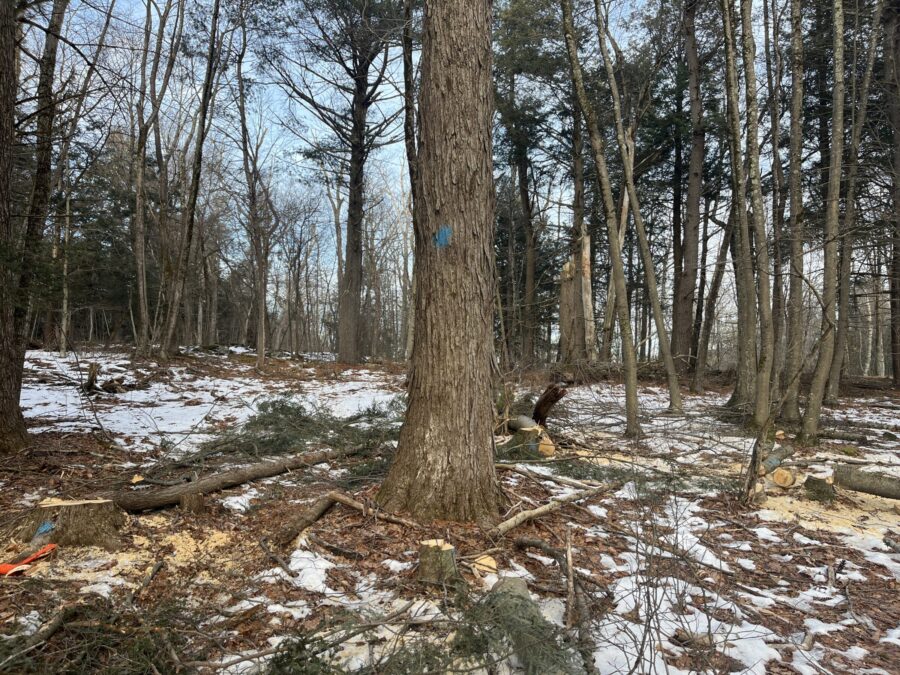
During the summer, bats rely on roost trees, to raise their young, or “pups.” Ideal roost trees are characterized as large and having peeling or shaggy bark; however, bats also use standing dead trees with cavities to shelter their pups. In the fall, GMF staff began collaborating with NRCS staff and biologists to identify prime roost trees along GMF’s Iron Trail, marking them with blue dots.
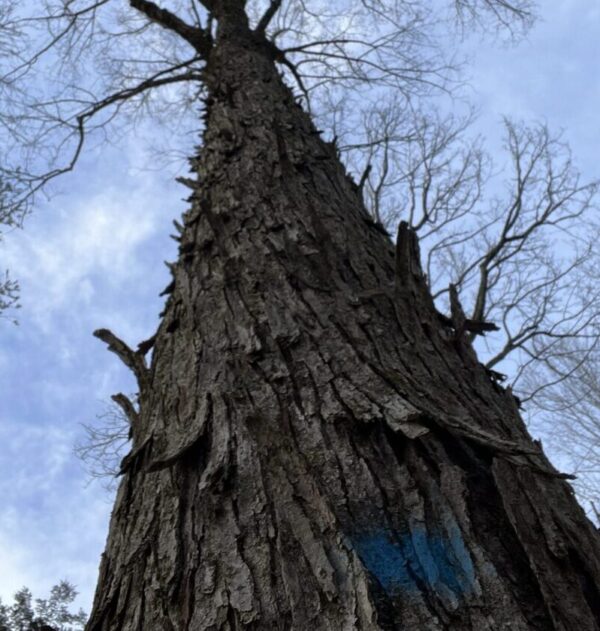
With its shaggy bark, this ideal roosting tree has been identified according to NRCS guidance and GMF preliminary research. Photo by Kate Regan-Loomis.
This winter, to support these roost trees and prevent disruption to the bats’ roosting cycle, trees within a 15-foot radius of the marked trees were removed. By reducing competition from surrounding trees, the selected roost trees have more room to grow their canopies and access light and nutrients. This allows them to increase in size, develop more exfoliating bark, and remain healthy for longer.
Clearing smaller surrounding trees also allows more sunlight to warm the tree trunks, creating more comfortable roosting conditions for bats. Additionally, this work increases structural diversity in an otherwise relatively homogeneous forest, thereby developing more foraging opportunities for bats.
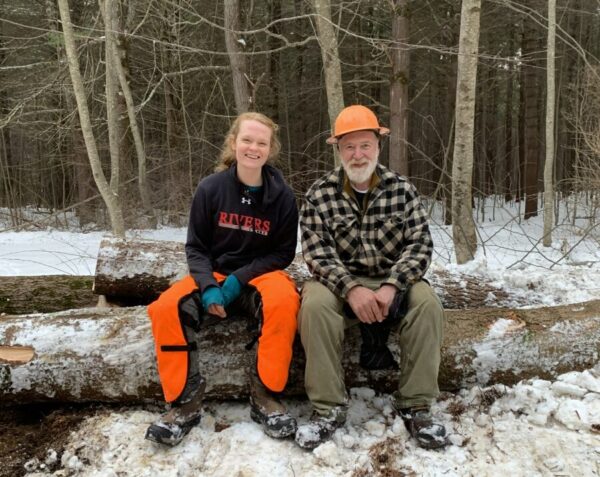
From left to right: Foresters Kate Regan-Loomis and Jody Bronson managing the forest and improving bat habitat. Photo by Kate Regan-Loomis.
The larger trees removed during this process are put to good use by GMF staff. Higher-quality logs are milled and used in current projects and future structures, while lower-quality wood is used for firewood to heat buildings and boil maple sap. Smaller trees and limbs are left in the forest, where they provide temporary shelter for wildlife and return nutrients to the soil as they decompose.
So while certain areas of GMF might look a little less tidy than usual, that apparent mess is creating more habitat for an endangered group of species, improving the health of large, old trees, and supporting the use of local wood by an organization dedicated to forest stewardship.
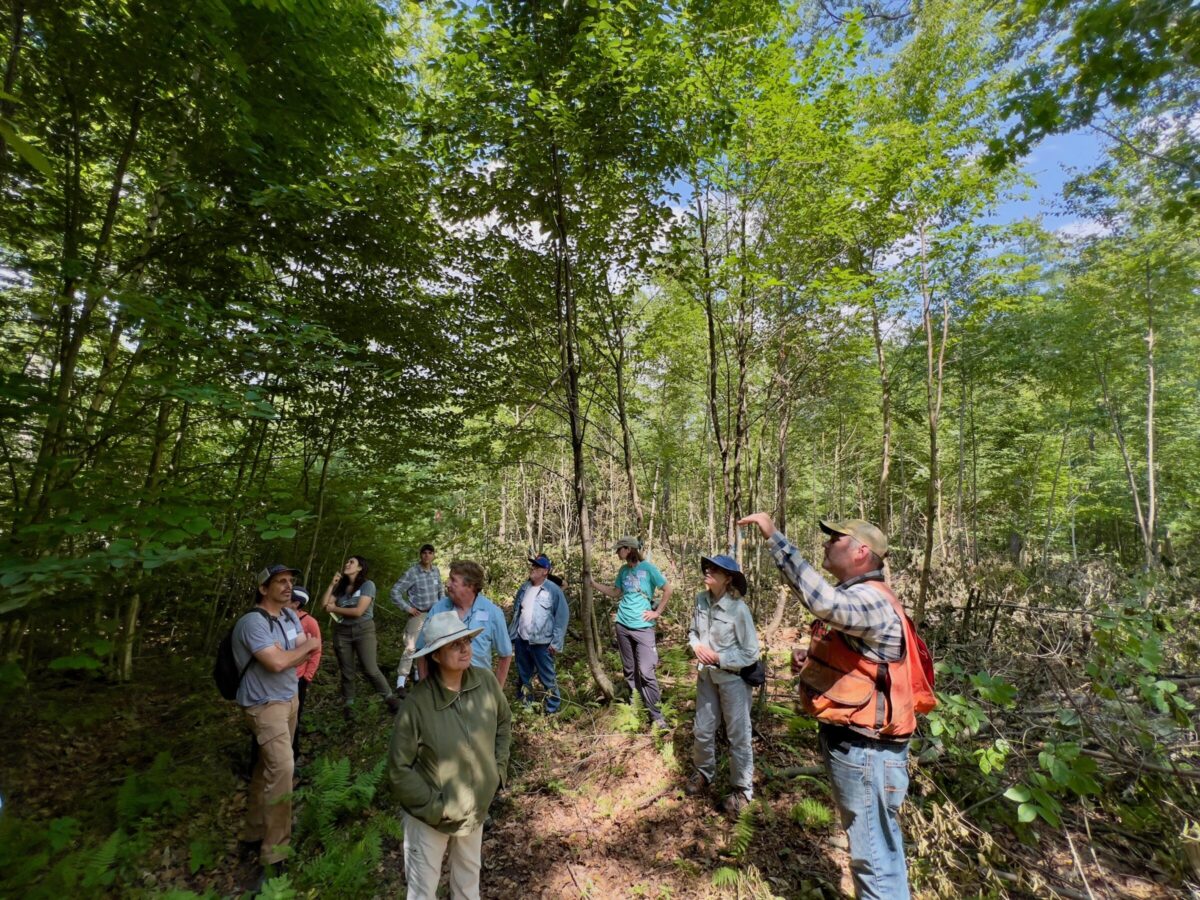
Future Forests in the Making: Climate-Smart Thinning at Great Mountain Forest
As New England experiences increasingly extreme weather, including hotter and wetter summers, keeping forests healthy and resilient to pests and disease is an ongoing challenge. Work has begun implementing Connecticut Land Conservation Council’s (CLCC) Climate Smart Land Stewardship Grant at GMF! Great Mountain Forest recently began a pre-commercial thinning project, which is a forest management practice that involves removing trees from a young, dense stand before they reach a size where they can be commercially harvested.
Managing Competition
In areas at GMF where trees were harvested 20 years ago, young trees have grown back fiercely, racing to become the future forest. Most of these new trees will end up being shaded out underneath their stronger brethren or succumbing to damage or disease. By applying management methods that support a diversity of tree and animal species and provide more resilience to pests and other disturbances, our foresters are controlling that competition to enhance traits we hope to promote.
We start by marking a “pre-commercial thinning,” or PCT, in three stands that are approximately 20 years old. “Thinning” means removing the trees that are competing with those we want to keep strong and healthy. “Pre-commercial” means that we are implementing this treatment when the trees are too small to be sold as wood products, which is where funding directed by CLCC comes in to support this work. We chose trees spaced on average 10 feet from one another, giving them the light they need to grow quickly when they are “released” from competition by this treatment.
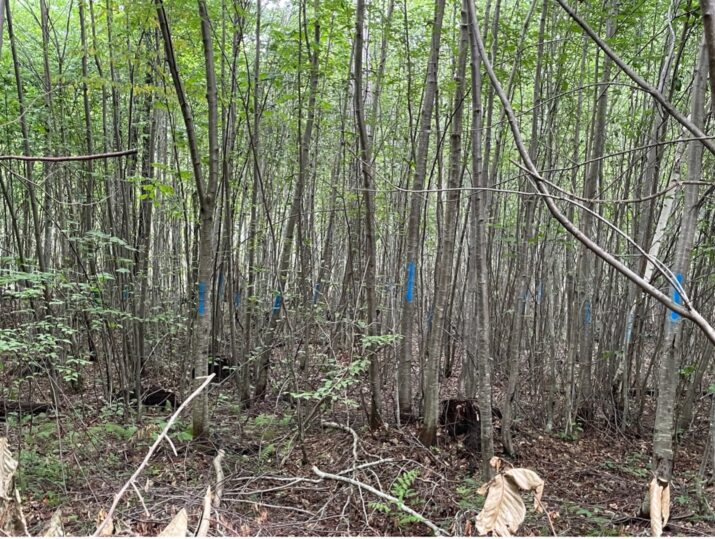
Stand marked before treatment (note very high density of stems).
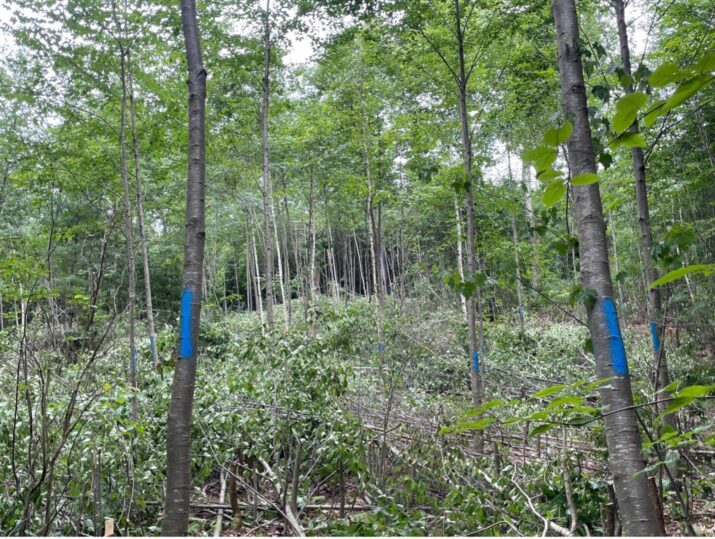
Stand after thinning treatment (only marked individuals remain standing).
Shaping the Future Forest
In selecting which trees to keep, there are a few things we keep in mind. The first is health and form. We choose trees that are going to last: those that aren’t suffering from disease, that have stable trunks and full crowns, and that have no obvious wounds.
Unfortunately, we have to remove most of the beech in these young stands. American Beech, or Fagus Grandifolia, is currently under a dual attack from beech leaf disease and beech bark disease. Nearly all of the beech in our forest are succumbing to one or both of these diseases. While we save any individuals that seem to display resistance, we know we cannot count on the majority of them as our future canopy.
The other factor we consider is species composition. Presently, these stands are almost entirely beech and black birch (Betula lenta). We therefore want to promote the other species within the stand to make it as diverse as we can. Tulip poplar, white, yellow and grey birch, ash, cottonwood, and oak are growing in these stands too, and we select for them to prevent the stands from becoming near-monocultures of black birch. While there’s nothing wrong with black birch, aiming for as much diversity as possible helps to increase stand resilience and support additional non-tree species in the forest. We’re also making sure to leave species like serviceberry and highbush blueberry. While these species won’t be our canopy trees, the fruits they produce are important food sources for birds.
Looking below the canopy, the effects of this treatment will also be seen on the forest floor. In this stage of competition, the amount of light that can reach the ground is quite limited. The trees are so densely packed that nearly nothing can grow beneath them. But by thinning the trees, we are allowing that light back in.
Forester Emeritus Jody Bronson inspired this project through his implementation of a similar PCT on a smaller scale over many years. What he saw after thinning was an understory full of not only herbaceous plants, but a new cohort of tree seedlings, particularly oaks, a group of species that has wonderful ecological value but can be difficult to regenerate. Now, should an ice storm come through and knock out the canopy trees, that young cohort is waiting in the wings to take off and swiftly become a forest again instead of having to compete for establishment.
Great Mountain Forest’s 2025 summer interns got to mark this treatment, selecting which trees to cut and which to leave. From the first week, they started thinking like foresters, making decisions that they would not see the full effects of for decades.
We are so grateful to CLCC for funding this work, which has provided young foresters with unique learning opportunities, added resilience to our forest, and created an excellent demonstration of sustainable forest stewardship.
Funding for this project was paid for by the Climate Smart Farming: Agriculture and Forestry Grant. Funding awarded and administered by the Connecticut Department of Agriculture and the Connecticut Land Conservation Council.