
PREVIOUS WEATHER REPORTS
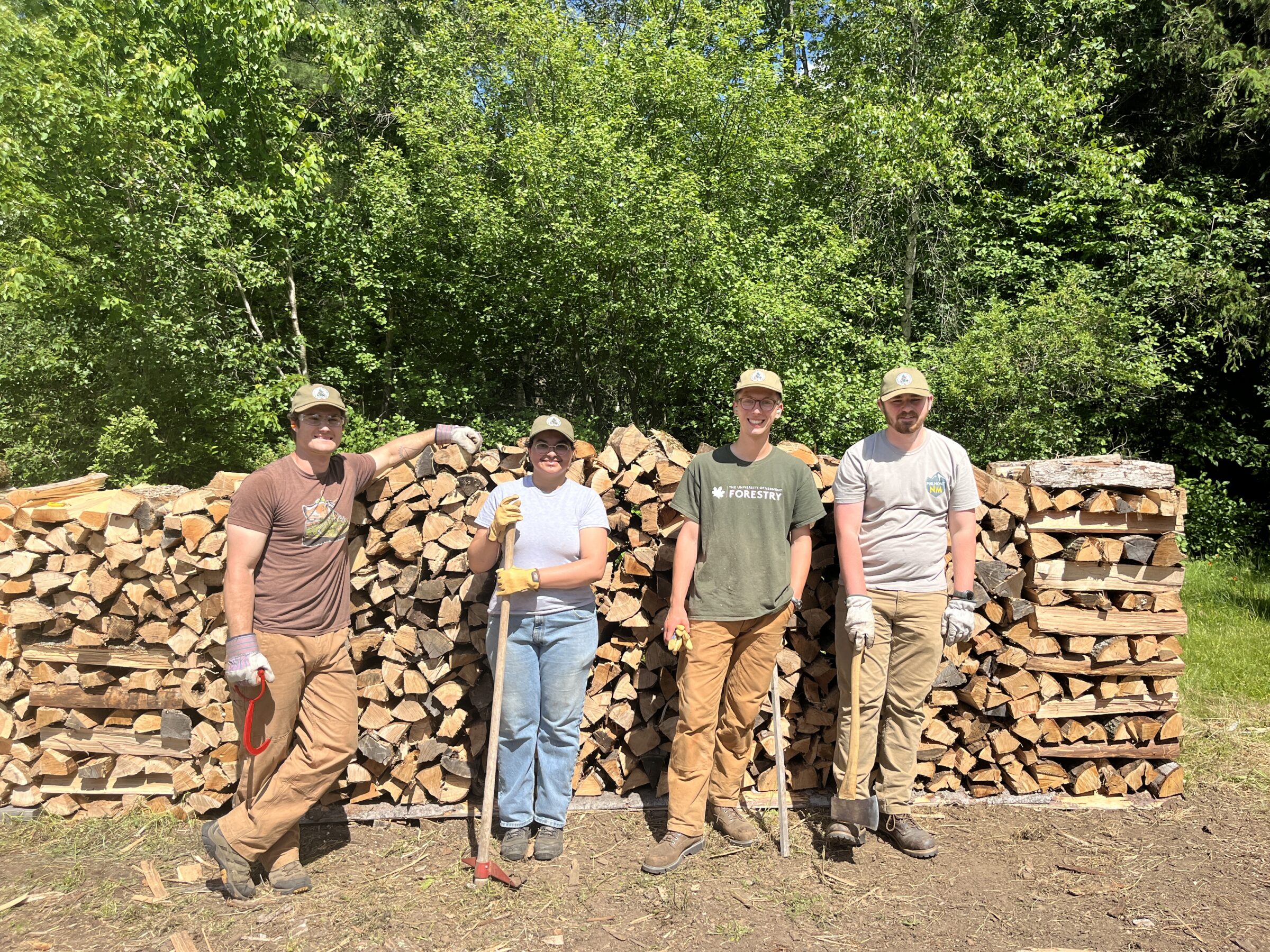
The Next Generation of Land Forest Stewards Take on Great Mountain Forest
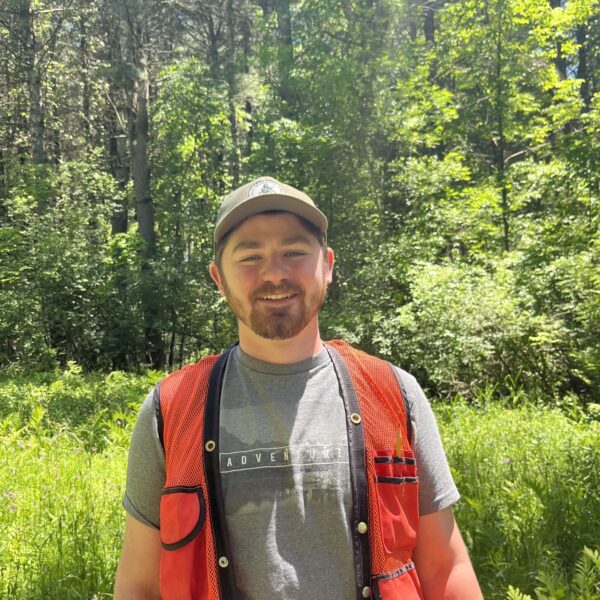
Photo courtesy of Kate Regan-Loomis.
Will Watkins, Forester’s Assistant
My name is Will Watkins. I recently graduated from North Carolina State University in Raleigh with a bachelor’s degree in Forest Management. If you recognize my bio at all, it’s because I was an intern here at GMF last summer, and I loved it so much that I wanted to return. This summer I am filling a position as a forester’s assistant, supervising and working with the interns on most of their projects while also getting to go out and complete some individual tasks. One of the reasons that I wanted to come back to GMF was because of how diverse and large the forest is. Even though I was here an entire summer, I only touched the surface of what I could experience at GMF. So, I wanted to come back and discover all I missed and continue some of the work I ran out of time to finish.
In only the first week of being back, we hit the ground running, setting up trail cameras around the forest to monitor wildlife. We have also begun to take inventory of and mark out an old stand of white pine for a thinning. We are thinning to give more space to the best trees in the stand so that they can add more growth around the stem and to allow more light to reach the forest floor. Methods to choose which trees to keep standing and which to take out involve looking at how the spacing of each tree impacts the trees around it as well as the growth form of the trees.
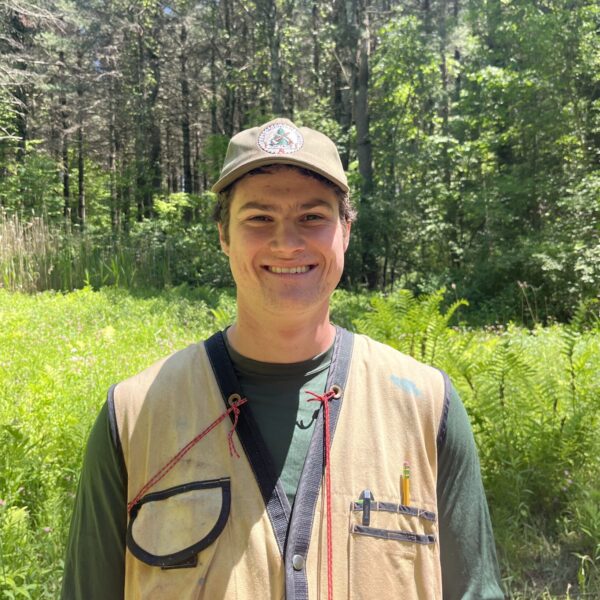
Photo courtesy of Kate Regan-Loomis.
Finn Harris, Intern
My name is Finn Harris, and I am a rising senior at the University of Tennessee Knoxville. There are many aspects of my life that have drawn me to pursue a life in natural resources, but simply put, I have been an avid outdoorsman my entire life and absolutely love being in natural spaces. I often catch myself daydreaming about playing in the woods or in a stream when I’m stuck indoors for too long, so I decided to make my career outdoors.
Throughout my hunt for a summer job, I had been monitoring available positions in New England, as I am eager to learn about a different region of the country and how forestry is done outside of the southeast. Luckily, I was able to land a position on the Great Mountain Forest summer crew!
GMF’s work on forest resilience, supporting biodiversity, protection of watershed resources, and commitment to education and research is important, impactful, and represents ideals that I value deeply. I was further drawn to this position because of GMF’s commitment to exposing interns to lots of different projects and learning opportunities. Considering my future goals are rooted in establishing productive forests to foster ecosystem services and functions, I truly believe my time at GMF will be very meaningful and memorable.
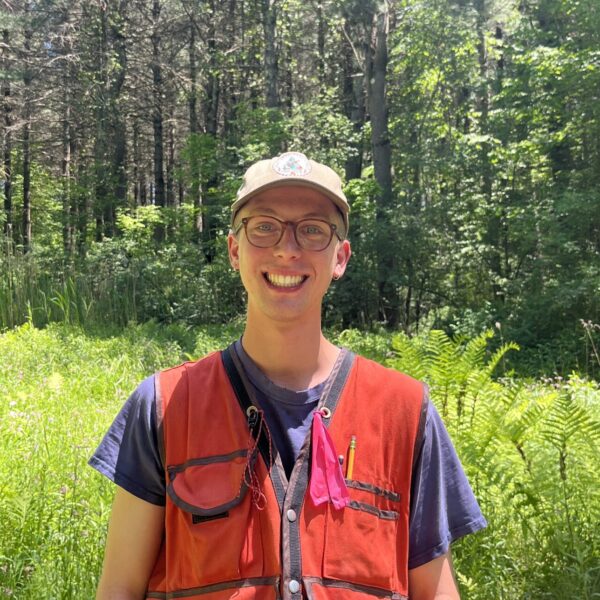
Photo courtesy of Kate Regan-Loomis.
Tim Ostap, Intern
My name is Tim Ostap and I am a rising senior at the University of Vermont pursuing dual B.S. degrees in Forestry and Wildlife and Fisheries Biology. Outside the classroom, I serve as president of the UVM Birding Club and as a board member of the local Audubon chapter.
What draws me most to forestry is the intersection of wildlife conservation and land stewardship, particularly the way active management can benefit both the land and the species that depend on it. Forests are incredibly complex systems, and I am continually fascinated by how a forester’s decisions cascade across an entire ecosystem, shaping far more than just species composition. I have already been surprised by the tree, wildlife, and bird diversity that Great Mountain Forest stewards, and I look forward to discovering more.
I am so grateful to be here this summer. I am excited to contribute to the large-scale inventory plots, participate in the wide array of ongoing research projects, and mark my first silvicultural treatment. GMF offers exactly the kind of hands-on experience that makes everything learned in the classroom feel tangible, and I cannot wait to see what the rest of the summer has in store.
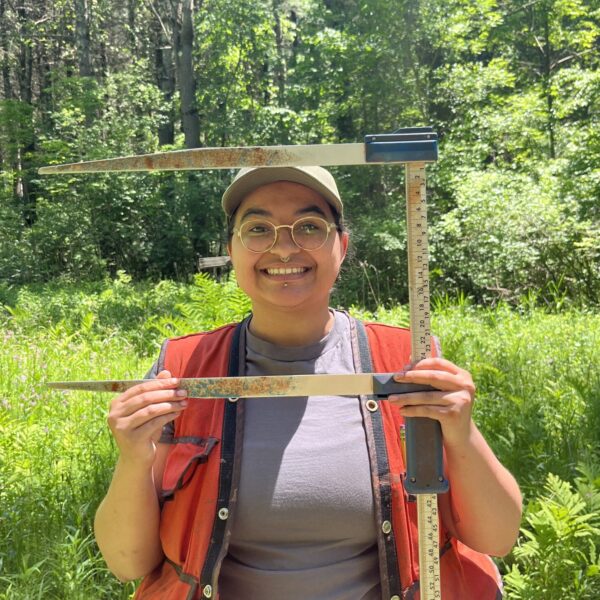
Photo courtesy of Kate Regan-Loomis.
Serenity Zullo, Intern
My name is Serenity Zullo and I’m a student at Paul Smith’s College majoring in ecological forest management with a botany minor. I was born and raised in New York City, specifically the Bronx. I currently reside in western New York near Buffalo and Rochester but
visit the Hudson Valley region often. I always had a love for nature but didn’t grow up knowing about forestry. It wasn’t until I did a landscaping internship at the Woodlawn Cemetery in the Bronx that really solidified my love for the outdoors. My love for nature increased when I decided to go to Paul Smith’s College in the Adirondacks.
I’m currently finding a lot of interest in understory plant identification and management. I’d love to be able to understand a forest through what grows below it. I’m also interested in forest management with a wildlife thought process. I’ve picked up bird watching not too long ago and continued to wonder how forestry might impact specific birds.
I’m very excited to build upon my forestry knowledge and skills with Great Mountain Forest. I’m looking forward to tackling different projects including forest inventory, setting up trail cameras, and more! I’m also looking forward to increasing my knowledge of understory plants in the Great Mountain Forest. I’m thrilled to be working with GMF this summer.
Reflections from Meekertown – 24 hours alone in the forest
In late May, in my role as GMF Newsletter Editor, I had the opportunity to spend the night at the Meekertown Cabin, a rustic but cozy outpost on the site of a onetime homestead at the southwestern extremity of this 6,300 acre forest. The objective was to produce the article you now read; whatever happened between embarking and inscribing was up to me.
In Connecticut, our forests are many, but they are crosshatched by private property, highways, and development. For all its rural charm, the fourth most densely populated state in the country offers little in the way of true wilderness. For those of us in the Northwest Corner, though, Great Mountain Forest (GMF) gives us something pretty close.
The following report is an account of a night spent alone in some of Connecticut’s deepest woodlands, with the only goal being that I allowed myself to be led by the experience instead of following a pre-planned agenda. When we’re alone in the woods, who leads us? And where do we go?
Setting out
GMF Property Manager Russell Russ picked me up on a sunny afternoon and ferried me from the East Gate entrance along the well-maintained Camp Road, onto Chattleton Road, and to the West Gate on Canaan Mountain Road.
Along the way, Russell identified the complex human interventions on the landscape that make it what it is today. Russell essentially grew up in these woods, his father Darrell being a longtime forester manager at GMF who, throughout the 20th century, essentially shaped the forest we see today alongside forester and owner Ted Childs. He pointed out a stone dam below Old Man McMullen Pond with an ancient outlet pipe, below which sits the subtle remnants of an old saw mill, once one of the major vocations of this now uninhabited stretch of highland forest. Further along, Russell explained that the stands of non-native conifers that hemmed the road had been planted as an arboretum for exotic evergreens.
As much time as Russel has spent in the forest, he was quite visibly surprised by the sight of a cow moose, grazing languidly on the Big Island of Old Man McMullen Pond, which we spotted from the window of his truck. With wide eyes, Russell said that in two and a half decades working full-time in the forest, it was the first time he’d seen a moose at this pond. While we watched, a beaver cut a clean V in the still black water just in front of the moose enjoying a leisurely lunch.
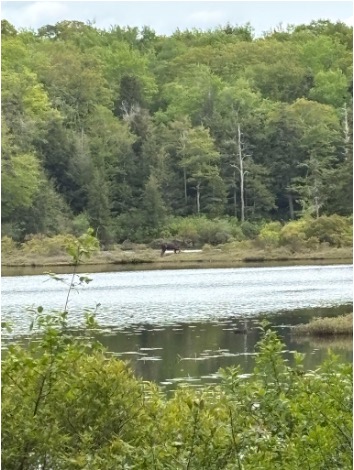
The best photo of the moose we managed, just barely within zoom range.
After exiting the forest, 15 more minutes brought us down the slopes of Canaan Mountain, out onto Route 63, and eventually onto North Goshen Road, where the chauffeured portion of my journey abruptly ended. Russell handed me a stack of paper maps, some parting bits of advice, and peeled off back to civilization.
My guides:
The ferryman
Buzzing with the anticipation of 24 hours of solitude in an unfamiliar place, I felt like Odysseus, ferried by Charon across the River Styx, even though the TV-sized display screen of his new Toyota Tacoma blared in front of my face. Russell was conveying me to an unknown frontier, depositing me at the forest’s wild southern boundary. He imparted the knowledge that would enable me to find my way through the tangle and keep me on the known path without getting lost.
But getting a little lost, of course, was part of the plan. Searching for Russell’s landmarks – the Collier’s Cliffs overlook, Pothole Falls, and several other remote curiosities of the wild Meekertown area – brought me on bushwhacking missions. I etched through thick undergrowth and scrambled up the slick bedrock exposed by the rush of Brown Brook’s cascades in a gambit to rediscover Meekertown Road, which I’d left behind some time before. Halfway up, I paused for a dip into a rust-colored pool as the light faded from the understory, and felt wonderfully a part of the darkening forest around me.
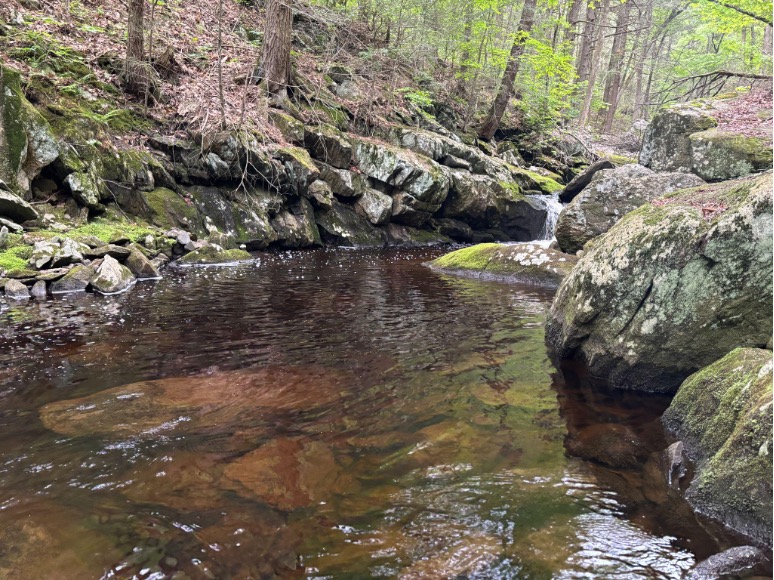
The grotto-like, rust-colored pool somewhere on Brown Brook
The bears, beavers, and beyond
I followed Russell’s directions up the verdant road until I crossed a bridge that brought me back into GMF territory and up a trail that would eventually intersect with the historic Meekertown Road near Wampee Pond. I began to spot mounds of bear droppings, a day or two old – a signpost of another type of guide in the forest.
These roads, though grown over and seldom used today, were once the conduits for thriving industry in these hills. Their legacy as thoroughfares is carried on today by the animals who have returned to habitats once wrested from them by the enterprises that built the roads.
As I arrived at Wampee Pond, taking in its boreal affect, a northern water snake cut s-shapes across the still, ink-black surface while two beavers busily reinforced a dam at an outflow of the aptly-named Brown Brook, which runs dark with the tannins of organic detritus steeping in its cold waters.
I tried to channel the animals’ movements across the landscape as guidance for my own. When multi-stemmed, heavily branched fallen trees blocked the overgrown corridor of the lower Meekertown Road, I followed the dim impression of deer tracks, to navigate the blockages obstructing my path.
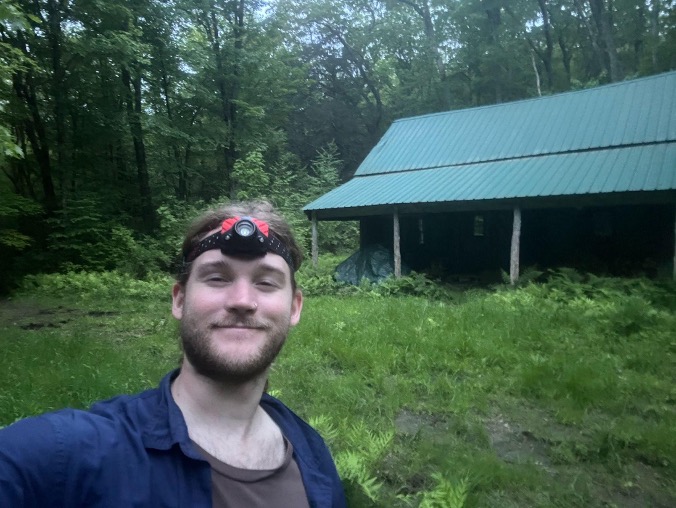
The author settling in for the evening at Meekertown Cabin
The colliers
That these animals are able to flourish – even impose their own will – upon a landscape once denuded by 19th century industrialism is remarkable. “It was a wasteland,” said former GMF director Hans Carlson on a recent phone call, emphasizing that resilience and resurgence are core aspects of GMF’s forest history. The now-verdant hills were stripped of vegetation to fuel the colliers’ fires, and the hollows subsumed by miasmas churning from charcoal hearths and pig iron blast furnaces.
When the colliers tended their fires here, there would have been no bears sharing the roads, no beavers laboring in Wampee Pond (which didn’t exist – it was dammed in the early 20th century as waterfowl habitat and forest fire protection). Traces of their hearths are found throughout the forest, and the Meekertown area would have been sporadically populated by these solitary, hardened men who were likely haunted by their desolated landscape.
There are lurid stories of murder and mischief whispered about the past inhabitants of Meekertown. In 1820, a clergyman described the settlement as a “hamlet of heathens, living in intellectual, moral, and spiritual darkness,” which GMF recently immortalized in a series of t-shirts and is also referenced in the name of a beer brewed by nearby Norbrook Brewery called “Hamlet of Heathens,” brewed with wild Meekertown-foraged hops.
While this reputation may have had some credence, the truth is that they were opportunistic, and maybe a little introverted, individuals who made their way in a difficult world. In any case, their stories, and the remnants of their hearths and shanties left behind, animate the landscape with a colder, more imperfectly human history entangled with the vibrancy of the forest that flourishes today.
Meekertown Road is split in two, where Brown Brook burbles over the long-collapsed remnants of a bridge before it cascades to the valley floor below. While I sat in that spot, listening to the tea-stained water rush over the rocks, the occasional roar of a semitruck from Route 63 broke through my reverie. GMF, as wild as it feels today, is still susceptible to industrial intrusions from time to time.
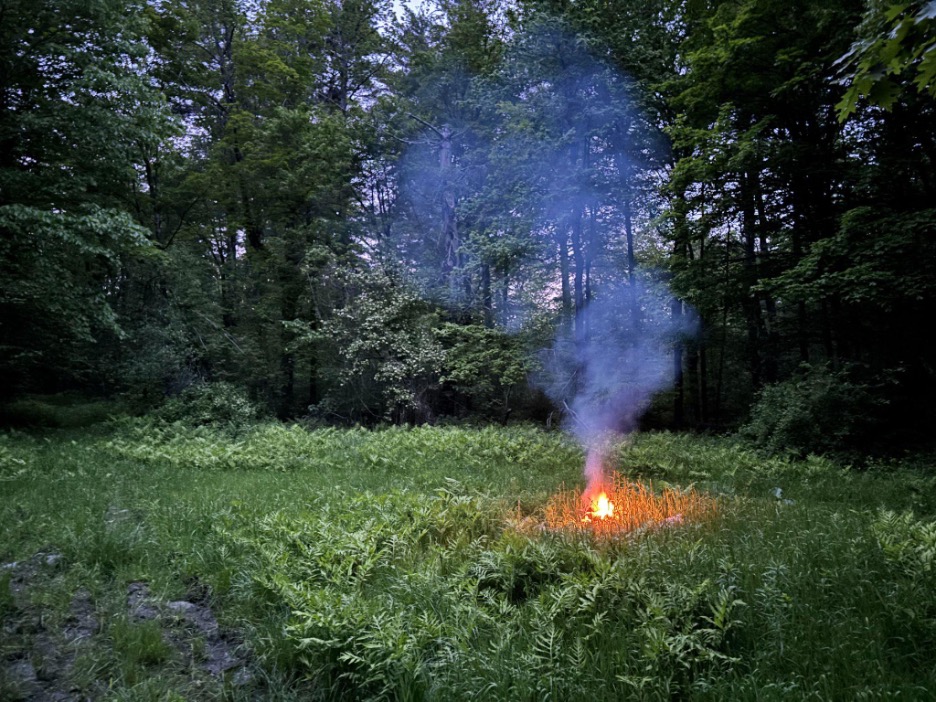
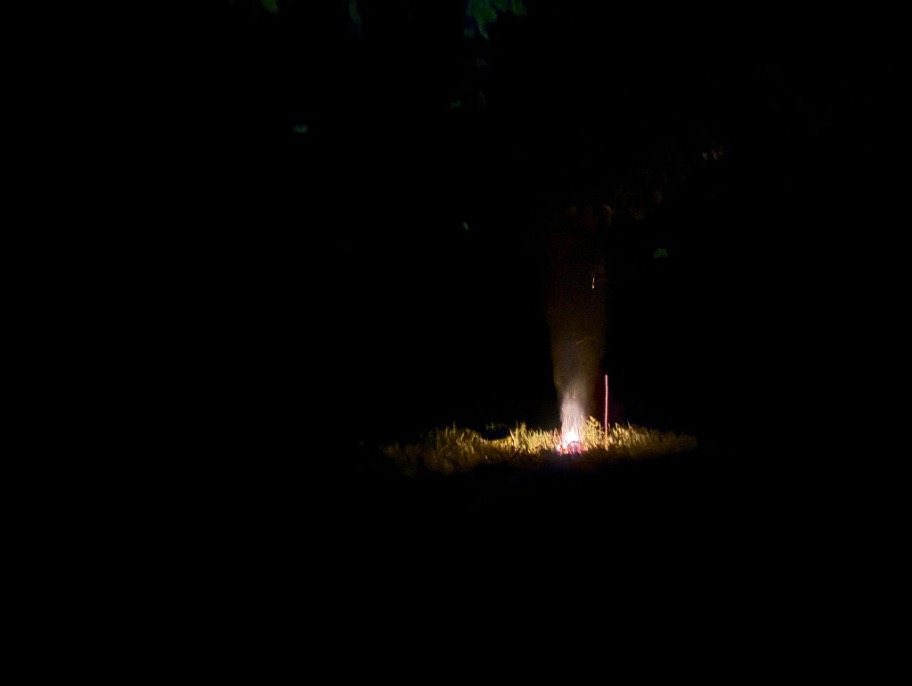
While the colliers may have not been focused on the trees and birds like many of our modern forest goers, they were certainly attuned to their fires. I meant to avoid cosplaying collier during my overnight stay at the cabin, but as evening fell I found myself tending to a smoldering blaze in the clearing just outside the building.
It’s difficult to imagine the life of a collier, staring intently at a pile of timber and earth for weeks on end, measuring its interior heat by the color of the smoke that rose from the mound. There would have been none of the hooting barred owls or rustle of the breeze in the treetops then. I have a note in my journal that I must have scribbled out there: “It’s amazing how long you can watch fire. It’s almost difficult to do anything else.”
The storyteller
I woke the next morning on the wooden floor of the cabin, the beaming sunshine illuminating the many inscriptions etched into the walls from the scout troops, artists, and hunters who had previously taken refuge within its walls. The two rocking chairs which face the formidable hearth at the front of the room sat eerily still as dust motes fluttered in the sunbeams.
“Don’t sit in Mrs. Dean’s rocking chair!” GMF trustee and forester Star Childs had told me the day before with a mischievous grin. “If it starts rocking, get outta there.” Luckily, nothing moved during my short stay – that I saw, at least.
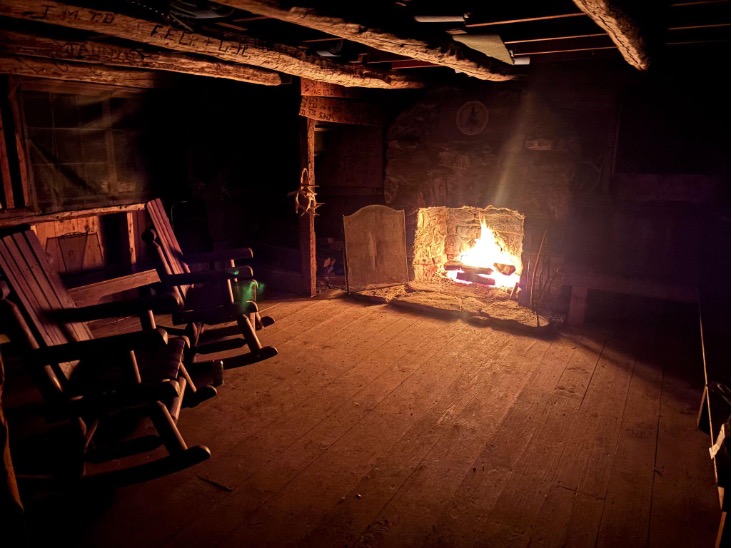
Which one is Mrs. Dean’s?
Having my route back to the East Gate more or less mapped out, I contemplated backtracking east on Meekertown Road a little bit to search for the gravesite of several onetime residents. The late environmentalist and poet David Leff wrote rhapsodically about GMF’s landscape, its tenacity and will to survive, and he described its former inhabitants with the same reverence.
“Meekertown’s ghosts are never frightened,” he wrote in a yet-unpublished paean to the forest. “Their tales linger.” On his own visit to the graves, Leff reflected somberly on their memory: “We show our respect by quietly keeping the stories alive, as best we can.”
Leff’s writing guided me to try and see the forest as he did – as a patchwork of animations and presences, each contingent upon the other. Leff showed that GMF is constituted by the stories that dwell in the minds of the foresters who have spent their lives within it, and the memory of those who made homes and lost them here, just as much as it is by its trees, hills, and hollows.
Having fulfilled my bushwhacking quota the previous evening tromping around Meekertown, I decided to let the graves lie. And anyways, as presumably solitary individuals in life, maybe they appreciate their alone time in death too.
A guide for the reader
With that decision made, I turned left onto GMF’s north-south arterial, the refreshingly obvious and debris-free Number 4 Trail, and began my journey home. What follows here is my attempt to pay it forward: as I was guided through my time in the forest, perhaps this suggested route – which I can confirm is well worth it – will inspire the intrepid rambler to undertake their own journey from GMF’s wild southern reaches to the East Gate Campus..
As a disclaimer, any distances given are estimations, and anyone wishing to walk these trails should consult a map, available on the GMF website.
Find your way to the intersection of Meekertown Road with the Number 4 Trail. Getting to this point means either hiking in on route of your choosing, or devising another creative access plan. For a detour to the Meekertown Cabin, follow Meekertown Road west about a half mile to a clearing where the cabin is easily seen, then turn around and head back to the junction. For those who want to skip the cabin, start heading north on the Number 4 Trail with Wampee Pond to the right. Make sure to spend a minute searching the surface for disturbances from snakes or busy beavers.
Continue up the Number 4 Trail for another 2/3 of a mile or so before coming to a small clearing on the left after a bit of an incline. At the back of this clearing, an obvious but small trail leads to the best view I’ve seen so far in the forest: Wapato Lookout.
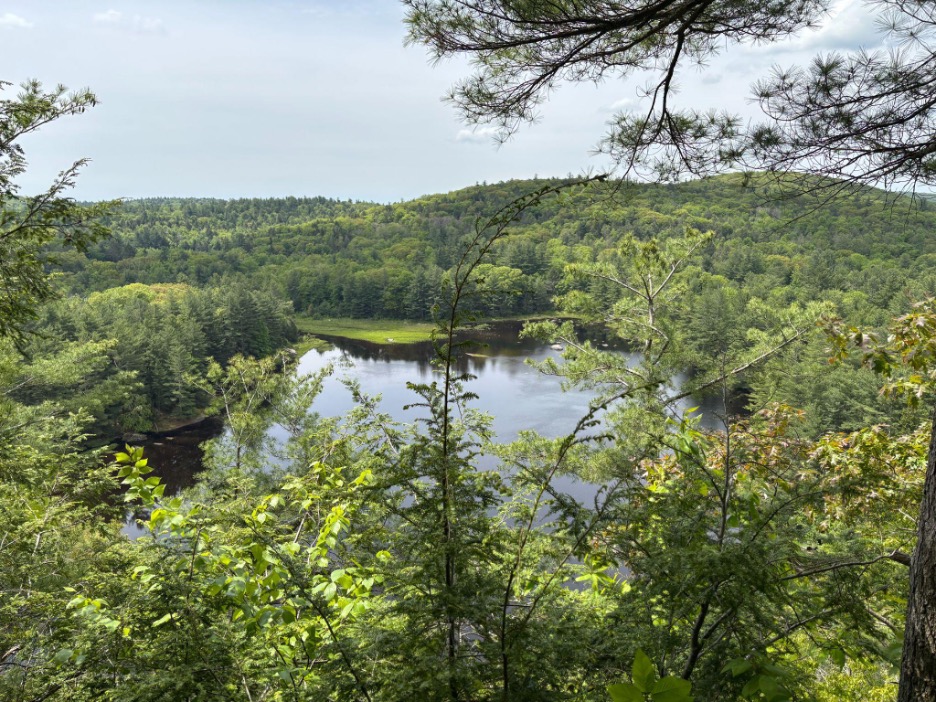
The view. It’s even better in person.
From a dramatic precipice, the view extends through a white pine-framed window over the black waters of Wapato Pond and rolling peaks beyond, exemplary of the adage that GMF often feels more like New Hampshire’s deep woods than southern New England. I spent a good 45 minutes here, swatting mosquitos and enjoying a respite on the bouncy, needle-strewn soil. It’s the type of spot one could spend quite a bit more time at with the right schedule.
Heading back to the Number 4 Trail, continue north for a little over a mile through varied woodlands until the Sam Yankee Trail peels off to the left. Follow it for a few hundred yards, until a well-marked sign points left to the Matterhorn. Enjoy the short but stimulating climb to the rocky precipice in the heart of GMF, with nothing but rolling woodlands around you. Enjoy your lunch here, and be careful with the lichens.
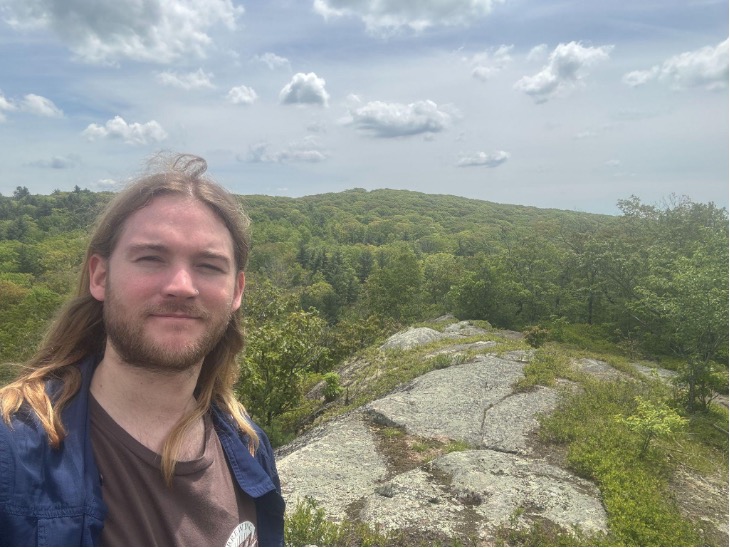
The author, post-lunch and perched on the Matterhorn
Backtrack to the trusty Number 4 Trail, and continue heading north. After another mile or so, turn right, rounding a gate onto the Crissey Trail, where a mystical forest of hemlock and slim maples towers above a formidable network of low stone walls.
After a while, turn left onto the shady and boulder-strewn Crossover Trail. If inclined, take a detour to the Crissey Pond overlook for another fabulous view. Head back to the Crissey Trail and continue on to GMF’s famed glacial erratics, large boulders dropped during the retreat of the Laurentide Ice Sheet. As a rock climber, I found myself atop one of them, hanging out with a ruby-throated hummingbird on a bed of ferns and moss.
The Crossover Trail spills out to the Camp Road, where one can head back to the East Gate through a corridor of hemlocks and yellow birches for another taste of the north country, making sure to stop at the model charcoal pile exhibit demonstrates the complexity of charcoal fires.
My iPhone clocked the total mileage, with all the detours, to be between seven and eight miles. For those who want more, a spur loop to visit the prehistoric Tobey Bog can be achieved via the Overlook Trail, Charcoal Pit Trail, and Tobey Bog Trail.
Happy hiking!
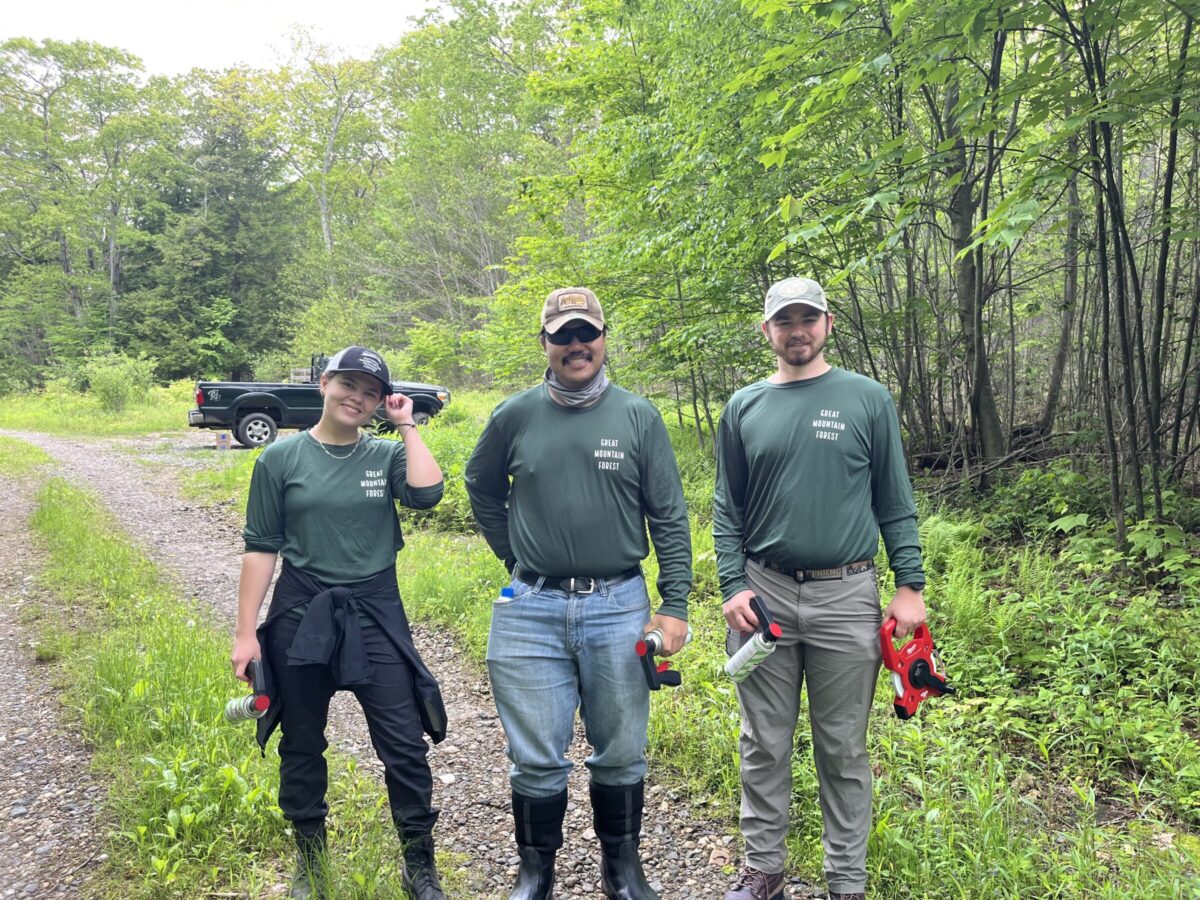
GMF’s 77th Cohort of Forestry Interns
Ren Cattafe
Hello! My name is Ren Cattafe, and I am an undergraduate student at UMass Amherst studying forest ecology and conservation. I grew up in eastern Massachusetts, spending a lot of time in forests, which fostered my love of nature early on and influenced my decision to pursue a career in natural resources. I’m interested in sustainable logging practices, promoting forest resilience through silviculture, and increasing community accessibility and knowledge of forested areas. During my studies I have also had the opportunity to participate in active hemlock woolly adelgid research, which I plan to continue in the coming academic year.
I feel extremely grateful to be working with GMF this summer. Not only has it been an incredible learning opportunity, but a chance to do work that serves a real purpose.
Within the first week, my fellow interns and I supported research that involved marking 30+ acres of trees with the goal of strengthening the dominant cohort and the understory. This experience has enhanced my ability to perceive and interpret forested landscapes in a manner that can’t be achieved in a classroom setting. I am thrilled that such research is supported here, and that both industry and science can coexist within the same space.
Will Watkins
Hello, my name is Will Watkins. I am a rising senior at North Carolina State University studying forest management with a concentration in ecology and a minor in environmental education. I first got into forestry as a degree because I grew up participating in boy scouts and spent a lot of time outdoors. The summer before I started my freshman year at college I was able to go on a special backpacking trip out in New Mexico where I learned about and helped with some forestry and conservation efforts. This inspired me to pursue forestry at school. Now that I have had some schooling and this internship, I know I made the right choice.
I was born and raised in North Carolina and had never heard of Great Mountain Forest, nor did I know much about the northwest corner of Connecticut. But as soon as I ran across this opportunity online I was excited and applied immediately. It checked all my boxes, plus it was in a part of the country that I have never been to? That’s great! Even now, after working here for a month, I am still slowly learning more about both GMF and the area.
So far, we have marked stands of trees for a pre-commercial thinning and we have made some plots in a stand of barberry to get an inventory of the understory. That is only a small bit of what we have done so far and what we will eventually get to do later in the summer. I am very much looking forward to the rest of the summer.
Ronald Law
Hello, my name is Ronald Law, and I am a 2025 summer intern at Great Mountain Forest. My interest in forestry began quite late in life as I was originally studying computer science. After some time however, my disinterest in the field became apparent to me and I decided I had to quit.

Six months later, I started working at a lawn care company, eventually becoming a tree and shrub specialist. Though I enjoyed my time there, I slowly came to realize the elements in our environment that were changing dramatically, resulting in the death and weakening of numerous plants under my care. As unusually warm winters became the norm, and invasive pests became more prevalent, I realized I wanted to work in a position that was more proactive than reactive when it came to the health of our environment. So I decided to return to school and pursue environmental studies, which eventually led me to my internship at Great Mountain Forest.

Healthy forests, healthy people – and healthy ticks?
The hills are alive in Northwest Connecticut, but it’s not all birdsong and snowdrops: the blacklegged tick has shaken off its winter torpor, and now crawls in droves through the understory, spreading disease and myths in equal measure.
Dr. Scott Williams, Chief Scientist and Head of the Department of Environmental Science and Forestry at the Connecticut Agricultural Experiment Station (CAES), a state organization spearheading research on tick-borne diseases, dismissed two commonly held misconceptions about the tiny, dangerous insect: “They don’t fly. They don’t drop out of trees.” Williams advised that rather than worry about the branches overhead, think low and keep your ankles covered. “They crawl up from the ground for the most part, or [from] a few inches off the ground.”
Demystifying tick behavior and pathogen transmission yields surprising insights into how to manage disease levels in our region: in a healthy forest, more ticks might actually equal less disease, Williams explained.
Debunking Myths
Blacklegged ticks (also widely known as deer ticks) and Lyme disease are commonly misunderstood components of the New England forest, starting with the illness’ origin story. Conspiracy theories abound speculating where it began, with an especially persistent and oft-debunked claim that it leaked from a government research facility on Plumb Island.
But reputable research has shown that the disease has been circulating in the northern hemisphere for millennia. One of the bacterium responsible for causing Lyme disease, Borrelia burgdorferi, was detected in Ötzi the Iceman, a 5,000 year-old mummy found in the Eastern Alps in the 1990s. A study conducted by the Yale School of Public Health in 2017 traced B. burgdorferi back to North American forests of 60,000 years ago, meaning the bacterium was resident in our woods long before the earliest human inhabitants arrived.
Closer to home
Deer ticks and Lyme disease are as Connecticut as New Haven pizza, with one of our picturesque coastal towns lending its name to the ailment after a cluster of cases there in the 1970s lead to its identification as a unique condition. The state remains positioned in the very heart of tick country, and the Icebox of Connecticut, which previously benefitted from the protection of its harsh winters, is losing its defenses as the cold season continues to warm up.
“We’re not trying to scare people from being outside, we’re trying to educate people on when the various stages [of ticks] are active – what’s tick habitat and what’s not,” Williams said. For instance, a field of high grass, commonly regarded as a tick haven, is actually largely inhospitable to the bugs, as they desiccate quickly in a dry environment. “That’s kind of a desert for ticks,” Williams explained.
The most “ticky” habitat “is really that edge where your lawn meets the forest,” he said, and when it comes to getting bitten, it’s often a matter of timing.
When to watch out
While adult deer ticks are active now, Williams explained that May, June, and early July are the months when most infections occur since that’s when both humans and the nymphal stage of deer ticks are likely to be active outdoors. Although the adult ticks wandering the undergrowth and brush now can certainly transmit the pathogen, it’s the nymphs that are “the really problematic guys,” Williams said, in part because they are small and hard to detect, and also because in spring, “human activity and tick activity in the nymphal stages coincide.”

A white-tailed deer in the forest. Photo: Mike Zarfos
Host competency and the dilution hypothesis
Active ticks, active humans, and an abundance of both yield higher bite rates, thus contributing to more infections. However, Williams explained that the species present in an ecosystem can have significant impacts on the spread of tick-borne pathogens to humans.
A surplus of white-tailed deer upon the landscape, for example, is often thought to correlate to more tick-borne illness. While a large deer population will often support a high concentration of ticks, deer are a “dead-end host” for the bacterium, meaning they don’t transfer the pathogen back into the ticks.
Mice, however, are “competent hosts.” The concept of host competency is the ability of a reservoir host species (animals that carry and spread disease-causing pathogens) to infect the ticks with pathogens, which small rodents are highly adept at whereas larger animals are less so. When deer are plentiful on a landscape, “you typically have high tick abundances with lower infections with the various pathogens,” Williams said.
The reservoir host species of B. burgdorferi that actually infects the ticks with the pathogen are small rodents, especially the white-footed mouse which is common to the Litchfield Hills. When fewer deer, and other medium sized mammals, are available, Williams explained that the ticks will then be forced to feed primarily on mice, which will support a smaller population of ticks within which the pathogen is much more concentrated.

CAES team conducts Lyme disease research with mice in Woodbury. Photo: Mike Zarfos
Healthy forests, healthy people
In a healthy ecosystem with a spectrum of animal species, ticks aren’t forced to rely on these highly competent hosts for a blood meal. Williams explained that this scenario, in a species-diverse forest, describes what disease ecologists call the dilution hypothesis: “with a diversity of animals, you’re going to see less infection in the ticks because they have so many options to feed.”
The loss of forest diversity can have the opposite effect, Williams said, which is happening across the Northeast due to development and the incursion of invasive species. Several years ago, Williams conducted research on the correlation of Japanese barberry, an invasive shrub, with tick populations; some of the work was done at Great Mountain Forest with the help of GMF forester Jody Bronson. The study found that the dense tangle of undergrowth created by the proliferation of the shrub caused a humid microclimate that not only provided great tick habitat, but enabled them to remain active throughout the day.
Normally, the moisture-dependent ticks might be inactive under a pile of leaves during the heat of the day, Williams said. But the microclimate created by the “monoculture” of invasive brush growth means ticks continue looking for a host “pretty much 24 hours a day.” He clarified that this was not specific to Japanese barberry, but any plant that grows in a monoculture tangle, “which is pretty much what invasives do in our neck of the woods.”
“What we’re trying to push is a healthy, diverse forest, and that’s very applicable to Great Mountain Forest,” Williams said. The goal, he continued, is responsible management: “If you have a healthy, diverse, well-managed forest, you’re going to have a diverse array of wildlife, and as a result you’re going to have a healthier tick population with lower pathogen infection. That’s kind of the bottom line.”