
PREVIOUS WEATHER REPORTS
Following the Forest GMF Style
Great Mountain Forest’s 6,300-acre expanse is, in a sense, one of Connecticut’s broadest highways. Save the rare maintenance vehicle or Sunday stroller, though, it is no conduit for humans, but rather the fast lane – or a rest stop – for the abundant flora and fauna of the New England woodlands.
That highway is not isolated to Norfolk and Falls Village. It is part of an ecological interstate that runs from the uplands of the lower Hudson Valley to the northern forests of Quebec. The Follow the Forest initiative, a collective effort between the Housatonic Valley Association, the Litchfield Hills Greenprint Collaborative, and many other regional groups, seeks to connect and protect this dark green thoroughfare, and GMF is a vital junction on a route that carries moose, bears, bobcats, salamanders, seed pods and beyond across an increasingly fragmented landscape.
The project recently received $30,000 in grant funding to further its mission, which combines citizen science, expert input, and regional partnerships to aid in wildlife mobility along a “corridor” that follows protected forests from the Hudson Highlands through the Berkshire and Taconic ranges before connecting with the Adirondack and Green Mountains and ultimately Canada.
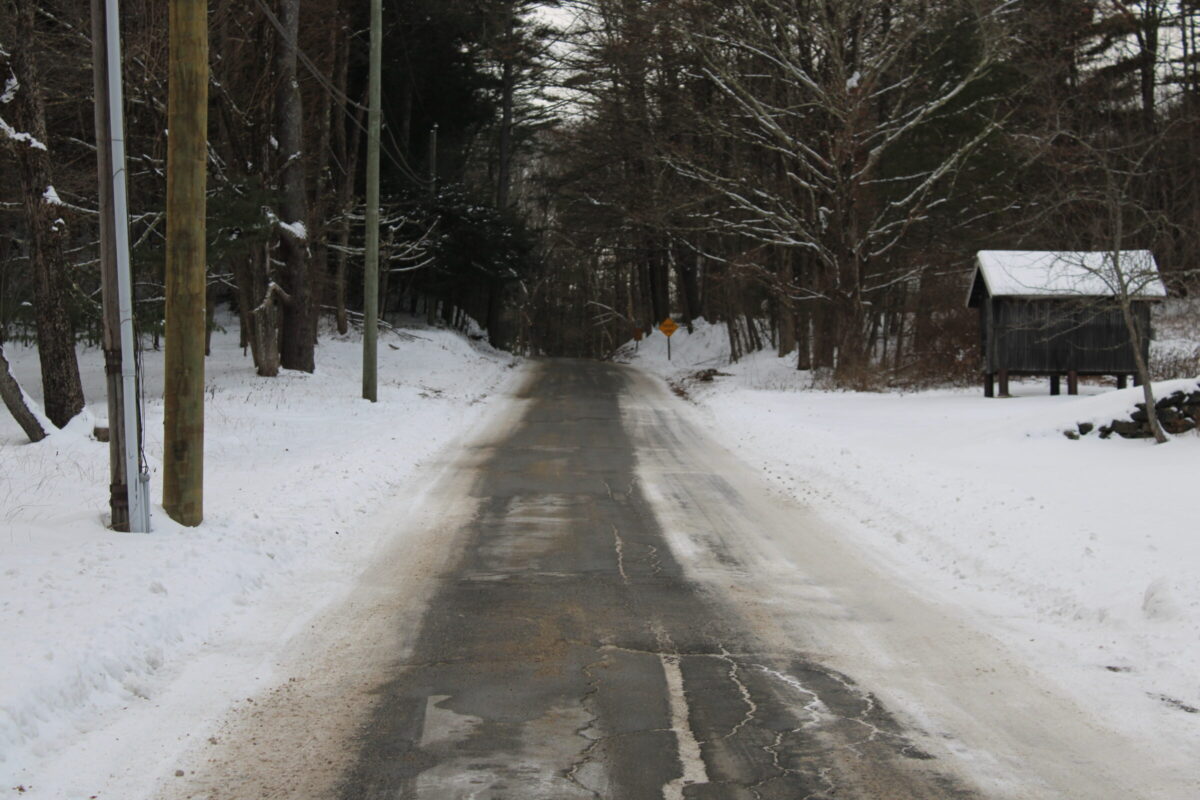
Windrow Road approaching the GMF Visitor Center in early December. Even quiet roads like this can pose an obstruction to wildlife mobility between large forest cores. Photo by Alec Linden.
“Connectivity” is the concept of keeping “core” habitats bridged through “linkages” – sites where animals are able to traverse an anthropogenic boundary from one core to another. Many animals depend on mobility for vital reasons, such as seeking food or water or mating and reproduction, but the isolation of habitats from one another impacts humans downstream as well. According to the World Wildlife Fund, habitat fragmentation stemming from development has impacts beyond local ecosystem collapse, including degrading soil health and polluting fresh water.
Large and connected refuges of wildland that enable animals and plants to move freely are considered havens of “resilience” amid increasing pressures from climate change and development, which is an ecosystem’s ability to survive and thrive amidst disturbance. The corridor that runs up the highland spine from southern New York state to Canada connects an extensive swath of North America’s eastern woods, regarded to be the largest stretch of intact temperate mixed and deciduous forest in the world, according to Follow the Forest.
GMF’s territory makes up what the Follow the Forest initiative identifies as “core forest habitat” – a tract of protected woodland, 250 acres or greater, that is not disrupted by human alterations like roads or farmland. In addition to GMF’s conserved lands, thousands more acres of protected state-owned highland forest spread across the Canaan Mountain massif. Far exceeding the size qualification, the extensive, contiguous, and diverse forest contained within and directly abutting GMF’s boundaries is part of a “key stronghold” of climate resilience, according to HVA Conservation Director Julia Rogers.
During a recent interview, Rogers addressed the value in GMF’s longstanding commitment to conserving forestland. “Without that legacy,” she said, “I would predict that there is a strong likelihood that parts of [the forest] would be developed and we would have a much smaller core forest.”
Big cores, she explained, are fundamental as they are able to withstand disruption and damage more so than smaller tracts of land. “Larger cores are going to be more resilient to all the impacts of climate change,” she said, including more extreme and unpredictable weather patterns, which may topple trees that have less protection.
Plus, GMF has elevation on its side: “As we think about species who are going to need to move either north or upward in elevation as a response to climate change, Great Mountain Forest is going to serve as a key climate refuge.”
“That connectivity with the protected lands further south and lower in elevation is so critical to Great Mountain Forest serving as a key part of the Follow the Forest initiative,” Rogers added.
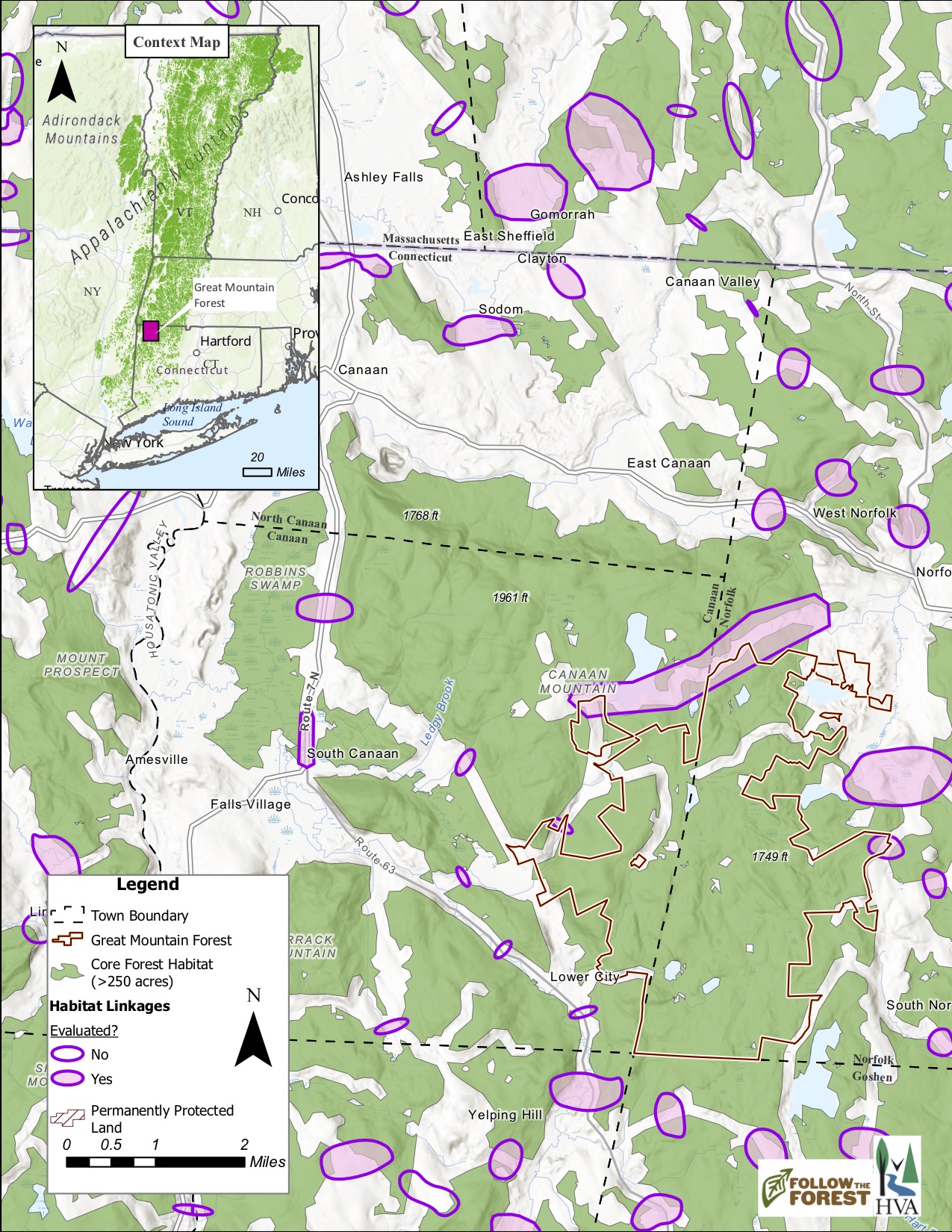
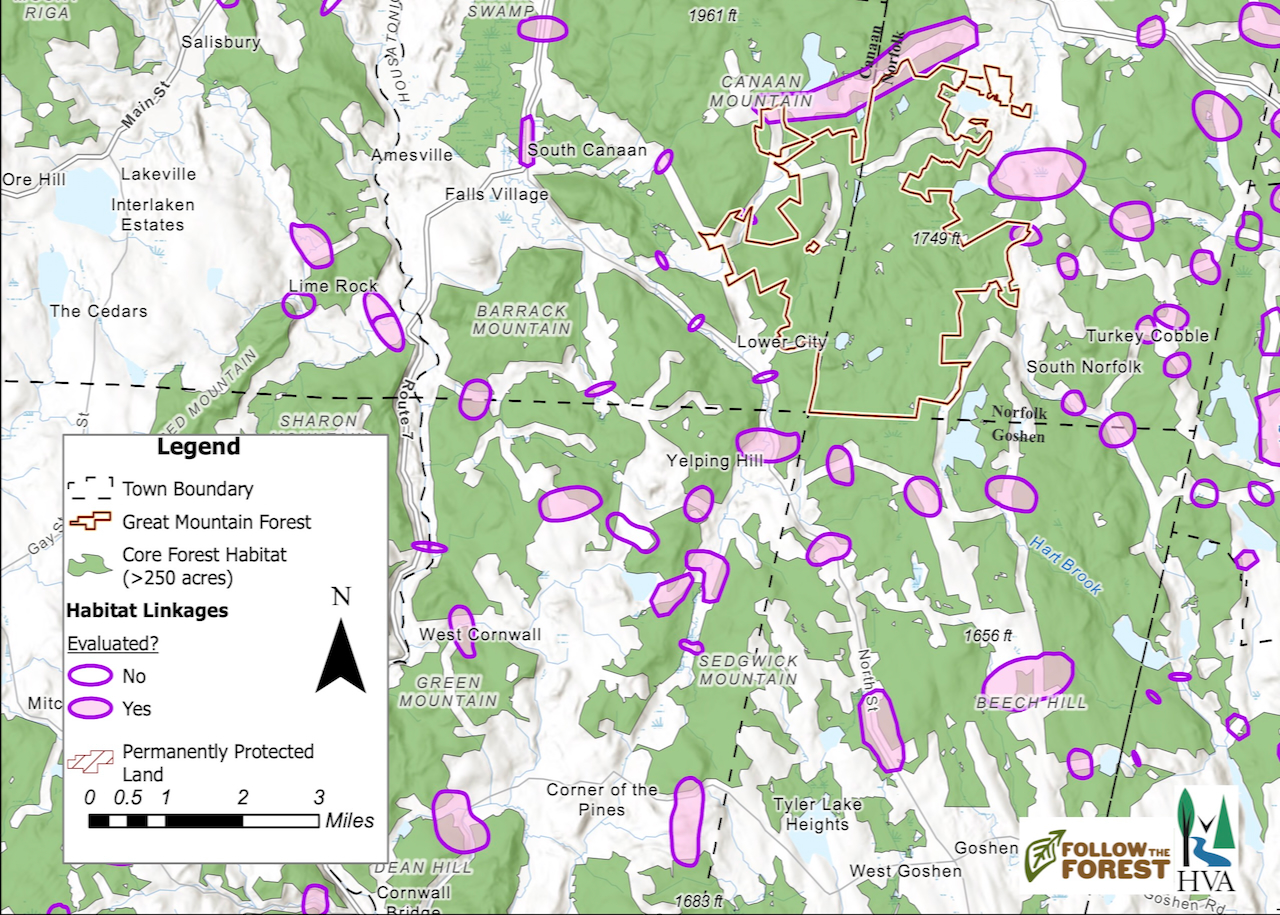
The property lines of GMF, outlined in red, with the surrounding wildlife linkages to other core forest habitat demarcated by purple ovals. Shaded ovals indicate sites that have been assessed in person by a community scientist. Map courtesy of Stacy Deming/Housatonic Valley Association.
Not just a stronghold, GMF is also surrounded by linkages to other protected habitats. These sites, identified by purple ovals on the Follow the Forest map, were initially identified by computer modeling, but many have been visited by volunteer citizen scientists who contributed their own observations to the data pool.
Stacy Deming, HVA’s GIS manager who is behind Follow the Forest’s intricate and user-friendly story map, also joined the interview. She spoke with pride about the collaboration with locals. “I’d say we’ve really done a lot of work with community scientists to come up with these,” she said of the map tags detailing each linkage. “I feel like they’re a better display of what the linkages really are.”
Rogers echoed Deming’s sentiment: “What’s really cool about getting community scientists out there is that they have information that we can’t gather from a computer.” Plus, involvement begets interest, she said, noting that the project promotes engagement with the idea of wildlife connectivity as volunteers inspect these linkage sites firsthand.
Both Rogers and Deming agree that a communal approach to preserving connected wildlife corridors is essential in southern New England, a region abounding with roads, property lines, and town borders.
“None of us can do it alone,” said Rogers. “We need each other. And what’s fun about Follow the Forest is that it unites all of us under something that’s exciting, right?”
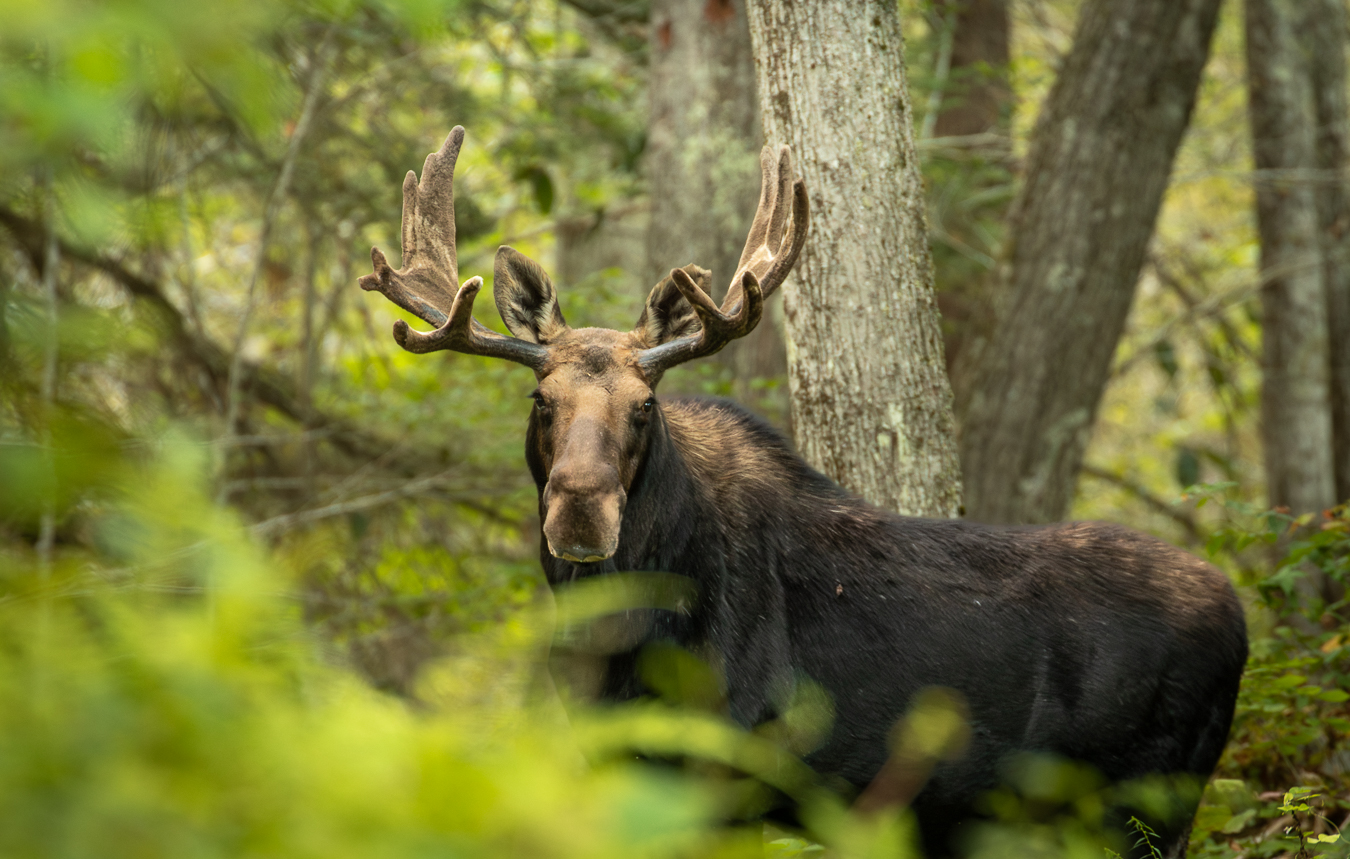
GMF’s Resident Moose are the Subject of Scientific and Photographic Study
Great Mountain Forest is home to 20 of Connecticut’s 100 or so moose. Yet most people who visit the forest will never spot one. That’s because despite their significant stature and status as New England’s largest land mammal, these ungainly ungulates—members of the order of hoofed mammals— move through the forest with remarkable stealth and agility.
Wildlife photographer Stephen Schumacher, however, who has been documenting GMF’s diverse fauna for eight years, has captured GMF’s resident moose on multiple occasions. And Ed Faison, senior ecologist at the Highstead Foundation, a regional conservation organization based in Redding, CT, has studied GMF moose to better understand how they impact temperate forests.
Under the Microscope
Faison, the lead author of a recent paper on the effect of moose and white-tailed deer in New England on forest regeneration, explains “Moose have been studied for decades in the boreal forest, in Canada and Scandinavia and Alaska. So a lot is known about what they do to forests up there, but very little is known about what’s going on down here [in the temperate forest].”
Moose are relative newcomers to Connecticut. In fact, there is no hard evidence to suggest that the species had a stable breeding population in the state until the 20th century.“GMF is a great study site because it’s one of the few spots in Connecticut with moose, it supports long-term research and is actively managed” explains Faison.
Faison along with Steve DeStefano from the United States Geological Survey Collaborative Wildlife Research Unit at the University of Massachusetts spent 15 years monitoring the browsing (foraging) habits of moose and deer to determine their impacts on the abundance and composition of a re-growing forest in a disturbed woodland site, such as an area that had been cleared for timber harvesting. GMF proved an ideal study site.
A moose that eats up to forty or fifty pounds of food per day can certainly produce notable effects on the reemergent trees. Faison and DeStafano found that rather than restrict the forest’s ability to regrow, as prior scholarship had suggested, browsing’s primary impact was to direct different plant species to succeed in the disturbed environment, without substantial sacrifices to overall biomass or biodiversity.
The study, Resilience and Alternative Successional Trajectories in Temperate Forests Exposed to Two Large Herbivores published in the journal Forest Ecology and Management in June, concluded that the moose and deer did not significantly impact forest resiliency, or its ability to regrow after disturbance.
However, the scientists also concluded that the moose and deer’s feeding habits did affect the forest’s composition. The browsed sites showed markedly reduced deciduous tree growth. That’s because the animals favored deciduous species, allowing white pine (Pinus strobus) to grow more abundantly in the browsed stands.
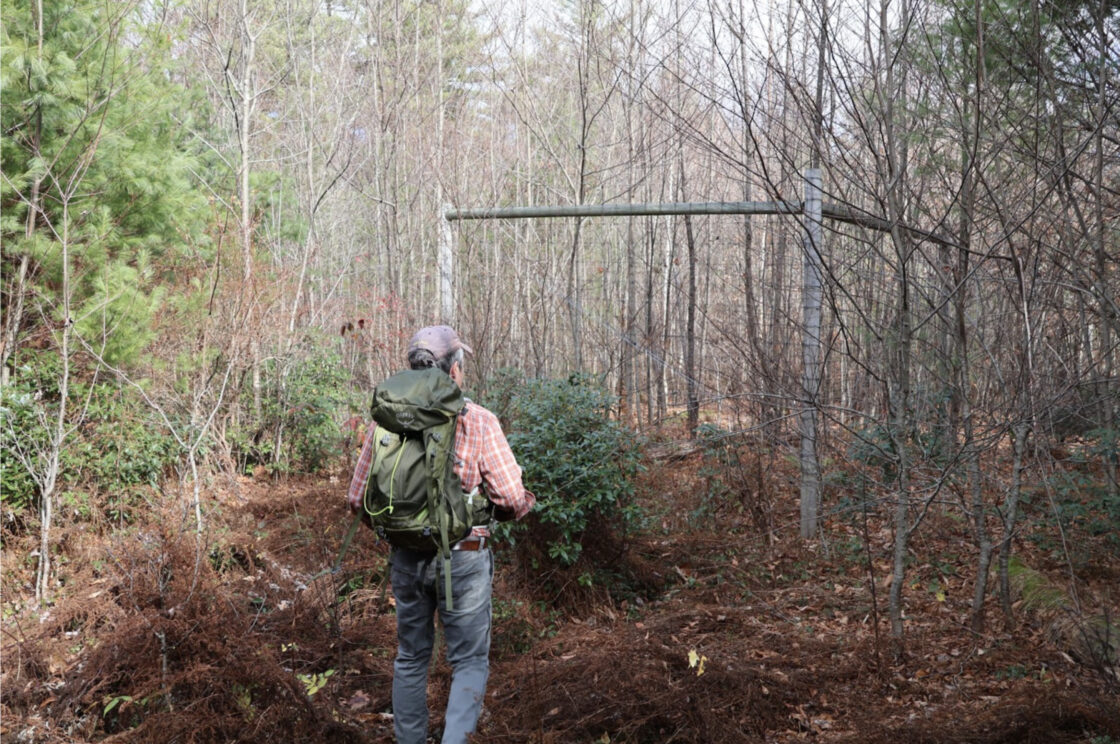
Faison inspects a partially enclosed plot that excludes moose but permits deer. Photo provided.
Through the Camera’s Lens
Rather than their impacts on the forest, wildlife photographer Stephen Schumacher is interested in documenting the animals themselves, which is no easy feat.
Despite being New England’s largest land mammal, moose are seldom seen. And even though their antlers can span up to five feet across, these ungainly looking, yet agile animals manage to negotiate the dense understory with remarkable ease.
“I’ve seen moose going through mountain laurel that is thicker than thick,” remarked Schumacher during a recent conversation. “It’s hard enough for me to get through there.”
Yet Schumacher persists. “This is a lifelong project,” he says. “I still want to get my quintessential moose in early morning or late afternoon sun getting lit up like a Christmas tree.”
Not only does their reticent nature make moose encounters a challenge. But a moose that feels threatened can kick, charge or stomp, particularly a cow protecting her calf.
Schumacher’s dogged pursuit of moose has meant he’s had his share of run-ins with the woodlands giants, and the pictures to prove it. On August 27 this year, while riding his bike, Schumacher spotted a looming shape emerging from the edge of the woods. Jumping off his bike, and struggling to keep his hands steady as he prepped his camera for the shot, Schumacher uttered a low guttural sound to draw the huge bull’s gaze.
Normally, the photographer wouldn’t vocalize to the animals, but since this was before rutting season, he said the bull was calm. “His ears were up… he wasn’t posturing with his antlers. He was relaxed.”
To Schumacher’s amazement, the bull offered a reply. “He turned his head broadside, and he looked back at me, and he answered me back.”
“It sent chills up my spine,” he continued, after a pause.
“Seeing that bull, that’s probably the coolest thing I’ll ever encounter. And I’ve been able to photograph wolves out in Yellowstone,” he said.
Schumacher has been tromping around GMF’s hinterlands for eight years, and he also monitors a number of trail cameras he set up around the forest, which gives him rare access to documenting moose as well as other mammals in the wild. Once, five years ago, two deer walked by one of his cameras and for a split second, the outline of their antlers matched perfectly. “Those guys were actually twins,” Schumacher said with a grin. Schumacher’s cameras have also captured fishers, martins, coyotes, foxes, bobcats, and “lots of bears—some giant bears.”
“I don’t take any of that for granted,” he said, emphasizing his gratitude to GMF staff for allowing him the access to do what he does. “It’s like getting a golden ticket in Willy Wonka.”
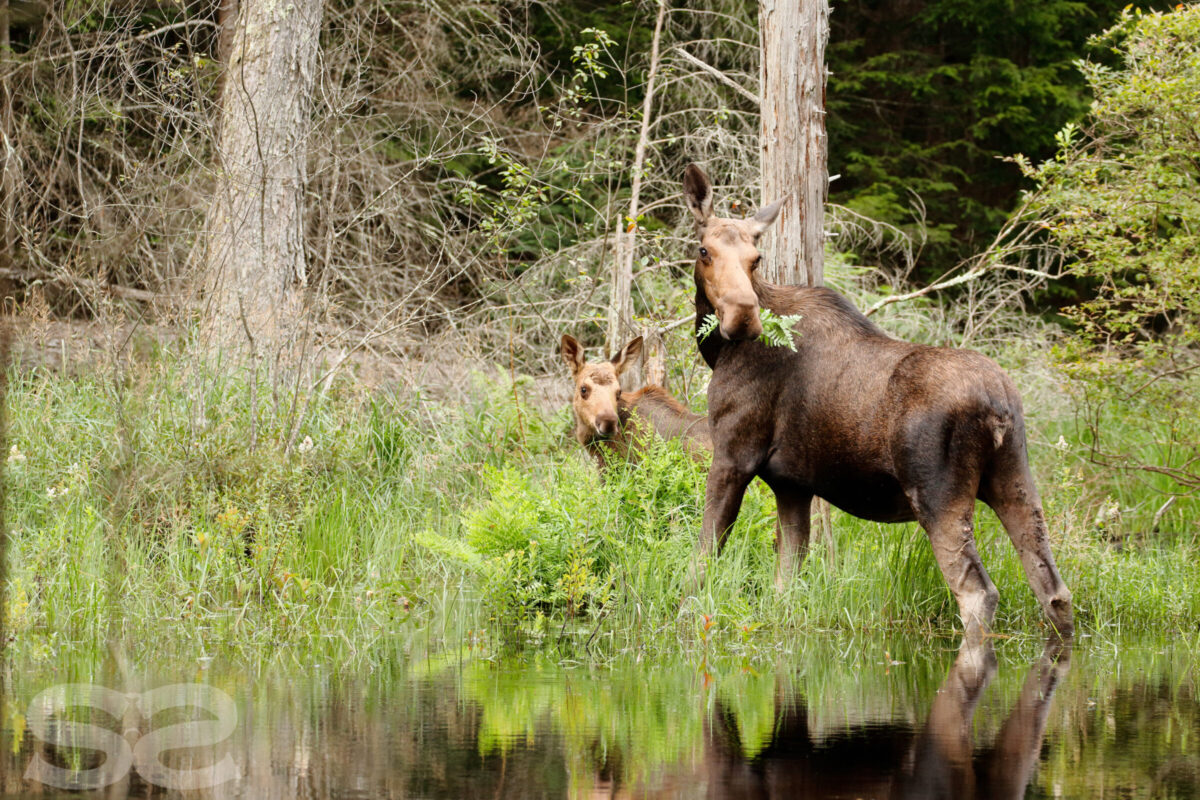
Despite his hands quaking with trepidation, Schumacher managed to capture a few images of a moose cow and her calf. Photo: Stephen Schumacher
Schumacher’s photographs and trail camera footage can be found on instagram @sds.wildlifeimages.
Misunderstood Asters: A conversation with Horticulturist Deb Munson
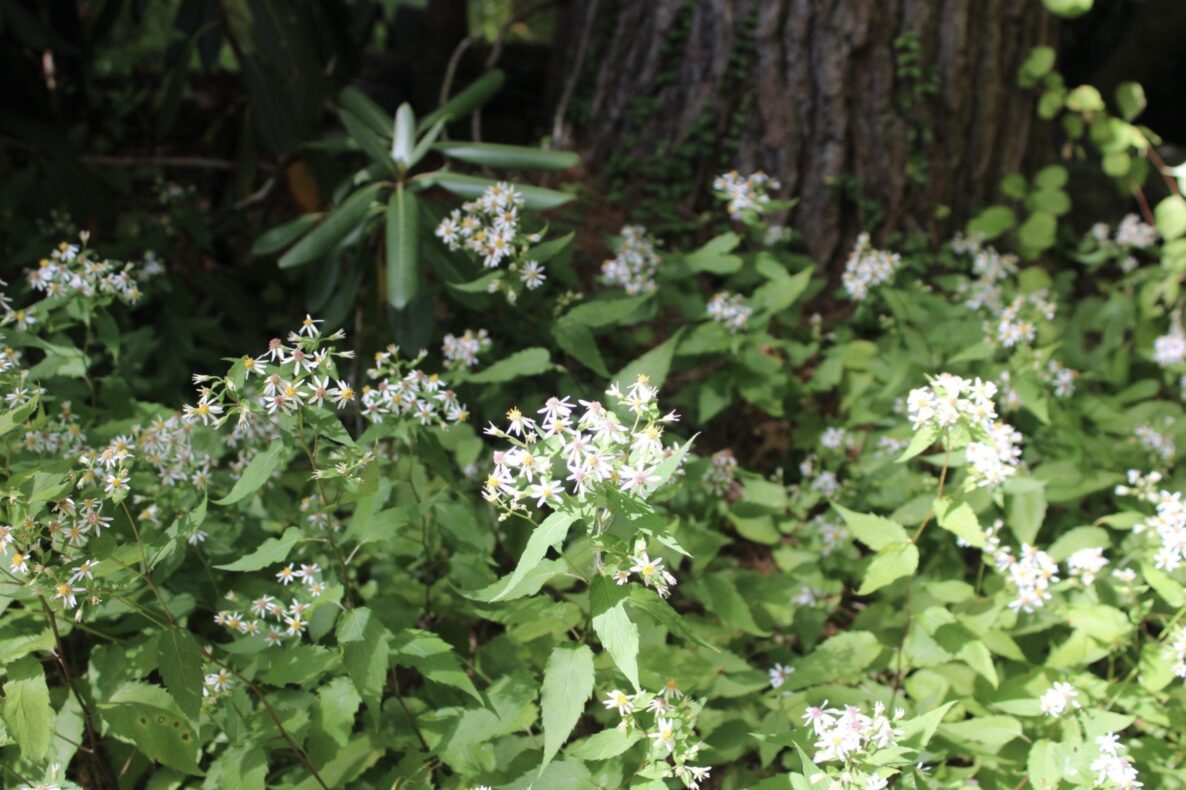
August has come and gone at last, the kids are back at school, and the forest floor is blanketed in white. While recent weather patterns have made anything seem possible, this is not the result of a historic Labor Day blizzard, but rather the on-schedule flowering of Eurybia divaricata, or, as it is commonly known, the white wood aster.
Expert horticulturalist, native plants advocate, and close GMF neighbor Deborah (Deb) Munson advises homeowners who see that snowy carpet abutting their yards at the forest’s edge to welcome the asters. They bring a host of late-season benefits to the garden and broader ecosystem alike.
“I think asters are very misunderstood,” said Deb in a recent interview, “which is unfortunate because they’re one of the greatest plants for pollinators and caterpillars,” second only in caterpillar hosting to fellow autumn-flowering goldenrod. The white wood aster is among the first of the New World asters to bloom in late August, and it has already brightened the dry and shady corners of Northwest Connecticut’s yards and woodlands.
If you’ve glanced out from your kitchen window in the past week, taken a recent stroll on one of GMF’s trails, or paid a long-weekend visit to your garden, chances are you’ve seen these late bloomers thriving under dappled sunlight, their individual stems mingling with their neighbors to create a veritable stronghold of delicate white blossoms.
The white wood aster’s ability to cover ground so extensively can alarm home gardeners and yard keepers who may find them to be “messy and weedy,” Deb said, but she assured that they provide a wealth of services.
That ability to provide a herbaceous groundcover is actually one of the aster’s greatest assets, she explained. “I believe in plants sort of being their own mulch,” Deb said, and the white wood aster can provide a perfect “carpet” in shadier portions of one’s garden or at the fringe where the yard meets the forest. She explained they flourish in the “ecotone” area at the woodland edge, or under a canopy that provides dappled shade.
Letting the garden, yard, or woodland mulch itself with understory plants and autumn leaf fall keeps the ecosystem contained, protecting against diseases or invasive species that could be brought in by an external material. Plus, it’s cost effective: “you pay people to take your debris away, and then you pay them to bring in mulch.” Deb suggested it’s cheaper, simpler, and safer to let the plants do the heavy lifting for you.
Plus, they’re self-sufficient. As they self-sow and are generally hardy, they require little maintenance. In Deb’s words: “They’re pretty carefree.”
Deb pointed out that like many other native fall-blooming wildflowers, they are drought-tolerant, unlike lots of non-native species that are sold at garden centers: “Native plants are adapted to our region, and they have more resiliency… I feel like it’s pretty dry right now, but it doesn’t seem like the asters are skipping a beat.” As erratic weather patterns, including droughts, persist, species that are able to withstand dry weather will continue to provide vital ecosystem functions and also, in the case of garden and yard populations, save water for homeowners.
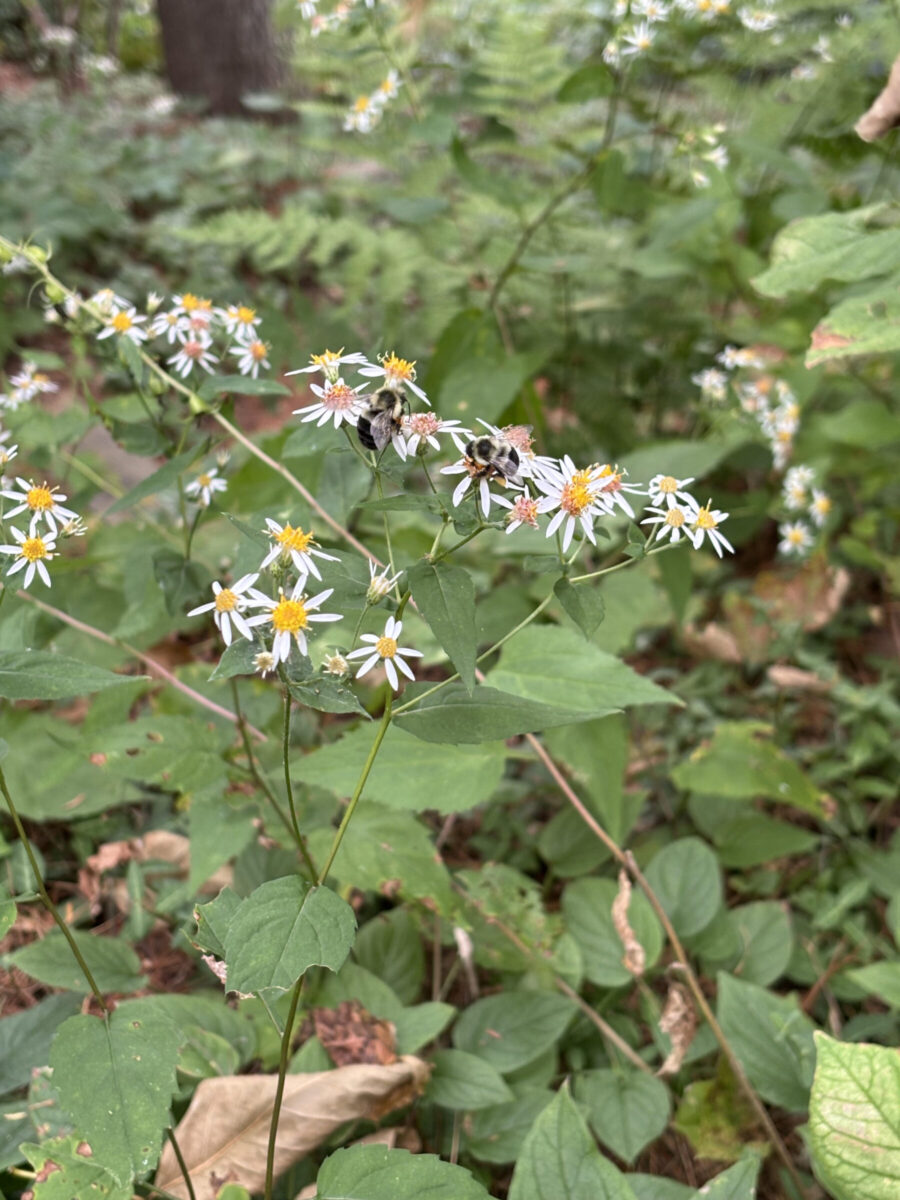
Photo by Alec Linden
And finally, aesthetics matter – as Deb put it, “they’re beautiful.” Since they are plants that flower in autumn, their comparatively humble springtime appearance of green, serrated foliage may entice many gardeners to pull them prematurely, unaware of the decorative potential in just a few months when the most glamorous spring ephemerals have long since shed their petals. Their good looks serve an ecological purpose too, bringing in bees, butterflies, and other late-season pollinators whose options for a meal are dwindling.
“If you’re not too tidy and antiseptic about your woodland edges, you could have an amazing display of asters and goldenrod,” Deb said, among other misunderstood yard-dwellers such as white snakeroot (Ageratina altissima). “I look out on my woodland edge, right off my porch, and I’m looking at goldenrod and aster divaricata (Eurybia divaricata), the white wood aster, and there’s Symphyotrichum cordifolium there.”
Deb advised the curious to keep their eyes peeled for a number of other fall flowering perennials just starting to show their colors: the deep purple New England Aster (Symphyotrichum novae-angliae), the flat-topped aster (Doellingeria umbellata), and the smooth aster (Symphyotrichum laeve), in addition to many others.
Deb said that she feels American landscaping aesthetics have erred too far in the direction of the sterile, and that she encourages homeowners and land managers in the Northwest Corner to embrace a “wilder” sensibility in their gardens and properties. Not only does welcoming fall wildflowers bring a jolt of color to one’s yard as the days ruthlessly shorten, but it establishes a communion between the home and the broader ecosystem that has largely eroded in much of modern Western life.
“I think learning your land is an important thing to do,” Deb said, and she has the resources for those looking to get started. For field guides, she recommends Lawrence Newcomb’s Wildflower Guide and Ted Elliman & New England Wild Flower Society’s Wildflowers of new England. She also suggests two introductory guides on local native plants: Native Plants for New England Gardens by Mark Richardson and Dan Jaffe and The Northeast Native Plant Primer by Uli Lorimer.
For those looking to chat directly to expert gardeners or start preparing for their own native plant garden, Deb has a list of local nurseries specializing in wild plants to check out: Lindera in Falls Village, the Native Plant Trust’s nursery Nasami Farm in Whately, Massachusetts, Earth Tones Native Plants Nursery in Southbury, Connecticut, and Helia Native Nursery in West Stockbridge, Massachusetts.
Reflections from Meekertown – 24 hours alone in the forest
In late May, in my role as GMF Newsletter Editor, I had the opportunity to spend the night at the Meekertown Cabin, a rustic but cozy outpost on the site of a onetime homestead at the southwestern extremity of this 6,300 acre forest. The objective was to produce the article you now read; whatever happened between embarking and inscribing was up to me.
In Connecticut, our forests are many, but they are crosshatched by private property, highways, and development. For all its rural charm, the fourth most densely populated state in the country offers little in the way of true wilderness. For those of us in the Northwest Corner, though, Great Mountain Forest (GMF) gives us something pretty close.
The following report is an account of a night spent alone in some of Connecticut’s deepest woodlands, with the only goal being that I allowed myself to be led by the experience instead of following a pre-planned agenda. When we’re alone in the woods, who leads us? And where do we go?
Setting out
GMF Property Manager Russell Russ picked me up on a sunny afternoon and ferried me from the East Gate entrance along the well-maintained Camp Road, onto Chattleton Road, and to the West Gate on Canaan Mountain Road.
Along the way, Russell identified the complex human interventions on the landscape that make it what it is today. Russell essentially grew up in these woods, his father Darrell being a longtime forester manager at GMF who, throughout the 20th century, essentially shaped the forest we see today alongside forester and owner Ted Childs. He pointed out a stone dam below Old Man McMullen Pond with an ancient outlet pipe, below which sits the subtle remnants of an old saw mill, once one of the major vocations of this now uninhabited stretch of highland forest. Further along, Russell explained that the stands of non-native conifers that hemmed the road had been planted as an arboretum for exotic evergreens.
As much time as Russel has spent in the forest, he was quite visibly surprised by the sight of a cow moose, grazing languidly on the Big Island of Old Man McMullen Pond, which we spotted from the window of his truck. With wide eyes, Russell said that in two and a half decades working full-time in the forest, it was the first time he’d seen a moose at this pond. While we watched, a beaver cut a clean V in the still black water just in front of the moose enjoying a leisurely lunch.
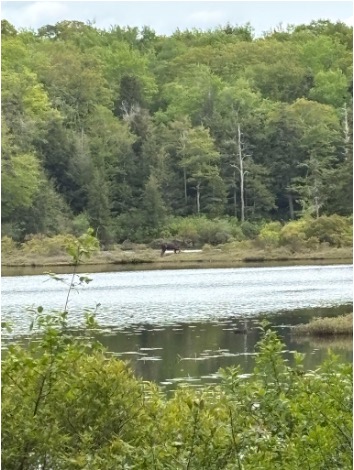
The best photo of the moose we managed, just barely within zoom range.
After exiting the forest, 15 more minutes brought us down the slopes of Canaan Mountain, out onto Route 63, and eventually onto North Goshen Road, where the chauffeured portion of my journey abruptly ended. Russell handed me a stack of paper maps, some parting bits of advice, and peeled off back to civilization.
My guides:
The ferryman
Buzzing with the anticipation of 24 hours of solitude in an unfamiliar place, I felt like Odysseus, ferried by Charon across the River Styx, even though the TV-sized display screen of his new Toyota Tacoma blared in front of my face. Russell was conveying me to an unknown frontier, depositing me at the forest’s wild southern boundary. He imparted the knowledge that would enable me to find my way through the tangle and keep me on the known path without getting lost.
But getting a little lost, of course, was part of the plan. Searching for Russell’s landmarks – the Collier’s Cliffs overlook, Pothole Falls, and several other remote curiosities of the wild Meekertown area – brought me on bushwhacking missions. I etched through thick undergrowth and scrambled up the slick bedrock exposed by the rush of Brown Brook’s cascades in a gambit to rediscover Meekertown Road, which I’d left behind some time before. Halfway up, I paused for a dip into a rust-colored pool as the light faded from the understory, and felt wonderfully a part of the darkening forest around me.
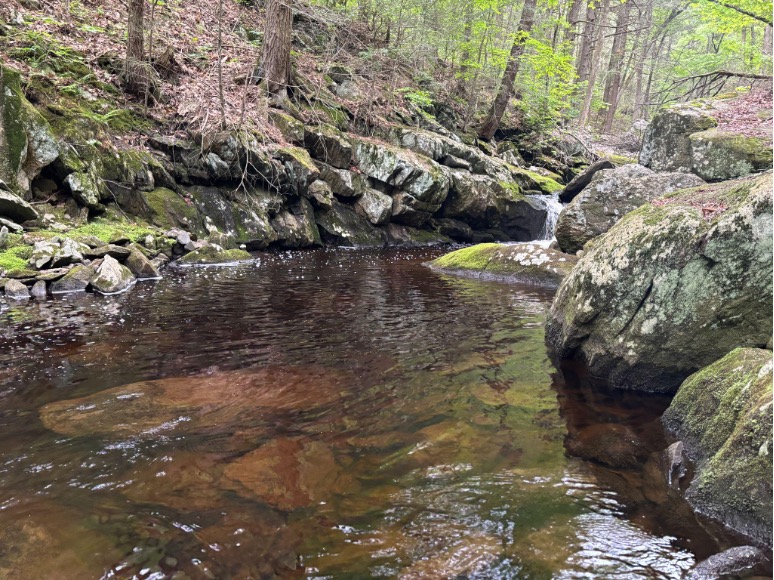
The grotto-like, rust-colored pool somewhere on Brown Brook
The bears, beavers, and beyond
I followed Russell’s directions up the verdant road until I crossed a bridge that brought me back into GMF territory and up a trail that would eventually intersect with the historic Meekertown Road near Wampee Pond. I began to spot mounds of bear droppings, a day or two old – a signpost of another type of guide in the forest.
These roads, though grown over and seldom used today, were once the conduits for thriving industry in these hills. Their legacy as thoroughfares is carried on today by the animals who have returned to habitats once wrested from them by the enterprises that built the roads.
As I arrived at Wampee Pond, taking in its boreal affect, a northern water snake cut s-shapes across the still, ink-black surface while two beavers busily reinforced a dam at an outflow of the aptly-named Brown Brook, which runs dark with the tannins of organic detritus steeping in its cold waters.
I tried to channel the animals’ movements across the landscape as guidance for my own. When multi-stemmed, heavily branched fallen trees blocked the overgrown corridor of the lower Meekertown Road, I followed the dim impression of deer tracks, to navigate the blockages obstructing my path.
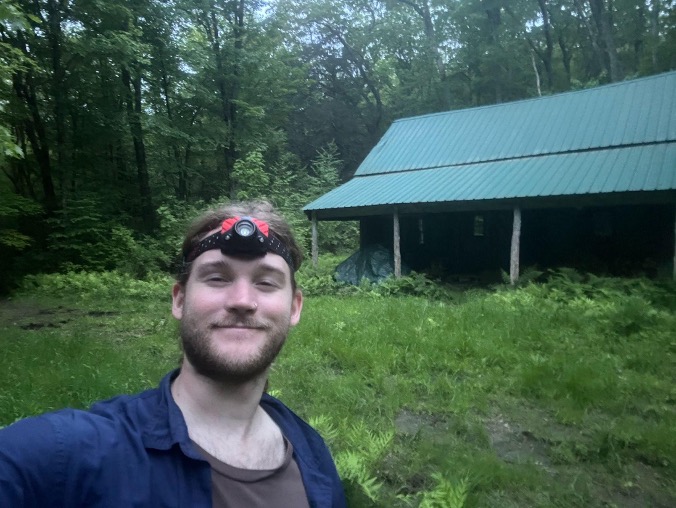
The author settling in for the evening at Meekertown Cabin
The colliers
That these animals are able to flourish – even impose their own will – upon a landscape once denuded by 19th century industrialism is remarkable. “It was a wasteland,” said former GMF director Hans Carlson on a recent phone call, emphasizing that resilience and resurgence are core aspects of GMF’s forest history. The now-verdant hills were stripped of vegetation to fuel the colliers’ fires, and the hollows subsumed by miasmas churning from charcoal hearths and pig iron blast furnaces.
When the colliers tended their fires here, there would have been no bears sharing the roads, no beavers laboring in Wampee Pond (which didn’t exist – it was dammed in the early 20th century as waterfowl habitat and forest fire protection). Traces of their hearths are found throughout the forest, and the Meekertown area would have been sporadically populated by these solitary, hardened men who were likely haunted by their desolated landscape.
There are lurid stories of murder and mischief whispered about the past inhabitants of Meekertown. In 1820, a clergyman described the settlement as a “hamlet of heathens, living in intellectual, moral, and spiritual darkness,” which GMF recently immortalized in a series of t-shirts and is also referenced in the name of a beer brewed by nearby Norbrook Brewery called “Hamlet of Heathens,” brewed with wild Meekertown-foraged hops.
While this reputation may have had some credence, the truth is that they were opportunistic, and maybe a little introverted, individuals who made their way in a difficult world. In any case, their stories, and the remnants of their hearths and shanties left behind, animate the landscape with a colder, more imperfectly human history entangled with the vibrancy of the forest that flourishes today.
Meekertown Road is split in two, where Brown Brook burbles over the long-collapsed remnants of a bridge before it cascades to the valley floor below. While I sat in that spot, listening to the tea-stained water rush over the rocks, the occasional roar of a semitruck from Route 63 broke through my reverie. GMF, as wild as it feels today, is still susceptible to industrial intrusions from time to time.
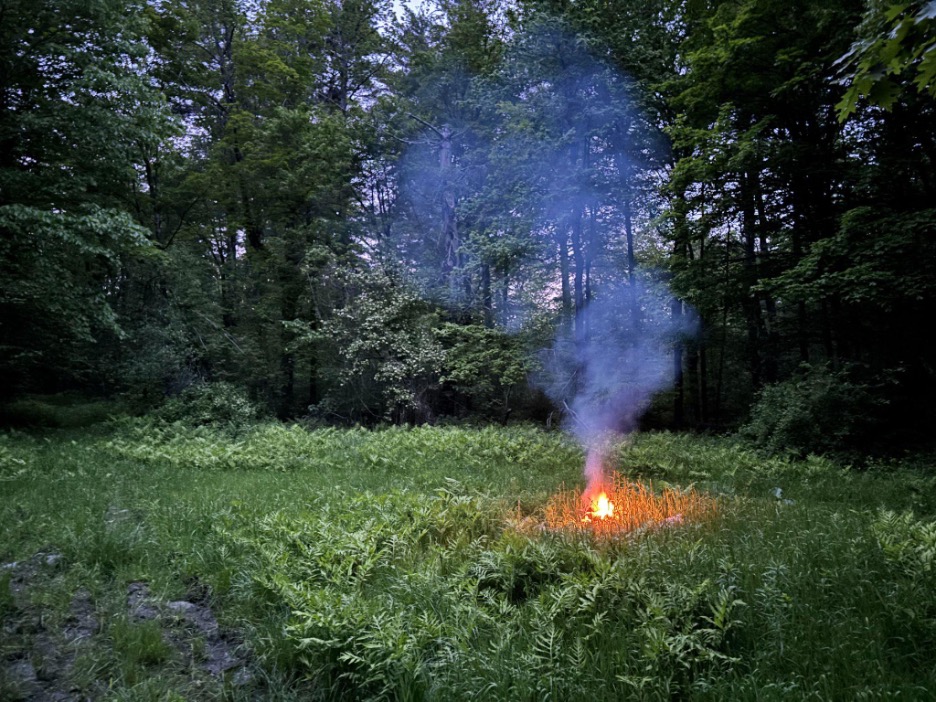
While the colliers may have not been focused on the trees and birds like many of our modern forest goers, they were certainly attuned to their fires. I meant to avoid cosplaying collier during my overnight stay at the cabin, but as evening fell I found myself tending to a smoldering blaze in the clearing just outside the building.
It’s difficult to imagine the life of a collier, staring intently at a pile of timber and earth for weeks on end, measuring its interior heat by the color of the smoke that rose from the mound. There would have been none of the hooting barred owls or rustle of the breeze in the treetops then. I have a note in my journal that I must have scribbled out there: “It’s amazing how long you can watch fire. It’s almost difficult to do anything else.”
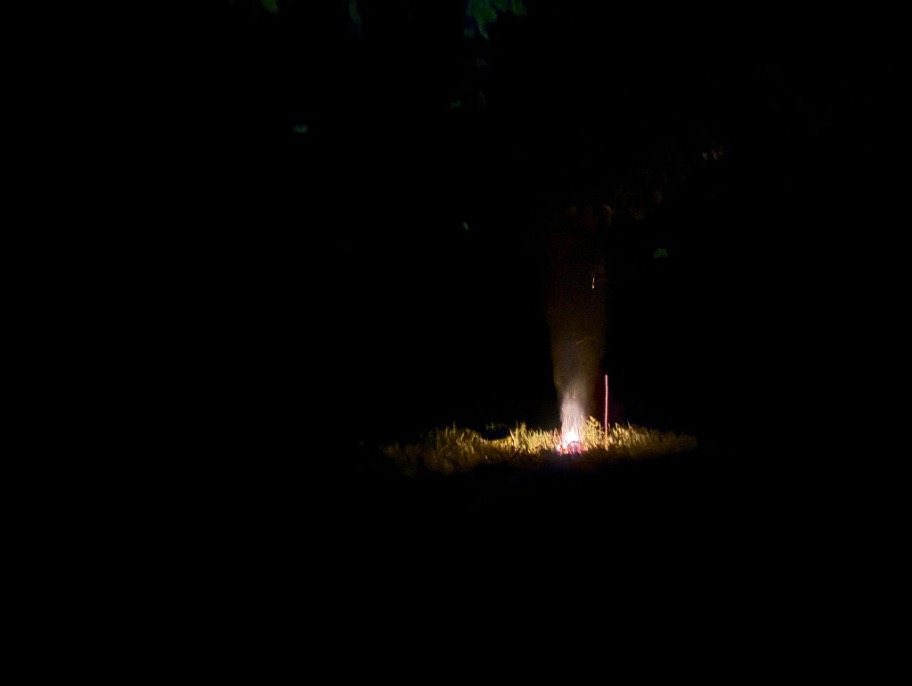
The storyteller
I woke the next morning on the wooden floor of the cabin, the beaming sunshine illuminating the many inscriptions etched into the walls from the scout troops, artists, and hunters who had previously taken refuge within its walls. The two rocking chairs which face the formidable hearth at the front of the room sat eerily still as dust motes fluttered in the sunbeams.
“Don’t sit in Mrs. Dean’s rocking chair!” GMF trustee and forester Star Childs had told me the day before with a mischievous grin. “If it starts rocking, get outta there.” Luckily, nothing moved during my short stay – that I saw, at least.
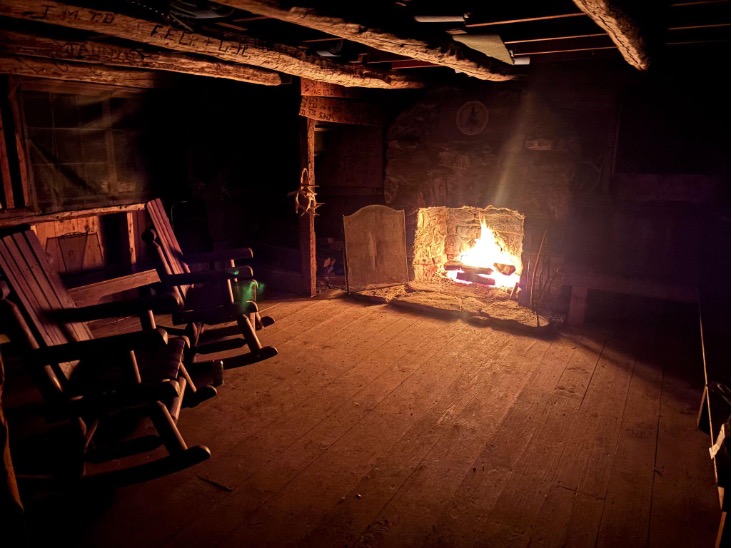
Which one is Mrs. Dean’s?
Having my route back to the East Gate more or less mapped out, I contemplated backtracking east on Meekertown Road a little bit to search for the gravesite of several onetime residents. The late environmentalist and poet David Leff wrote rhapsodically about GMF’s landscape, its tenacity and will to survive, and he described its former inhabitants with the same reverence.
“Meekertown’s ghosts are never frightened,” he wrote in a yet-unpublished paean to the forest. “Their tales linger.” On his own visit to the graves, Leff reflected somberly on their memory: “We show our respect by quietly keeping the stories alive, as best we can.”
Leff’s writing guided me to try and see the forest as he did – as a patchwork of animations and presences, each contingent upon the other. Leff showed that GMF is constituted by the stories that dwell in the minds of the foresters who have spent their lives within it, and the memory of those who made homes and lost them here, just as much as it is by its trees, hills, and hollows.
Having fulfilled my bushwhacking quota the previous evening tromping around Meekertown, I decided to let the graves lie. And anyways, as presumably solitary individuals in life, maybe they appreciate their alone time in death too.
A guide for the reader
With that decision made, I turned left onto GMF’s north-south arterial, the refreshingly obvious and debris-free Number 4 Trail, and began my journey home. What follows here is my attempt to pay it forward: as I was guided through my time in the forest, perhaps this suggested route – which I can confirm is well worth it – will inspire the intrepid rambler to undertake their own journey from GMF’s wild southern reaches to the East Gate Campus..
As a disclaimer, any distances given are estimations, and anyone wishing to walk these trails should consult a map, available on the GMF website.
Find your way to the intersection of Meekertown Road with the Number 4 Trail. Getting to this point means either hiking in on route of your choosing, or devising another creative access plan. For a detour to the Meekertown Cabin, follow Meekertown Road west about a half mile to a clearing where the cabin is easily seen, then turn around and head back to the junction. For those who want to skip the cabin, start heading north on the Number 4 Trail with Wampee Pond to the right. Make sure to spend a minute searching the surface for disturbances from snakes or busy beavers.
Continue up the Number 4 Trail for another 2/3 of a mile or so before coming to a small clearing on the left after a bit of an incline. At the back of this clearing, an obvious but small trail leads to the best view I’ve seen so far in the forest: Wapato Lookout.
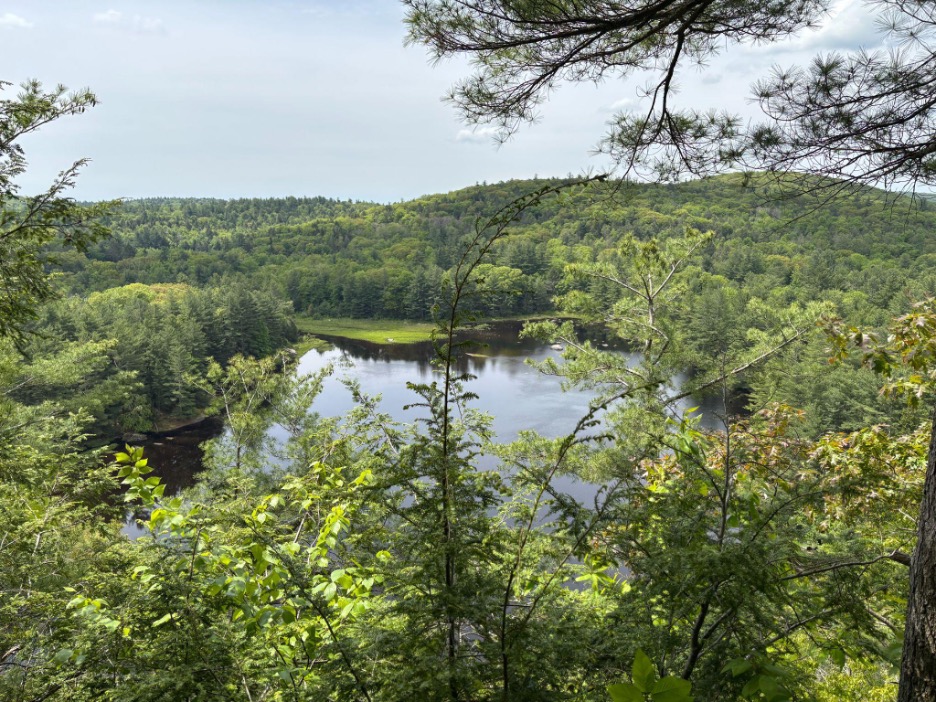
The view. It’s even better in person.
From a dramatic precipice, the view extends through a white pine-framed window over the black waters of Wapato Pond and rolling peaks beyond, exemplary of the adage that GMF often feels more like New Hampshire’s deep woods than southern New England. I spent a good 45 minutes here, swatting mosquitos and enjoying a respite on the bouncy, needle-strewn soil. It’s the type of spot one could spend quite a bit more time at with the right schedule.
Heading back to the Number 4 Trail, continue north for a little over a mile through varied woodlands until the Sam Yankee Trail peels off to the left. Follow it for a few hundred yards, until a well-marked sign points left to the Matterhorn. Enjoy the short but stimulating climb to the rocky precipice in the heart of GMF, with nothing but rolling woodlands around you. Enjoy your lunch here, and be careful with the lichens.
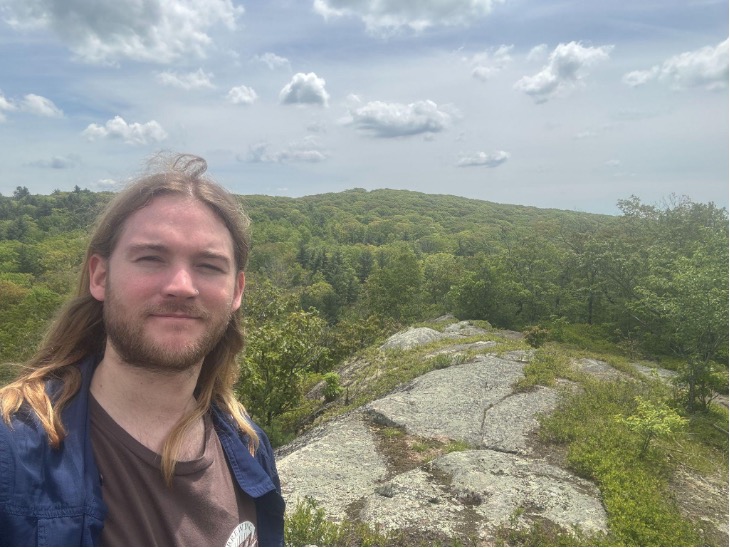
The author, post-lunch and perched on the Matterhorn
Backtrack to the trusty Number 4 Trail, and continue heading north. After another mile or so, turn right, rounding a gate onto the Crissey Trail, where a mystical forest of hemlock and slim maples towers above a formidable network of low stone walls.
After a while, turn left onto the shady and boulder-strewn Crossover Trail. If inclined, take a detour to the Crissey Pond overlook for another fabulous view. Head back to the Crissey Trail and continue on to GMF’s famed glacial erratics, large boulders dropped during the retreat of the Laurentide Ice Sheet. As a rock climber, I found myself atop one of them, hanging out with a ruby-throated hummingbird on a bed of ferns and moss.
The Crossover Trail spills out to the Camp Road, where one can head back to the East Gate through a corridor of hemlocks and yellow birches for another taste of the north country, making sure to stop at the model charcoal pile exhibit demonstrates the complexity of charcoal fires.
My iPhone clocked the total mileage, with all the detours, to be between seven and eight miles. For those who want more, a spur loop to visit the prehistoric Tobey Bog can be achieved via the Overlook Trail, Charcoal Pit Trail, and Tobey Bog Trail.
Happy hiking!
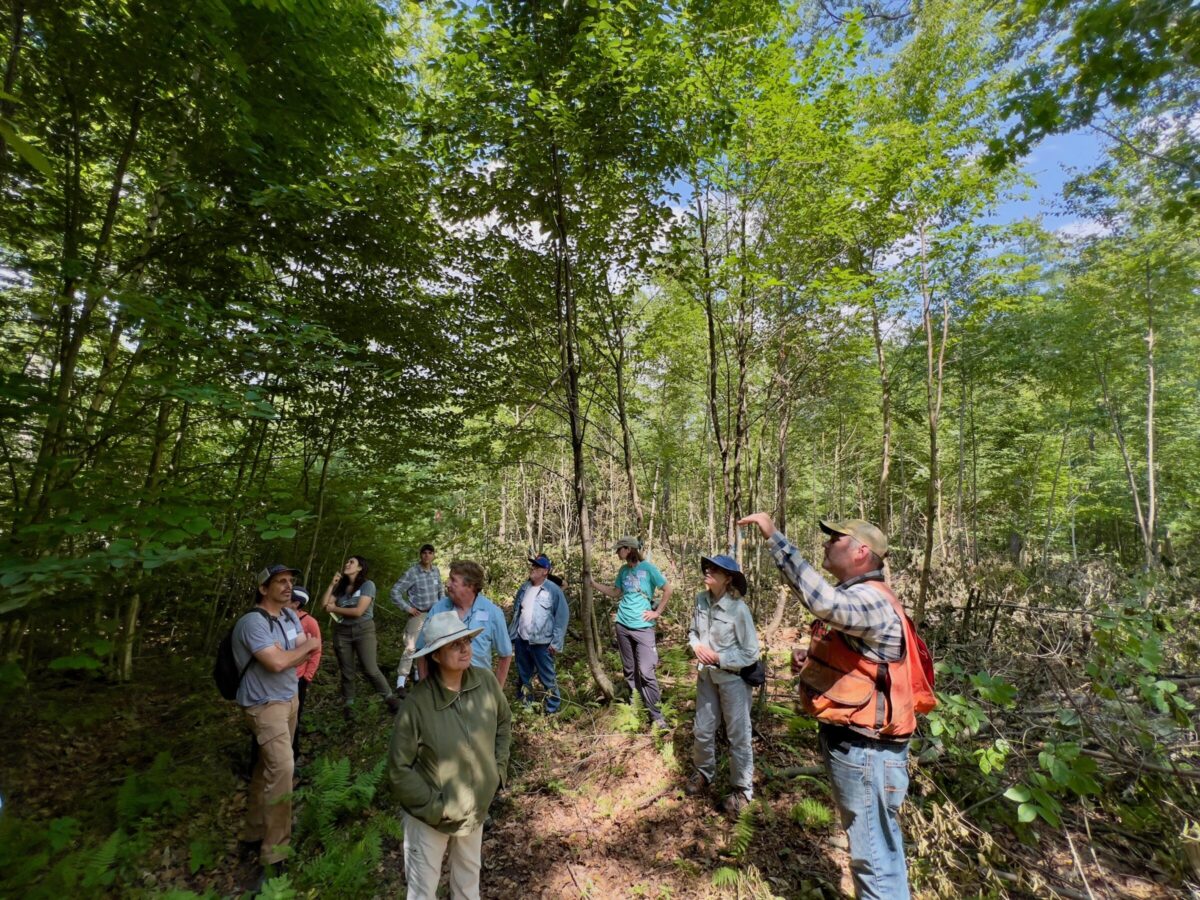
Future Forests in the Making: Climate-Smart Thinning at Great Mountain Forest
As New England experiences increasingly extreme weather, including hotter and wetter summers, keeping forests healthy and resilient to pests and disease is an ongoing challenge. Work has begun implementing Connecticut Land Conservation Council’s (CLCC) Climate Smart Land Stewardship Grant at GMF! Great Mountain Forest recently began a pre-commercial thinning project, which is a forest management practice that involves removing trees from a young, dense stand before they reach a size where they can be commercially harvested.
Managing Competition
In areas at GMF where trees were harvested 20 years ago, young trees have grown back fiercely, racing to become the future forest. Most of these new trees will end up being shaded out underneath their stronger brethren or succumbing to damage or disease. By applying management methods that support a diversity of tree and animal species and provide more resilience to pests and other disturbances, our foresters are controlling that competition to enhance traits we hope to promote.
We start by marking a “pre-commercial thinning,” or PCT, in three stands that are approximately 20 years old. “Thinning” means removing the trees that are competing with those we want to keep strong and healthy. “Pre-commercial” means that we are implementing this treatment when the trees are too small to be sold as wood products, which is where funding directed by CLCC comes in to support this work. We chose trees spaced on average 10 feet from one another, giving them the light they need to grow quickly when they are “released” from competition by this treatment.
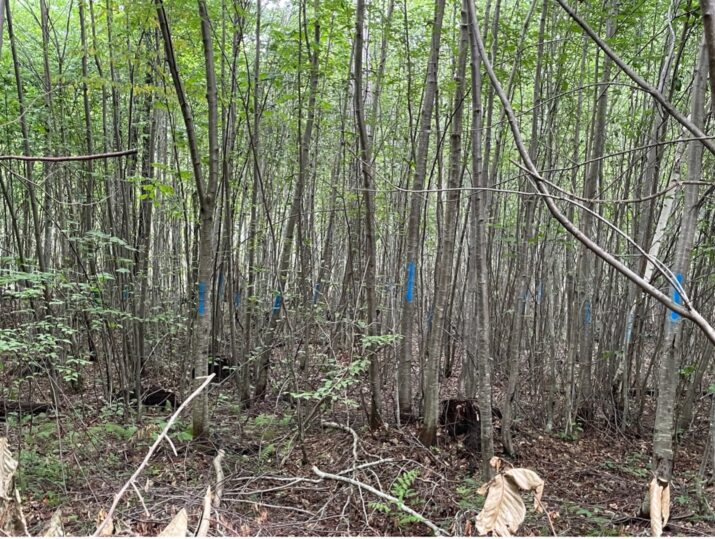
Stand marked before treatment (note very high density of stems).
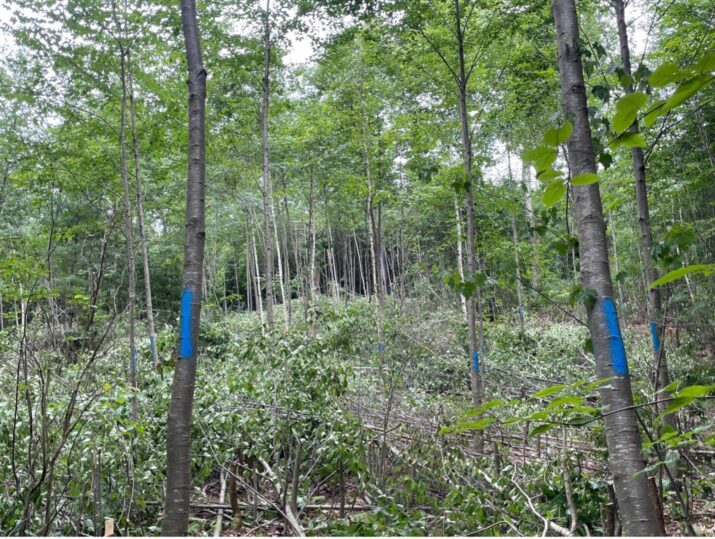
Stand after thinning treatment (only marked individuals remain standing).
Shaping the Future Forest
In selecting which trees to keep, there are a few things we keep in mind. The first is health and form. We choose trees that are going to last: those that aren’t suffering from disease, that have stable trunks and full crowns, and that have no obvious wounds.
Unfortunately, we have to remove most of the beech in these young stands. American Beech, or Fagus Grandifolia, is currently under a dual attack from beech leaf disease and beech bark disease. Nearly all of the beech in our forest are succumbing to one or both of these diseases. While we save any individuals that seem to display resistance, we know we cannot count on the majority of them as our future canopy.
The other factor we consider is species composition. Presently, these stands are almost entirely beech and black birch (Betula lenta). We therefore want to promote the other species within the stand to make it as diverse as we can. Tulip poplar, white, yellow and grey birch, ash, cottonwood, and oak are growing in these stands too, and we select for them to prevent the stands from becoming near-monocultures of black birch. While there’s nothing wrong with black birch, aiming for as much diversity as possible helps to increase stand resilience and support additional non-tree species in the forest. We’re also making sure to leave species like serviceberry and highbush blueberry. While these species won’t be our canopy trees, the fruits they produce are important food sources for birds.
Looking below the canopy, the effects of this treatment will also be seen on the forest floor. In this stage of competition, the amount of light that can reach the ground is quite limited. The trees are so densely packed that nearly nothing can grow beneath them. But by thinning the trees, we are allowing that light back in.
Forester Emeritus Jody Bronson inspired this project through his implementation of a similar PCT on a smaller scale over many years. What he saw after thinning was an understory full of not only herbaceous plants, but a new cohort of tree seedlings, particularly oaks, a group of species that has wonderful ecological value but can be difficult to regenerate. Now, should an ice storm come through and knock out the canopy trees, that young cohort is waiting in the wings to take off and swiftly become a forest again instead of having to compete for establishment.
Great Mountain Forest’s 2025 summer interns got to mark this treatment, selecting which trees to cut and which to leave. From the first week, they started thinking like foresters, making decisions that they would not see the full effects of for decades.
We are so grateful to CLCC for funding this work, which has provided young foresters with unique learning opportunities, added resilience to our forest, and created an excellent demonstration of sustainable forest stewardship.
Funding for this project was paid for by the Climate Smart Farming: Agriculture and Forestry Grant. Funding awarded and administered by the Connecticut Department of Agriculture and the Connecticut Land Conservation Council.

Healthy forests, healthy people – and healthy ticks?
The hills are alive in Northwest Connecticut, but it’s not all birdsong and snowdrops: the blacklegged tick has shaken off its winter torpor, and now crawls in droves through the understory, spreading disease and myths in equal measure.
Dr. Scott Williams, Chief Scientist and Head of the Department of Environmental Science and Forestry at the Connecticut Agricultural Experiment Station (CAES), a state organization spearheading research on tick-borne diseases, dismissed two commonly held misconceptions about the tiny, dangerous insect: “They don’t fly. They don’t drop out of trees.” Williams advised that rather than worry about the branches overhead, think low and keep your ankles covered. “They crawl up from the ground for the most part, or [from] a few inches off the ground.”
Demystifying tick behavior and pathogen transmission yields surprising insights into how to manage disease levels in our region: in a healthy forest, more ticks might actually equal less disease, Williams explained.
Debunking Myths
Blacklegged ticks (also widely known as deer ticks) and Lyme disease are commonly misunderstood components of the New England forest, starting with the illness’ origin story. Conspiracy theories abound speculating where it began, with an especially persistent and oft-debunked claim that it leaked from a government research facility on Plumb Island.
But reputable research has shown that the disease has been circulating in the northern hemisphere for millennia. One of the bacterium responsible for causing Lyme disease, Borrelia burgdorferi, was detected in Ötzi the Iceman, a 5,000 year-old mummy found in the Eastern Alps in the 1990s. A study conducted by the Yale School of Public Health in 2017 traced B. burgdorferi back to North American forests of 60,000 years ago, meaning the bacterium was resident in our woods long before the earliest human inhabitants arrived.
Closer to home
Deer ticks and Lyme disease are as Connecticut as New Haven pizza, with one of our picturesque coastal towns lending its name to the ailment after a cluster of cases there in the 1970s lead to its identification as a unique condition. The state remains positioned in the very heart of tick country, and the Icebox of Connecticut, which previously benefitted from the protection of its harsh winters, is losing its defenses as the cold season continues to warm up.
“We’re not trying to scare people from being outside, we’re trying to educate people on when the various stages [of ticks] are active – what’s tick habitat and what’s not,” Williams said. For instance, a field of high grass, commonly regarded as a tick haven, is actually largely inhospitable to the bugs, as they desiccate quickly in a dry environment. “That’s kind of a desert for ticks,” Williams explained.
The most “ticky” habitat “is really that edge where your lawn meets the forest,” he said, and when it comes to getting bitten, it’s often a matter of timing.
When to watch out
While adult deer ticks are active now, Williams explained that May, June, and early July are the months when most infections occur since that’s when both humans and the nymphal stage of deer ticks are likely to be active outdoors. Although the adult ticks wandering the undergrowth and brush now can certainly transmit the pathogen, it’s the nymphs that are “the really problematic guys,” Williams said, in part because they are small and hard to detect, and also because in spring, “human activity and tick activity in the nymphal stages coincide.”

A white-tailed deer in the forest. Photo: Mike Zarfos
Host competency and the dilution hypothesis
Active ticks, active humans, and an abundance of both yield higher bite rates, thus contributing to more infections. However, Williams explained that the species present in an ecosystem can have significant impacts on the spread of tick-borne pathogens to humans.
A surplus of white-tailed deer upon the landscape, for example, is often thought to correlate to more tick-borne illness. While a large deer population will often support a high concentration of ticks, deer are a “dead-end host” for the bacterium, meaning they don’t transfer the pathogen back into the ticks.
Mice, however, are “competent hosts.” The concept of host competency is the ability of a reservoir host species (animals that carry and spread disease-causing pathogens) to infect the ticks with pathogens, which small rodents are highly adept at whereas larger animals are less so. When deer are plentiful on a landscape, “you typically have high tick abundances with lower infections with the various pathogens,” Williams said.
The reservoir host species of B. burgdorferi that actually infects the ticks with the pathogen are small rodents, especially the white-footed mouse which is common to the Litchfield Hills. When fewer deer, and other medium sized mammals, are available, Williams explained that the ticks will then be forced to feed primarily on mice, which will support a smaller population of ticks within which the pathogen is much more concentrated.

CAES team conducts Lyme disease research with mice in Woodbury. Photo: Mike Zarfos
Healthy forests, healthy people
In a healthy ecosystem with a spectrum of animal species, ticks aren’t forced to rely on these highly competent hosts for a blood meal. Williams explained that this scenario, in a species-diverse forest, describes what disease ecologists call the dilution hypothesis: “with a diversity of animals, you’re going to see less infection in the ticks because they have so many options to feed.”
The loss of forest diversity can have the opposite effect, Williams said, which is happening across the Northeast due to development and the incursion of invasive species. Several years ago, Williams conducted research on the correlation of Japanese barberry, an invasive shrub, with tick populations; some of the work was done at Great Mountain Forest with the help of GMF forester Jody Bronson. The study found that the dense tangle of undergrowth created by the proliferation of the shrub caused a humid microclimate that not only provided great tick habitat, but enabled them to remain active throughout the day.
Normally, the moisture-dependent ticks might be inactive under a pile of leaves during the heat of the day, Williams said. But the microclimate created by the “monoculture” of invasive brush growth means ticks continue looking for a host “pretty much 24 hours a day.” He clarified that this was not specific to Japanese barberry, but any plant that grows in a monoculture tangle, “which is pretty much what invasives do in our neck of the woods.”
“What we’re trying to push is a healthy, diverse forest, and that’s very applicable to Great Mountain Forest,” Williams said. The goal, he continued, is responsible management: “If you have a healthy, diverse, well-managed forest, you’re going to have a diverse array of wildlife, and as a result you’re going to have a healthier tick population with lower pathogen infection. That’s kind of the bottom line.”